Politics & Government
The Framingham Mayor's MBTA Zoning Solution Is a Trojan Horse
The Mayor's submission to the state hides a real danger that 4,500 new 3 bedroom units would add 2,800 students to the schools.


On December 17, 2024, when the City Council pushed off its further considerations of a plan to comply with the state MBTA Communities Act (MBTA CA) law, till February 4, 2025, it seemed certain that the city would violate the deadline to submit a completed plan to the state by December 31, 2024.
The Mayor’s response was to immediately submit his own plan for compliance to the state, which he announced in a memo on December 23, 2024, with no collaboration with the City Council, usurping its approval authority. Under the MBTA CA, the City Council is the local authority for approval of any plans submitted to the state.
The substance of the submission was explained in the Mayor’s memo as:
Find out what's happening in Framinghamfor free with the latest updates from Patch.
“Today, December 23, 2024, the City of Framingham submitted the request that the Central Business District (CBD) multi-family zoning, which was approved by Town Meeting in 2015, be deemed compliant with the MBTA Community Act.”
On January 22, 2025, the city received a response to the Mayor’s submission, in which the Massachusetts Office of Housing and Livable Communities (EOHLC) determined that the City of Framingham is “conditionally compliant” for the MBTA Communities Act law. The conditions were:
Find out what's happening in Framinghamfor free with the latest updates from Patch.
- Framingham must submit an Economic Feasibility Analysis consistent with the requirements of Section 72.04(1)(b)1b of the Regulations no later than 180 days after the date of this letter.
- EOHLC may establish a system to monitor compliance over time to ensure that approved districts allow multi-family housing in accordance with the criteria under which they were approved.
- Permitting conducted in connection with the additional factors listed above must not effectively reduce the estimated multi-family unit capacity of the District. If those factors reduce the estimated multi-family unit capacity of the District, EOHLC may revisit Framingham’s conditional compliance with Section 3A, and could require the City to remedy any deficiency with amendments to its zoning.
This information is drawn from a city press release on January 22, 2025.
Implicit in these conditions is the requirement that the proposed Central Business District units would be designed for families with children, per the intent of the MBTA Communities Law: MGL Ch 40A, Section 3A, which specifically states:
"Section 3A. (a)(1) An MBTA community shall have a zoning ordinance or by-law that provides for at least 1 district of reasonable size in which multi-family housing is permitted as of right; provided, however, that such multi-family housing shall be without age restrictions and shall be suitable for families with children. ..."
Thus, future development in the CBD could be dominantly 3BR units, as that is what is encouraged by the new state law. Those are the units which are most suitable for families. Note that the US average number of children under 18 in a family is about 1.93.
With the prior CBD zoning the city had control of the number of units and the mix of studios, 1BR, 2BR and 3BR units in a building. With that power, for the last 10 years, the city has been able to minimize the number of 3BR units in the CBD. A good example is the Modera building on Rt 135, which has 270 units, with 90% of them studios, 1BR or 2BR.
With the new MBTA CA zoning, that control disappears, which opens up the possibility that future new units built in the CBD could be dominantly 3BR. Developers will decide, not the city zoning and permitting authorities.
The Mayor’s plan, which was concocted in a few days, confines all the zoning changes and associated development to the Central Business District, has no community buy in, and has had zero review by the Planning Board and the City Council.
Such a slapped together plan is a recipe for disaster.
Let’s expand on the issue of 3BR units.
US Census data shows that a 1BR unit generates 0.06 school age children, a 2BR generates 0.24 and a 3BR generates 0.63. Here is a chart taken from a report done by the Town of Hopkinton, which shows the US Census data on p.12:
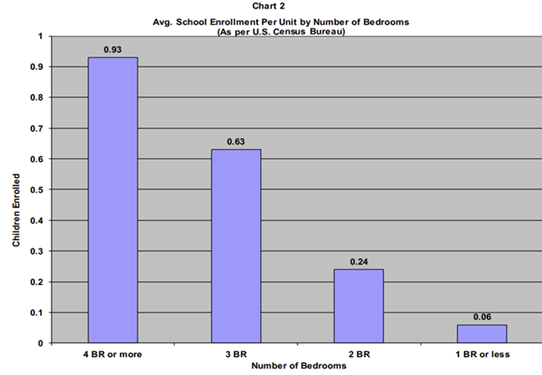
Applying that information to the CBD case, with the prior city zoning, which produced new units which were dominantly 1-2BR, generating an average of (0.24 + 0.06)/2 = 0.15 students per unit, 4,500 new units would be expected to generate about 4,500 * 0.15 = 675 new students.
Under the new MBTA CA zoning embedded in the Mayor’s plan that number could jump to 4,500 * 0.63 = 2,835 new students. This is more than 4 times the number of students!
Such an increase would be a disaster for the school system, which could never expect budget increases to cover the huge additions of staff needed nor the building of multiple new schools to provide the added classroom space. Think of 4 new elementary schools at $100 million each and with $17,000 the average operating budget cost per student, a further $48 million in staffing costs.
It can be argued that this issue of 3BR apartments and the associated flood of new students would apply to any Framingham submission to the state, but in addition to the Mayor’s CBD plan, we have the plan the City Council was working on up to December 17, 2024.
A very useful perspective on the City Council effort was put together by City Councilor Leora Mallach:
Very Informative Commentary on the MBTA Zoning Issues by City Councilor Leora Mallach
This plan combines all of the best parts of the 9 months of Planning Board MBTA CA planning efforts, including all of the community input and Planning Board review of most aspects relevant to compliance. It also removes the controversial Nobscot Edgell/Edmands parcel which the Mayor dumped into the planning process on September 19, 2024, with no warning to the Nobscot community nor any attempt to get their input.
This prospective City Council plan affords a real opportunity to reduce the number of students generated by new development far below the number which would be generated by the CBD plan. It has multiple location components and places higher density development in parts of the city where that makes sense. The Staples property at 9/90 would certainly see very slow development. The Buckley location would see no development.
In other words, the City Council plan provides a great starting point for arriving at a sound zoning solution which minimizes the number of added students.
My own opinion is that the Mayor’s plan should be discarded because it was simply a last minute ploy to mitigate state repercussions from a late MBTA CA submission and flew in the face of all the Planning Board work and the community input which had been carried out since March 2024.
Developing the City Council plan would capitalize on prior Planning Board efforts, with one proviso: the Nobscot Edmands/Edgell parcel should not see the light of day in a properly crafted submission to the state.
The City Council could proceed with substantial further input and development from Christine Long and her crew on the Planning and Zoning Subcommittee, come to a draft recommendation approved by the City Council, have it pass muster with Planning Board review, then have that come back to the City Council for final approval and transmission to the state.
There is time to get this right.
With the finalization of the Milton court case, the state moved the final date for plan submission to February 13, 2025, but it seems from the state response to the Mayor’s submission that a submission of a City Council plan even in late March 2025 would be viewed favorably.
In some quarters, there has been an inclination to embrace conditional state acceptance of the Mayor’s plan as a game winning Hail Mary pass. That is the same mentality which lead the citizens of Troy to hail the appearance of the giant wooden horse outside their city gates, as a magical gift from the Gods, celebrating the apparent disappearance of the warriors laying siege to their city.
The Mayor’s plan is not a magical gift from the gods, celebrating the end of a state zoning assault on the city. It contains a formula for uncontrolled expansion of the student population which could easily destroy the city school system.
The best path forward is for the City Council to ignore the Mayor’s CBD plan and work their plan to sound completion. That way Framingham will arrive at a solution which satisfies the state and ensures that added students from new developments can be reasonably accommodated by the school system.