Politics & Government
High Density Nobscot Development Will Damage the Framingham Schools
Data from the US Census shows that the planned development will rapidly flood the schools with 400 students or more.


One of the numbers floating around in the Nobscot high density development discussion is the number of students the proposed 620 units would add to the Framingham Public Schools. A memo from Lincoln Lynch, the FPS Executive Director of Finance & Operations, notes that the number of students generated by existing large apartment buildings in Framingham is about 0.15 per unit. See:
Planning Board Projects - Apartment Analysis
That would suggest that the 620 units would generate only about 93 students. However, the existing large apartment buildings in Framingham, included by Lincoln Lynch, have only 1-2BR per unit.
Find out what's happening in Framinghamfor free with the latest updates from Patch.
<< The Nobscot development will have a much higher bedroom count per unit. >>
The proposed Nobscot units will be designed for families with children, per the intent of the MBTA Communities Law: MGL Ch 40A, Section 3A, which specifically states:
Find out what's happening in Framinghamfor free with the latest updates from Patch.
"Section 3A. (a)(1)An MBTA community shall have a zoning ordinance or by-law that provides for at least 1 district of reasonable size in which multi-family housing is permitted as of right; provided, however, that such multi-family housing shall be without age restrictions and shall be suitable for families with children. ..."
Thus, the proposed Nobscot residential complex will likely be dominantly 3BR units to comport with the new state law and to maximize developer profits.
That makes a huge difference.
US Census data shows that a 1BR unit generates 0.06 school age children, a 2BR generates 0.24 and a 3BR generates 0.63. Applying that information to the Nobscot case, 390 students would be generated, not the 93 Lincoln Lynch's memo would suggest.
Here is a chart taken from a report done by the Town of Hopkinton, which shows the US Census data on p.12:
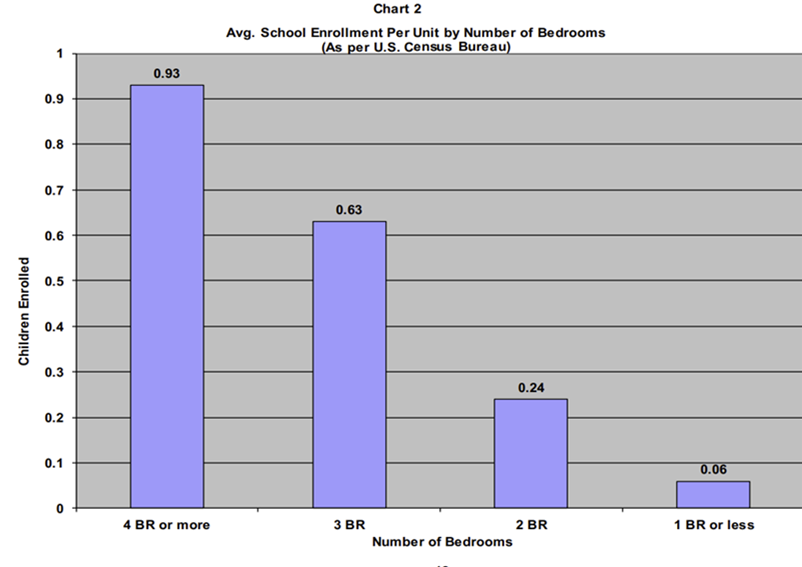
Note that the US Census data shows that if apartment complexes have typically 1-2BR units, the average number of school age children per unit comes to (0.24 + 0.06)/2 = 0.15. That’s exactly Lincoln Lynch’s number.
Lincoln Lynch’s Data
Here are some of the data he used:
- 266 Waverly St: 270 1-2BR apartments
- 50 Concord St: 196 1-2BR apartments
- The Buckley: 68 1-2BR apartments
- 59 Fountain St: 160 1-2BR apartments
- 61 Fountain St:98 1-2BR apartments
- The Green at 9 & 90: 1000 1-2BR apartments
- Waterview Terrace at 1400 Worcester Rd: 300 1-2BR apartments
- 1550 and 1500 Worcester Rd, large condo complexes which are dominated by 1-2BR units
[Note: There are small numbers of 3BR units in these buildings, but the data are dominated by 1-2BR units.]
All of these numbers can be checked by using the city’s GIS Mapping Tool.
Bottom Line
The Framingham Public Schools input from Lincoln Lynch simply does not apply to the residential developments enabled by the MBTA Communities Law. 3BR units will be dominant, not 1-2BR units.
That spells big trouble for the Framingham Public School if the high density development plans for Nobscot come to fruition. That parcel is shovel ready and the impact of almost 400 added new students will be felt in the next 2 years.
The Flood of Students Could Be More Than 400
It could also be worse than 400 students, as the US Census data is an average for 3BR units.
Most families raise their kids for about 20 years, stay on in their house for maybe 15-20 years more and then possibly downsize when the parents retire. Young families will have 1-2 children in the house. Empty nester families will have none. The US Census data shows the average at 0.63 school age children per unit, which includes a good portion of empty nester units. The actual average for families who buy into Nobscot will be higher, as there will likely be no empty nester families. That could boost the 400 estimate to 600 or more.
Action
If parents across the city want to slow down the influx of children the MBTA Communities Law will bring into the Framingham Public Schools, so there is time to absorb the increasing numbers in a more gradual way and not overwhelm the school district, they should join the movement to remove the Nobscot parcel from the city’s plan to comply with the MBTA Communities Law.
The high density Nobscot development will adversely affect all Framingham students if it is allowed to proceed.
<< There is a City Council meeting on Monday, November 25, 2024, at 7pm, which will be devoted entirely to this issue. Everyone should turn up, especially parents with children in the schools, or whose children are headed that way. >>


