Politics & Government
How Framingham's Charter Almost Fixed the Representation Imbalance
The City Charter transformed the School Committee, but the City Council still retains bias which disadvantages the lower income southside.


On April 4, 2017, the Framingham community approved the transition from a town to a city form of government. The vote was close, with 5690 for and 5582 against.
One of the compelling reasons for moving to a city form of government was that there was a significant imbalance in northside/southside representation on the Board of Selectmen and the School Committee.
All of the members of the Board of Selectmen and the School Committee under the town form of government were elected at large, and given the challenges of time and money needed to conduct at large campaigns in the largest town in Massachusetts, residents from the wealthier northern side had a clear advantage in mounting a successful run for office on those two bodies.
Find out what's happening in Framinghamfor free with the latest updates from Patch.
For years, all of the Selectmen and all of the School Committee members had lived north of Route 9.
This was especially troubling for the school district, as a majority of the students lived south of Route 9. Governance of the school district was in the hands of elected officials who had no day to day experience of the southside.
Find out what's happening in Framinghamfor free with the latest updates from Patch.
One of the principal responsibilities of the School Committee is policy making, so it seemed to be a very good thing for the policy makers to be drawn more equitably from across the entire municipality, by ensuring that School Committee members would each have to reside in one of the 9 districts created by the new City Charter.
There would thus be a strong voice for the southside in the new ‘city’ School Committee.
That has panned out to a reasonable degree as evidenced by the subsequent push for a new southside elementary school, termination of ‘lunch line shaming’ where students from low income families were punished with inferior lunches and humiliation if their families fell behind on payments in their lunch accounts, creation of a new dual language Portuguese program to supplement the already successful Spanish dual language program, abolition of pre-K fees, and multiple other improvements.
Further, the shift in 2018 to a 100% district based elected School Committee saw the election of 6 new members, who had never served in elected office in Framingham. Totally fresh perspectives came into play, as the new City Charter had foreseen.
The new School Committee saw the city as a whole, with all of its students in clear view.
There are no at large School Committee members, and that has worked well for the greater benefit of all of the students in the city.
The story is somewhat different for the City Council.
Here, following reasonable advice and consideration, the Charter Commission members opted for an 11 member City Council, with 9 members elected by district just like the School Committee, but with the addition of 2 at large City Council members who could live anywhere in the city and would be elected initially for a 2 year term, but subsequently for 4 year terms.
As it has turned out the ‘at large’ problem which afflicted both the prior School Committee and the Board of Selectmen also afflicted the newly minted City Council.
For more than 6 years, all at large City Councilors have resided north of Route 9. So, the bias, which the City Charter hoped to address, still has not been eradicated.
In a prescient commentary on the proposed new City Charter early in 2017, Teri Banerjee, a Charter Commissioner, wrote:
‘If the two “at large” councilors are elected from the same district, three councilors could be from one district. This doesn’t ensure fair, balanced representation.’
This is exactly the current situation.
The two at large City Councilors currently live within a mile of each other in District 6.
It is useful to put that into a perspective where the city is considered as 3 groups of 3 districts: 1-3, 4-6 and 7-9, moving from north to south in the city. Here is what the weighting is:
Districts 1-3: 3 City Councilors
Districts 4-6: 5 City Councilors
Districts 7-9: 3 City Councilors
The argument that representation is not fair and balanced seems to have merit.
A very simple remedy exists for this imbalance, and that is to apply residence restrictions to at large City Councilors. If the number of at large City Councilors were increased to 3, but only one could be resident in Districts 1-3, one in Districts 4-6 and one in Districts 7-9, the community would be assured of at large City Councilors evenly distributed throughout the city.
That would increase the City Council size to 12 and would be a modest change to the City Council, well within the purview of the Charter Review Committee.
The Charter Review Committee could add this into its recommendations and let the voters decide if they want to approve this.
A larger change would be to require that the election of those 3 new City Council positions not be at large, but be elected by just the voters in their trio of Districts: 1-3, 4-6, 7-9. The Charter Review Committee could figure if that would make sense. It has the advantage of making campaigns easier in both time and money, which are factors to consider since encouraging candidates to run for office is a good thing. In this scenario, the terms for these at large City Councilors could also be changed to 2 years, to be brought into alignment with all other City Council and School Committee positions.
The final consideration which is pertinent to making representation more equitable is the effect the City Charter has had on the southside.
Arguments will be made in the following which support the view that the southside has done poorly in the last 6 years, which supports expanding City Council southside representation in the manner described above.
The City Charter cannot make the City Council make better decisions, but it can make sure all voices are properly heard. In considering the issue of community voice and southside inequities, I offer the following.
With the city transition, budget approval passed from a 216 member Town Meeting, with plenty of parents of school children, to an 11 member City Council. By that means, students immediately lost a key advocacy group in financial decision making.
Parents lost political power in the city.
In many ways, it is fair to say that Town Meeting had as its top priority making sure the education system thrived. With the transition to a city, the top priority of the City Council turned out to be low taxes.
Budget power was concentrated in a few very different hands, with substantial effect.
As a School Committee member from 2018-2021, and also during that time Chair of the Finance & Operations Subcommittee, I saw all financial decision making up close. Since retiring from the School Committee, I have followed finances closely, including all of the cityside financial decision making.
The conclusion, which is quite clear in my mind, and supported by the data, is that City Council financial support for the school district is weak. It seems that the City Council considers the school district as a financial liability, not a city asset critical to drawing new residents to Framingham. Especially, they do not consider the impacts of their financial decision making on southside students.
Under Town Meeting, the local contribution the town made to the school district budget increase averaged $3.3 million/year for the last 5 years as a town. For the first 4 years as a city, that fell to $1.1 million/year. Then under the Sisitsky administration, the local contribution decreased by $5 million in FY23, then decreased by another $5 million in FY24. See the graphic for the trend:
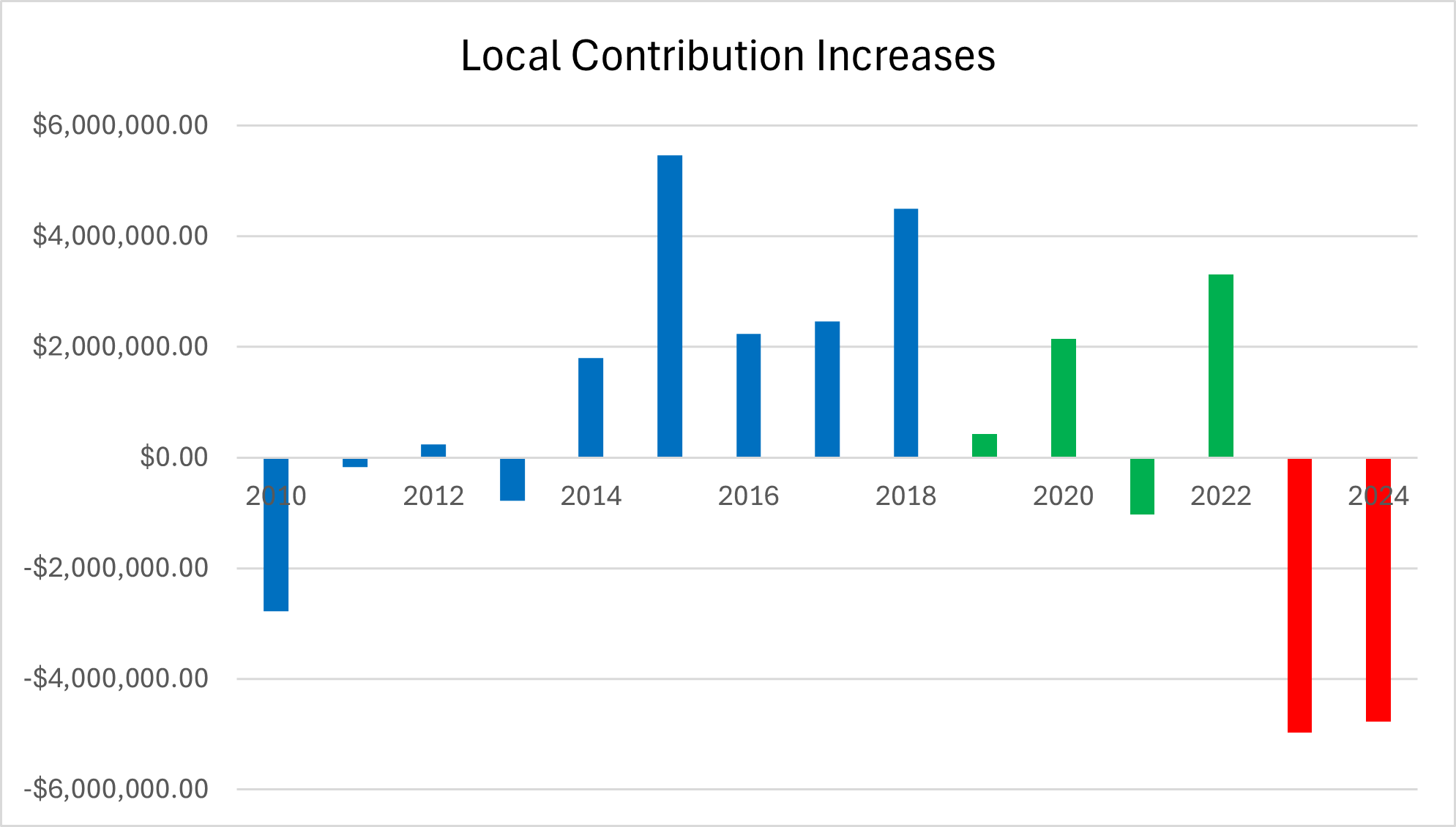
Blue – Town period
Green – Spicer administration
Red – Sisitsky administration
The City Charter enabled a completely different set of values to be prioritized through the financial control given to the City Council.
A financial squeeze was put on the school district, as low taxes won out against education.
Although the School Committee had policy control over the school district, it was still subject to its new financial master: the City Council, and the City Council did not have the same concern as the School Committee did for its southside students. Here is some of the damage done, largely to students who live on the southside:
- Late buses
- Lack of pre-K capacity
- Lack of quality classroom aides
In a broader view, looking beyond just students on the southside, the City Council has carried out policies which seem blind to southside families in general:
- Lack of support for the Residential Exemption, which would help southside low income homeowners the most.
- Across the board tax breaks, which send most of the relief to the well off on the northside.
- Huge increases in water & sewer bills which adversely impact southside low income homeowners the most.
- Lack of investment in trees for the southside, which ensures that the southside remains 10 degrees hotter than the northside in summer, due to poor tree canopy.
The gist of all of this is that the southside has not done well under the City Charter.
However, while the City Charter cannot mandate wise decision making, it can level the playing field.
The questions for the Charter Review Committee members to ask are:
- What charter changes are we making that will give southside residents a better deal than they are getting now?
- How can we address the myriad inequality problems which so obviously affect southside students and their families?
It seems the least that can be done is to remove the obvious bias present in current at large City Council positions, and hope that helps improve the future for all southside residents.