Politics & Government
The School Committee Keeps on Failing Framingham Students
School buses are still late. Millions of dollars in state aid for disadvantaged students were hijacked. Vital school roof work is on hold.


Families across the City of Framingham have endured more than 3 years of mounting trouble in the local education system:
- They have had to put up with late school buses year after year. Getting to class late is a daily experience for many students, and when they arrive late, not only do they end up missing out on breakfast, but their late arrival disrupts the classes they attend. One late school bus can disrupt almost every classroom in an elementary school.
- Families with special needs children and non-English speaking children have also seen aide support for their children fall away due to a severe shortage of aides following the pandemic, caused largely by hourly wages for aides being about 15% too low. Hundreds of aide positions have gone unfilled, leaving neglected students to struggle silently, as their educational prospects diminish.
- Expansion of pre-K to include all 4-year-olds is still 7 years off, despite a giant boost in state Chapter 70 education aid, which could have solved the problem. With 40% of the incoming kindergarten class having no pre-K experience and struggling with English, year after year a wave of inadequately prepared students is surging through all of the elementary school grades, making classes much more difficult to teach and degrading educational progress for all students.
- And now, although funding has been approved to properly address the many failing school roofs in the district, the plan to accelerate school roof replacement may be put on hold due to a shortage of project managers to handle the increased workload. The simple fact remains that installing solar roofs on Farley, Dunning and McCarthy would bring in almost $300,000/year in utility savings which could be used to hire those needed project managers and get the roof replacement effort back on track.
The Mayor has been roundly criticized for his role in these strategic failures, in a series of prior articles, including:
Framingham Mayor Explains 4 Ways to Not Solve the School Bus Problem
Find out what's happening in Framinghamfor free with the latest updates from Patch.
Find out what's happening in Framinghamfor free with the latest updates from Patch.
What bears closer examination is the School Committee's inability to stand up to the Mayor, as he keeps on delivering damaging blows to the public school system.
1. The Buses
On the buses, it was clear all along that boosting driver pay from $29/hour to $34/hour would have a large positive impact on the driver shortage, but the School Committee never fought to ensure that would happen, as city procurement, under the direction of Jennifer Pratt, pressured NRT, the bus company to lower its driver pay in the next contract from $32.4/hour to $31/hour, paying no attention at all to the School Committee objective of increasing bus driver pay to $34/hour.
Further, when the Mayor claimed within a month of the new contract signing that bus driver pay had been increased to $34/hour, the School Committee remained silent. In fact, it was this publication which drew attention to this misinformation 6 weeks later and forced the Mayor to retract his false assertions:
Framingham Mayor Confuses Everyone On School Bus Problems
The School Committee voted to insource busing to solve the driver shortage problem, but it is hard to see how that will happen in the next budget cycle, unless the School Committee develops a backbone and starts to fight for students, when getting them to school on time is at stake.
2. The Mismanagement of Increased Student Opportunity Act State Education Funding
Here the major problem is that student demographics are changing dramatically and at kindergarten the percentage of non-English speaking student is rising. Further, those students desperately need pre-K instruction to ensure they launch successfully when they arrive at kindergarten, yet a majority of them have no pre-K experience. This is a problem the Student Opportunity Act money could have easily solved if it had been applied to students in full measure, instead of being diverted away from the classroom to pay for roof replacements.
No classroom will be insulated from this problem. All parents should be very concerned about this.
Yet the School Committee seems quite OK with a snail’s pace on pre-K expansion, with a full solution 7 years from now. Naysayers will claim there is no expansion space, but the Community Center building, which used to be a school, could easily be used to support pre-K instruction, as many cities and towns have done with their community centers.
Further details on the scale of this problem were elaborated in:
Title I Threat, MCAS Results Highlight Framingham's Education Crisis
In addition, a severe shortage of classroom aides for special needs students and non-English speaking students is well established, with Lincoln Lynch, the Executive Director of Finance & Operations, noting that there are many vacancies in these positions. There have been as many as 100 vacancies out of 250 positions in recent years. Yet, the School Committee has shown no interest in boosting classroom aide pay by 15% to solve the problem.
The worst feature of this situation is that the state specifically greatly increased its support for exactly this student demographic: low income, special needs and non-English speaking students.
Increased state Chapter 70 education aid, fueled by the Student Opportunity Act of 2019, and delivered to Framingham in full measure in FY23 ($11.8 million/year increase) and FY24 ($16.1 million/year increase) was cancelled out to a large degree by the Mayor cutting the city's local contribution to the Framingham Public School's (FPS’s) annual operating budget from $89.8 million in FY22 to $84.8 million in FY23, and further cut to $80.0 million in FY24.
As shown in the chart below, the local contribution should have typically grown at least by inflation (~2%), as it did on average for the prior decade. The Sisitsky cuts are shown in red.
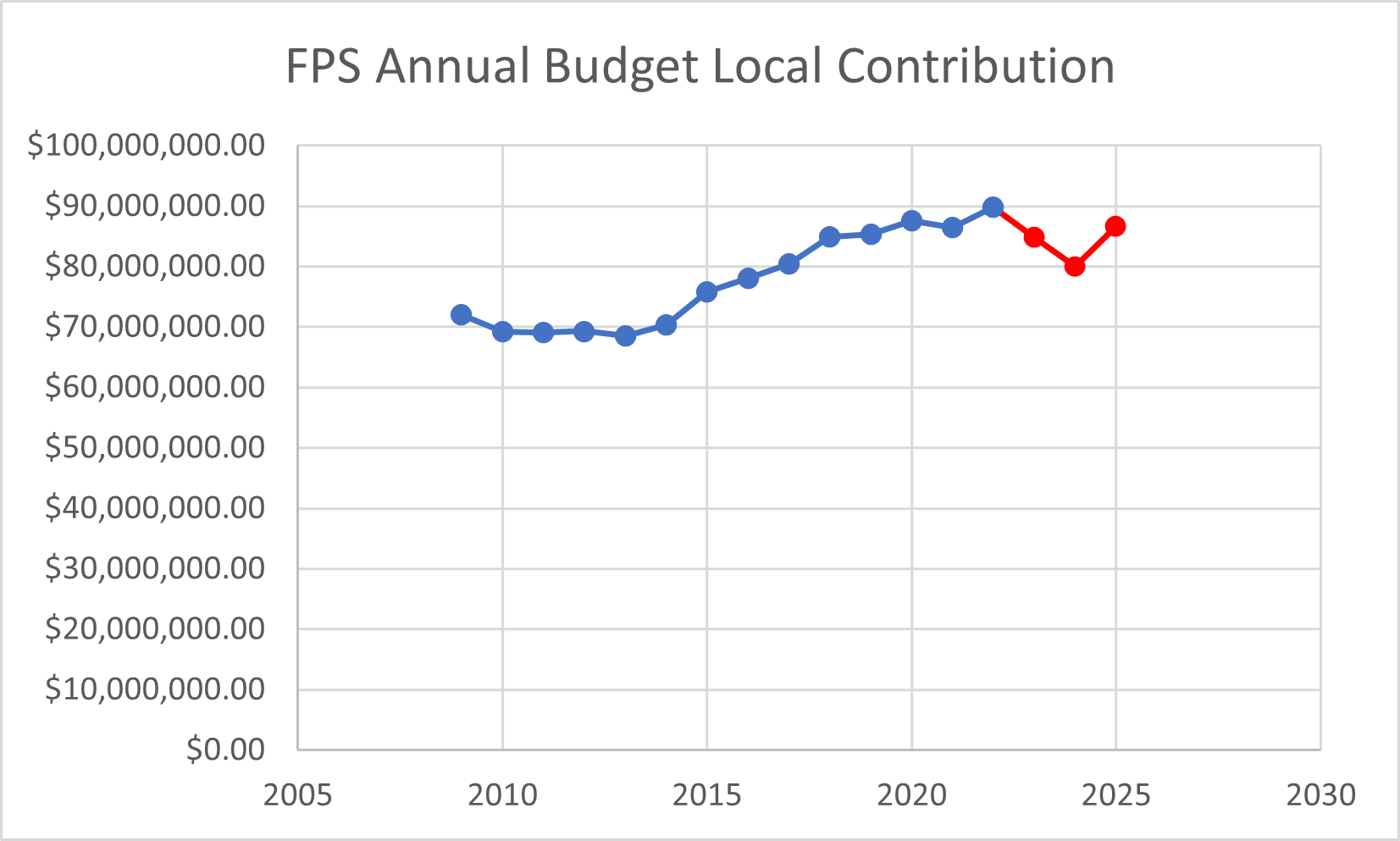
The Mayor has cut a total of $18 million from local funding of the FPS annual budget over the last 3 years compared to the FY22 funding level.
As a result, low income, special needs and non-English speaking students have felt very little impact of the Student Opportunity Act.
The School Committee simply stood aside and let the Mayor divert critical financial support from our neediest students.
3. School Roof Replacements and Solar Projects
Perhaps it is clearest here why we have a problem with School Committee member resolve. In the most recent School Committee meeting on September 18, 2024, the dreadfully inadequate FY26 Capital Plan came up for a vote. The full horror of that emaciated FY26 Capital Plan was explained in:
Framingham Mayor Puts the Brakes on School Roof and Solar Projects
In the September 18 meeting, School Committee member Adam Freudberg argued convincingly that the FY26 Capital Plan was inadequate, that the cost of deferring vital roof replacements was going to be steep, and that the vote should be delayed until the Framingham Public Schools (FPS) staff could provide the School Committee an estimate of that deferral cost.
He also noted that adding several project staff could obviously get roof replacements back on track and wanted further information on that. He ended by arguing that the absence of new solar projects was a serious problem, given that the Dunning and Farley roofs have been recently replaced and the McCarthy roof was going to be completed in the summer of 2025.
One of his key points here was that the savings generated by solar projects on newly roofed schools could easily cover the hiring of the needed project staff.
He proposed an amendment to the FY26 Capital Plan approval motion to defer a final vote to the next meeting and for the FPS staff to supply information on roof project deferral costs, staffing and solar projects prior to that final vote.
This was clearly a sound proposal, yet 4 School Committee members voted against it: Chair Jessica Barnhill, Vice Chair Jenn Moshe, David Gordon and Valerie Ottaviani.
It is hard to fathom why these 4 voted against getting the cost of deferring roof replacements. That is school district Finance 101.
They also showed no support for solar roof expansions, which would help boost climate change action to protect our children’s future, and bring substantial utility savings to the school system. They missed the point entirely that such savings could fund adding the missing project staff and get the roof replacement effort back on track.
Note that Barnhill, Gordon and Ottaviani voted last summer against putting a solar roof on Farley, so they are repeat offenders!
It is this kind of thinking which explains why the School Committee is in such trouble.
Those 4 School Committee members do not wish to change the current projected rate of progress, which replaces just one failing school roof each year.
The list of failing roofs is as follows, with roof warranty expiration dates shown:
- Juniper Hill (2021)
- Brophy (2022)
- Potter Road (2023)
- King (2023)
- Cameron (2023)
- Barbieri (2023)
- Harmony Grove (2023)
- Hemenway (2023)
- Walsh (2025)
- Framingham High School (2026)
- Stapleton (2027)
The majority of these roofs are obviously beyond their end of life, especially considering that those with a 2023 warranty expiration date actually reached the end of their warranty in 2018, but had their warranties stretched to 2023 by FPS hiring a roofing maintenance company to repair them for a further 5 years.
Many of those roofs are leaking and to complete one roof replacement per year is inviting disaster, with compromised classrooms and higher expenses.
This problem affects almost all schools, just like the busing problem, and the lack of pre-K instruction and classroom aides for so many students in so many classrooms.
Having served for 4 years on the School Committee with Adam Freudberg, it is painful to see him no longer in any leadership position, as he is the most active and articulate in arguing for solutions to key problems which affect our students every day.
However, it is clear that there is a slim 5-4 majority on the School Committee which is starting to show some interest in fighting back against the Mayor’s roofing slowdown and possibly his other interference to sound solutions on buses and student pre-K and classroom aide support.
There is hope, but now is the time for this majority of 5 to swing into action, following Adam Freudberg’s lead.
Something drastic has to happen to School Committee thinking, both now on the FY26 capital plan, and in the upcoming FY26 operating budget discussions, or the school system will continue on its downward trajectory.
And if big changes don’t happen in that time frame, the community, and especially Framingham parents must get involved and intervene at the 2025 election by swapping out School Committee members who won’t stand up for students.