Politics & Government
Third Year of Zero Tax Dollars for Framingham Schools Budget Increases
Students have been seriously damaged, as the Mayor also hijacked boosted state Chapter 70 education funds to prop up cityside operations.


SUMMARY
The Student Opportunity Act passed by the state in 2019 is an investment in students who are disadvantaged for various reasons. It is a potential game changer for Framingham students especially, which is why funds provided by that legislation and delivered to the city through the Chapter 70 state program should have transformed school experiences and life prospects for these children.
However, Mayor Sisitsky has engaged in a multi-year effort to reduce the impact of this act on key Framingham Public Schools strategic investments in pre-K expansion, which is a lifeline for our non-English speaking 4-year-olds, and in boosting classroom aide support for both special needs and non-English speaking students.
Find out what's happening in Framinghamfor free with the latest updates from Patch.
Large amounts of funding meant for disadvantaged students has ended up in city coffers supporting cityside services such as infrastructure maintenance.
Decayed infrastructure can be fixed, but the damage being done, especially to many of our youngest learners, is likely irreversible.
Find out what's happening in Framinghamfor free with the latest updates from Patch.
The Mayor has an opportunity to turn things around, but he has to grasp the nettle.
On Tuesday, November 26, 2019, Governor Charlie Baker signed into law the Student Opportunity Act to boost funding for students in 3 distinct groups:
- Students who come from families which are economically disadvantaged.
- Students with disabilities relative to their non-disabled peers.
- English learners compared to students whose first language is English.
This historic commitment to students is delivered to cities and towns through the Chapter 70 Program which is the major state program of state aid to public elementary and secondary schools.
The act requires the state to spend an additional $1.4 billion — before inflation — on Chapter 70 aid paid to districts, with the full investment to be complete by 2027.
For a summary of the act, see: https://www.doe.mass.edu/soa/ and for a description of the Chapter 70 Program see: https://www.doe.mass.edu/finance/chapter70/default.html.
Charlie Baker’s comment at the time was:
"If there's one thing I've learned in my 63 years, it's that talent is evenly distributed. What's not evenly distributed is opportunity, and there's a reason why this is the Student Opportunity Act," Baker said at a bill-signing ceremony hosted at English High School. "This legislation is about making sure every kid in the commonwealth of Mass., regardless of where they live or where they're from or where they go to school, has the opportunity to get the education they need to be great."
The state’s commitment to ensure that the Student Opportunity Act goal was supported in full measure has been impressive and bipartisan. For the last FY24 fiscal year budgeting, here is a quote from the state Education Secretary on February 23, 2023:
“By increasing funding for the Student Opportunity Act, we are taking a critical step toward closing the opportunity and achievement gaps that many Massachusetts students still face. This is an investment in every student in the Commonwealth, so that regardless of their zip code or their background, each learner can access the high-quality education they deserve,” said Education Secretary Patrick Tutwiler. “In our first budget, the Healey-Driscoll Administration is making sure these funds get out the door and into communities, so that local school districts and educators can meet the needs of the students they serve – including increasing mental health services, supporting transportation services for students, and addressing the needs of low-income students and English language learners."
From all of this, nothing is clearer than the fact that ALL of this boosted Chapter 70 aid MUST flow to students.
The problem is that in Framingham it did not.
In his first two budgets, Mayor Sisitsky diverted more than 30% of the boosted Student Opportunity Act (SOA) Chapter 70 education funds away from the schools to fund cityside operations. Here is a table summarizing the diversion.
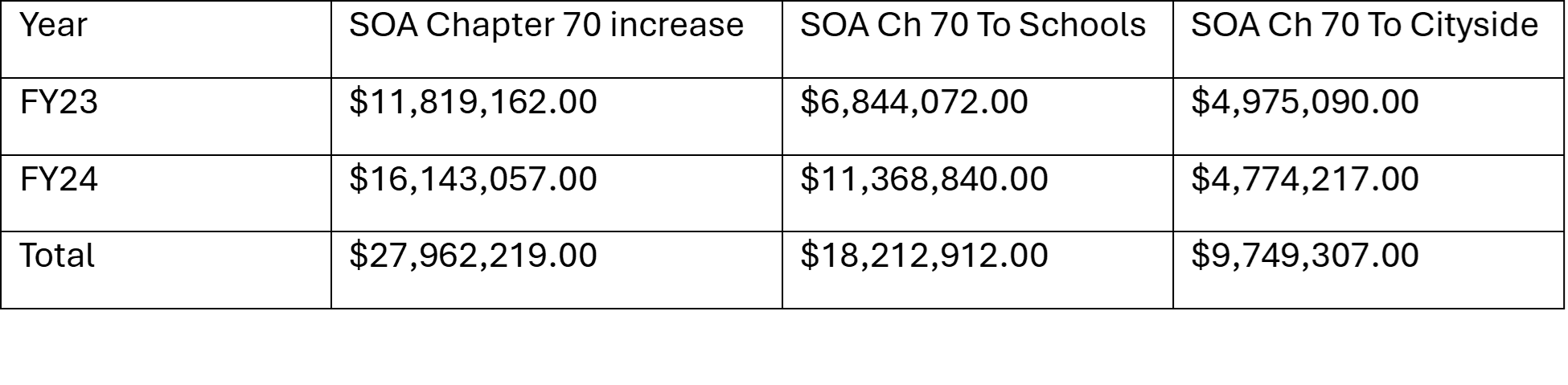
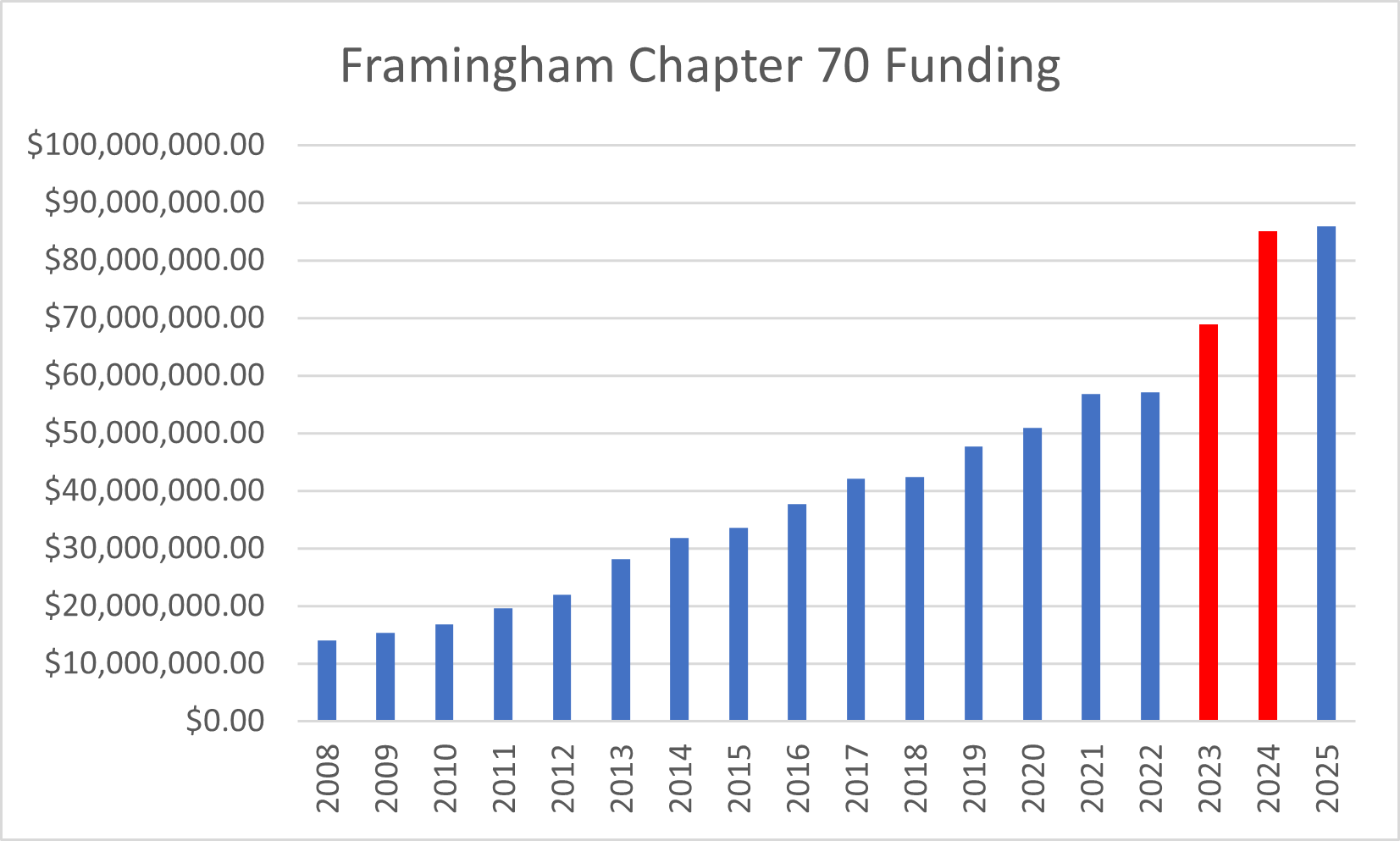
Note that Chapter 70 funding is recurring, so that increases add up year over year. The chart shows Chapter 70 funding for the past 10 years, with FY23 and FY24 highlighted in red.
From the table, it is clear that the Mayor subverted the intent of the Student Opportunity Act that all the boosted aid must go to students and in particular boost support for:
- Students who come from families which are economically disadvantaged.
- Students with disabilities relative to their non-disabled peers.
- English learners compared to students whose first language is English.
Instead, he diverted $5 million/year in recurring funds away from students in FY23, and a further $4.8 million/year in FY24.
By manipulating boosted Chapter 70 funding in this way, he spent not a single dime of taxpayers in funding the Framingham Public Schools FY23 and FY24 annual budget increases. Chapter 70 increases covered all of those increases.
Further, he used the diverted money to fund roughly 50% of the cityside budget increases.
In the Mayor’s mind the Student Opportunity Act was also the ‘Fix Framingham Infrastructure and Boost Property Tax Breaks Act’.
Diverting Student Opportunity Act money from the schools has had serious consequences. At least two major strategic objectives the school district has for the students targeted by the SOA have been set aside:
- Expansion of pre-K capacity to support all 700 4-year-olds in the city at no cost, adding to the 300 capacity at Blocks. Currently the Blocks program serves only 60 out of 370 English learners. See: https://profiles.doe.mass.edu/...
- Addressing the chronic shortage of classroom aides by boosting their pay by 20%, as they are severely underpaid. Although 270 classroom aides are funded in the FY24 FPS budget, the school year started with many positions vacant and a further 30 aides have quit mid-year.
By the Mayor’s financial manipulation, the city has already substantially reduced Chapter 70 funding for the schools in FY23 and FY24, and aims to keep on diverting Chapter 70 funding to support cityside operations in FY25.
The Mayor’s plan is to give the school district an FY25 budget increase of $6.6 million.
How does that look in the context of boosted Chapter 70 funding from the SOA?
The state is increasing Chapter 70 funding for Framingham by $943,299.00 in FY25. That brings the increase in annual Chapter 70 funding over FY23, FY24, FY25 to $28,905,518.
Under the Mayor’s FY25 plan, the increase in the FPS annual budget over that same time period would be: $6,844,072 + $11,368,840 + $6,600,000 = $24,812,912.
So, it is very clear.
The Mayor is intent on using $4,092,606 in Chapter 70 recurring funding to prop up cityside operations in FY25.
When will he learn that he is derailing the whole intent of the Student Opportunity Act?
Further, in recent comments to the MetroWest Daily News he painted a very misleading picture, implying that the school district is not a team player, and how he has worked so hard to fund the school district budget in the past. [See the Notes at the end for the full quote and link.]
It’s hard to square that with the facts, for he has consistently simply funded the schools budget increases with increased Chapter 70 funds, while grabbing a whole chunk of that ‘student’ money to fix roofs, roads, and the water & sewer system amongst other things.
He knows that is not what the state plan was.
He knows that a whole echelon of students in the city are struggling because they did not get the aid the SOA promised.
Imagine being a 4-year-old who only speaks Spanish or Portuguese at home, has no exposure to English through pre-K, and then flounders in kindergarten. It is a truly terrible scenario, entirely fixable if pre-K is available at no cost to all 4-year-olds and if that is supplemented by later grade language support classroom aides.
It is widely acknowledged that if a student is not a proficient reader by 3rd grade, their educational prospects become very dim, as do their life prospects.
By blocking both the expansion of free pre-K and solving the classroom aide shortage, the Mayor is explicitly responsible for major educational damage to at least 300 of our youngest students each year.
And yet he persists.
The Mayor should remember the days when Hoops and Homework was starting up and how important he thought that was for our kids. Along the way he lost something important.
He has an opportunity for redemption in the FY25 budget cycle.
Here is a 6 point action plan which would completely turn things around:
- Return all of the diverted SOA Chapter 70 funds to the schools, by adding the remaining $4,092,606 in Chapter 70 funds owed to the students, to the Mayor’s $6,600,000 budget increase figure to yield a total of $10,692,606 for the FPS FY25 budget increase.
- Earmark most of that additional budget increase to help fix the classroom aide shortage and expand pre-K staffing capacity to help achieve SOA objectives.
- Invest a portion of the $15 million already removed from the school district budget - $5 million in FY23, $10 million in FY24 – in the Marian Community Center project to support added pre-K classrooms and space for the Thayer program to also move there.
- Having thus repaired some of the damage done to our students, take the necessary financial steps to ensure the cityside budget is put on a sound footing, so it does not need to suck money out of the schools. That means calculating the property tax revenue increases needed to address inflation eroded city staff compensation and the ballooning $400 million backlog of maintenance for roads, buildings, and the water & sewer system. That includes restoring the original FY25 Capital Improvement Plan so that FY26 does not become a deferred project nightmare, and full disclosure with facts and figures of the state of all of the city infrastructure: roads, buildings, water & sewer system.
- Commit to raising the tax levy beyond 2.5% as determined by that process, and acknowledge past misstatements suggesting that the tax levy cannot be raised by more than 2.5%.
- Stop blaming the school district for problems the city administration and past City Councils have caused.
Notes
The entirely misleading April 8 MetroWest Daily quote from the Mayor on the school district budget: https://www.metrowestdailynews...
Sisitsky urges collaborative effort to make budget that 'we can all agree on'
During Wednesday's School Committee meeting, Sisitsky said the city has worked closely with the School Department to come up with a budget that will be approved by the City Council.
"We've been working very hard, crunching numbers and trying to figure out ways to come in with a balanced budget," Sisitsky said. "As you know, we have very limited amounts of new revenue for this year over last year, and we've shared that with the school finance subcommittee about a month ago."
The mayor took exception to rhetoric that took place during the public comment period of Wednesday's meeting, when a couple members of the public voiced concern that Sisitsky was shortchanging the school budget.
"I think it is inappropriate to say that there are two sides to the budget process — the school side and the city side. We're all in this together and we're working as a team. I want to point out this will be my third budget as mayor. The first two budgets I've submitted and got approved by the council and fully funded the requests of the School Committee. I recommended every penny that you asked for and we got it done,"
Full Disclosure: The Framingham Observer was one of the members of the public voicing concern that the Mayor was shortchanging the schools budget.