Politics & Government
Two Information Management Failures of Framingham City Government
The city is unable to do simple spreadsheet analyses critical for decision making on the Residential Exemption and water & sewer billing.


One of the fundamental weaknesses of the Sisitsky administration is its glaring inability to handle the basics of information management across its municipal operations. Whether it's managing the state of the roads or the water & sewer system, planning for building roof replacements, managing the community center and downtown garage projects, or even responding to public records requests, there seems to be a persistent fog shrouding what is actually going on.
Not only is the community perpetually in the dark, but also it seems quite clear that the managers running some city operations appear to lack the skills or judgment to analyze and present data to support timely, sound decision making.
On occasion, however, the fog lifts enough to allow some observations to be made and conclusions to be drawn on the competence of the Mayor's administration, as it attends to the nuts and bolts of municipal operations.
Find out what's happening in Framinghamfor free with the latest updates from Patch.
The focus here will be on two topics: the Residential Exemption and water & sewer billing
These are both timely topics for discussion as:
Find out what's happening in Framinghamfor free with the latest updates from Patch.
- Adoption of the Residential Exemption, which provides tax relief to homeowners with lower property values, is on the agenda for continued consideration at the City Council meeting on October 8, 2024.
- A long overdue consultant’s report on water & sewer billing is also slated to be on the City Council’s agenda in a meeting later in October.
It turns out that in each of these two areas, the city administration has made blindingly simple mistakes which have caused long delays on solutions or action of any kind.
When I say ‘simple’, I mean it, as I hope will become clear in the following commentary.
I have had about 20 years’ experience in information management, including the whole gamut of database management - including running reports, doing data analytics and building data-driven websites – plus lots of experience with the spreadsheet tool Excel which is widely used to manage data in business and government operations worldwide.
Further, from my time serving on the School Committee in Newton for 6 years, it was obvious that both school side and city side operations depended critically on the use of Excel to manage large amounts of data, produce graphs and charts to visualize information and to make calculations to support decision making, including projections essential to ensuring budget spending is on track.
It is astounding to me that the Framingham city administration has so little capacity to carry out the simplest analyses of its own data.
Let’s talk about the two topics.
1. The Residential Exemption
Enacted in 1979, the Residential Exemption is an option under property tax classification MGL c. 59, sec. 5C that shifts the tax burden within the residential class from owners of moderately valued residential properties to the owners of vacation homes, higher value homes and residential properties not occupied by the owner, including apartments and vacant lands.
A good overview of the Residential Exemption can be found here.
A key feature of the Residential Exemption is that if a lower value residential property is owner occupied, the owner qualifies for the property tax relief afforded by the Residential Exemption. There is no property tax relief if the residential property is not owner occupied.
Multiple municipalities have adopted the Residential Exemption to provide property tax relief to their homeowners with lower value properties: Barnstable, Boston, Brookline, Cambridge, Chelsea, Everett, Malden, Nantucket, Provincetown, Somerset, Somerville, Tisbury, Truro, Waltham, Watertown, Wellfleet.
A discussion about the Residential Exemption occurred in a City Council meeting towards the end of 2023, where the tax rate was being finalized. The discussion was completely stymied by the fact that no one had any idea which residential properties were owner occupied or not. So, with incomplete information, the matter of whether to adopt the Residential Exemption was deferred.
Fast forward to September 10, 2024, where in a City Council Finance Subcommittee meeting the matter of owner occupancy had still not been resolved.
That was amazing.
Even more amazing was the fact that the city administration seemed inclined to figure out the answer by sending out a survey to residential property owners.
That really is quite mad, when the answer is sitting in plain sight in the city property tax billing database.
Each residential property in that database has two associated addresses: a physical address and a billing address so that property tax bills are sent to the owner, whether they live at the property or elsewhere. Aside from dedicated rental apartment complexes, if the two addresses are the same, the property is owner occupied. If the addresses are different, the proper is not owner occupied.
The simplest of Excel spreadsheet analyses would run a report to identify which properties are owner occupied by filtering the data for those properties which have the same physical and billing address. As with all data analytics operations, the filtered data can be further reviewed for accuracy, but this approach should capture 99% of the owner occupied properties.
It’s that simple!
A year has passed since the owner occupancy issue surfaced, and still the city has no answers. That is a monstrous information management failure.
It seems that it is time to hire some fulltime data analytics experts who can use all the data in city databases to produce information that is critical to city decision making!
2. Water & Sewer Billing Problems
The background here is that water billing issues for the city’s 3000 multi-unit residential buildings were raised at the end of 2023 by the departing Chief Financial Officer, Louise Miller. The billing problems center on the use of what is called the Multi Unit Dwelling (MUD) factor.
If a residential building has 200 units, then if the MUD factor is applied in billing, the total water usage by the entire building is divided by 200 to get the average amount used by one unit, which is typically about 14 HCF/quarter, where HCF= one hundred cubic feet, so the average quarterly water cost per unit is about $260.
That is figured out by using the city quarterly billing rates shown in the table which is extracted from the city website:
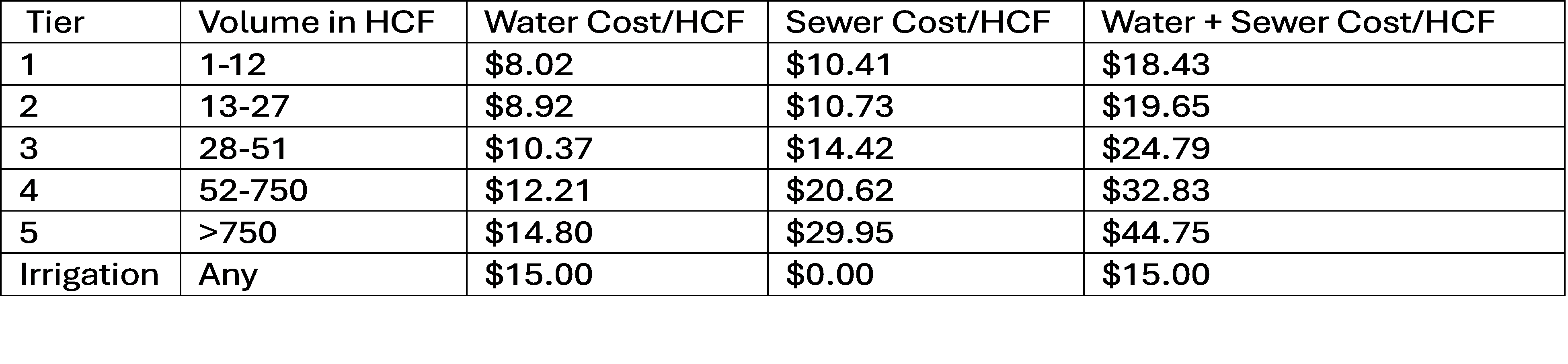
If the MUD factor is not used, the 200 unit residential building is treated as a single water user using an average of 2800 HCF/quarter. Then, because most of the building water is billed at the highest Tier 5 rate, the average quarterly water cost per unit, without applying the MUD factor, is about $580 – 120% more!
For a 10 unit residential building, without applying the MUD factor, the average quarterly water cost per unit comes out to about $400 – 54% more!
As the Louise Miller noted 10 months ago, the city has about 3,000 multi-unit dwellings, and about half are billed with the MUD factor applied and half without it applied, apparently somewhat randomly. That was completely inconsistent and needed to be fixed.
Here is the simple issue.
Obviously, city staff had gone through the billing system at the end of last year, identifying which multi-unit dwellings had the MUD factor applied, and which did not. At that point the city staff had complete information on the problem and should have been able to calculate in an Excel spreadsheet, containing the 3,000 multi-unit dwelling records, how the total quarterly revenue from all of those dwellings would be affected if the MUD factor was applied to all dwellings or not at all, or just to some class of multi-unit dwellings.
The problem is so straightforward that in a week or two staff should have been able to do the necessary spreadsheet work and provide the revenue impact of various MUD factor options.
Then the City Council could have decided on how to apply the MUD factor based on the options presented to them. The FY25 budget process could have then included that revenue information and the water billing issue would have been put to bed.
Instead, there was delay after delay on addressing the problem. Then the city hired an outside consultant(!) to figure out what staff should have been able to do in a few weeks.
How come the city seems to have no staff capable of doing the most basic Excel spreadsheet calculations and an outside consultant has to be hired because apparently our staff doesn’t understand the billing system?
When this gets finally discussed at a City Council meeting with the consultant present, City Councilors should ask for an explanation as to what skills were needed to complete the analysis and why our city staff failed at the task and why on earth all of this took so long.
Almost a year has passed since the water & sewer billing issue surfaced, and still the city has no answers. That is another monstrous information management failure.
Again, it seems that it is time to hire some fulltime data analytics experts who can use all the data in city databases to produce information that is critical to city decision making!
There are multiple other information management failures plaguing the city administration and future articles will address those. But these two are in full view right now, and will affect decision making in the near term.
The City of Framingham has a budget of more than $300 million and multiple complex operations with large amounts of data, which can be mined to provide a clear picture of the state of each operation to support sound decision making.
Yet the city administration seems to be flying blind, with none of the guidance basic data analytics could provide.
That is a recipe for trouble.