Politics & Government
Why the Framingham School Committee Needs to Resist Budget Cuts
The FY25 school district budget affords no inflation relief for staff and does not boost support vital to address student behavior issues.


At its meeting on April 3, 2024, the School Committee will vote on its FY25 Framingham Public Schools budget. As explained in a prior article, the current draft budget is professionally crafted but brings into stark relief the fiscal problems the city has created by taxing under the levy limit:
A Sound Framingham Schools Budget Illuminates City Fiscal Crisis
The numbers quoted in that article remain in agreement with the latest version of the budget book:
Find out what's happening in Framinghamfor free with the latest updates from Patch.
Framingham Public Schools Fiscal Year 25 Budget
The budget increase of $9.5 million is comprised of two pieces:
Find out what's happening in Framinghamfor free with the latest updates from Patch.
1. Salary increases: $3.9 million.
2. Expense increases: $5.6 million.
The expense increases are almost entirely unavoidable state mandated special education cost increases and contracted school bus transportation increases. There is no budget cutting which can be done there.
The salary increases are based on a 2% annual cost-of-living adjustment (COLA) which provides staff with no relief from the salary erosion experienced over the last several years. In FY23 and FY24, the two prior fiscal years, the state estimated inflation for education costs to be 4.5% for each year. By that standard Framingham staff lost at least 5% in salary to inflation as their COLAs were pegged at 2% for each of FY23 and FY24.
It is foolish to imagine that the Framingham unions are going to settle for a 2% COLA for each of the next 3 years in their new contracts. Newton recently tried to force a total of 8% COLA over 3 years on their school district staff, failed to settle in 16 months of negotiations, had a 2 week strike, and then settled for a 12% COLA over 4 years. Taking that lesson into account, it would be wise to build in a 3% annual COLA for Framingham unions, to address inflation losses and for the school district to compete effectively with surrounding districts when hiring.
Increasing the annual COLA to 3%, would add about $1.2 million to the FY25 budget, so the School Committee would be wise to take that into consideration if they are considering any other cuts.
Further, as the community is well aware, the school district is experiencing an upswing in student behavior problems which require serious attention and investment but are cast aside in this budget. A fundamental cause of this student behavior problem is the erosion of classroom aide support since the pandemic.
Many aides left the profession when 9 months of remote classes left them with no job to do. The resulting shortage has shifted the market for classroom aides to such a degree that they are currently underpaid by about 20%. At one point a year or so ago, Framingham Public Schools had 140 classroom aide vacancies in 280 budgeted positions! Classroom aide annual turnover also runs to 25%, as shown in the budget book at p. 98.
The state experienced exactly this problem in their special education out of district placement operations, and raised those special education costs by 20% over the last 2 years. But while the state did something about their staff shortages by raising compensation, Framingham did nothing.
Addressing this problem by raising compensation for classroom aides (bargaining Unit T) by 20% would be a remarkably sound and wise investment for students and for all the teachers who have been increasingly finding their classes harder and harder to manage.
Students cannot learn in classes roiled by student behavior problems. Everyone should agree this needs to be fixed.
In a very rough estimate, there are about 270 classroom aides making about $30,000/year, so the FY25 budget cost increase due to boosting classroom aide pay would be about $30,000 * 270 * 20% = $1.6 million.
The current draft of the FY25 school district budget is built in a systematic, consistent manner, but inflation relief and classroom aide compensation boosts have been forced off the table by financial pressure from the Mayor and the City Council Finance Subcommittee leadership of Councilors George King and Mike Cannon.
These issues need to be brought back onto the bargaining table and included in the FY25 budget strategy. In truth, the Framingham Public Schools FY25 budget increase should be boosted from $9.5 million to $9.5 + $1.2 + $1.6 million = $12.3 million.
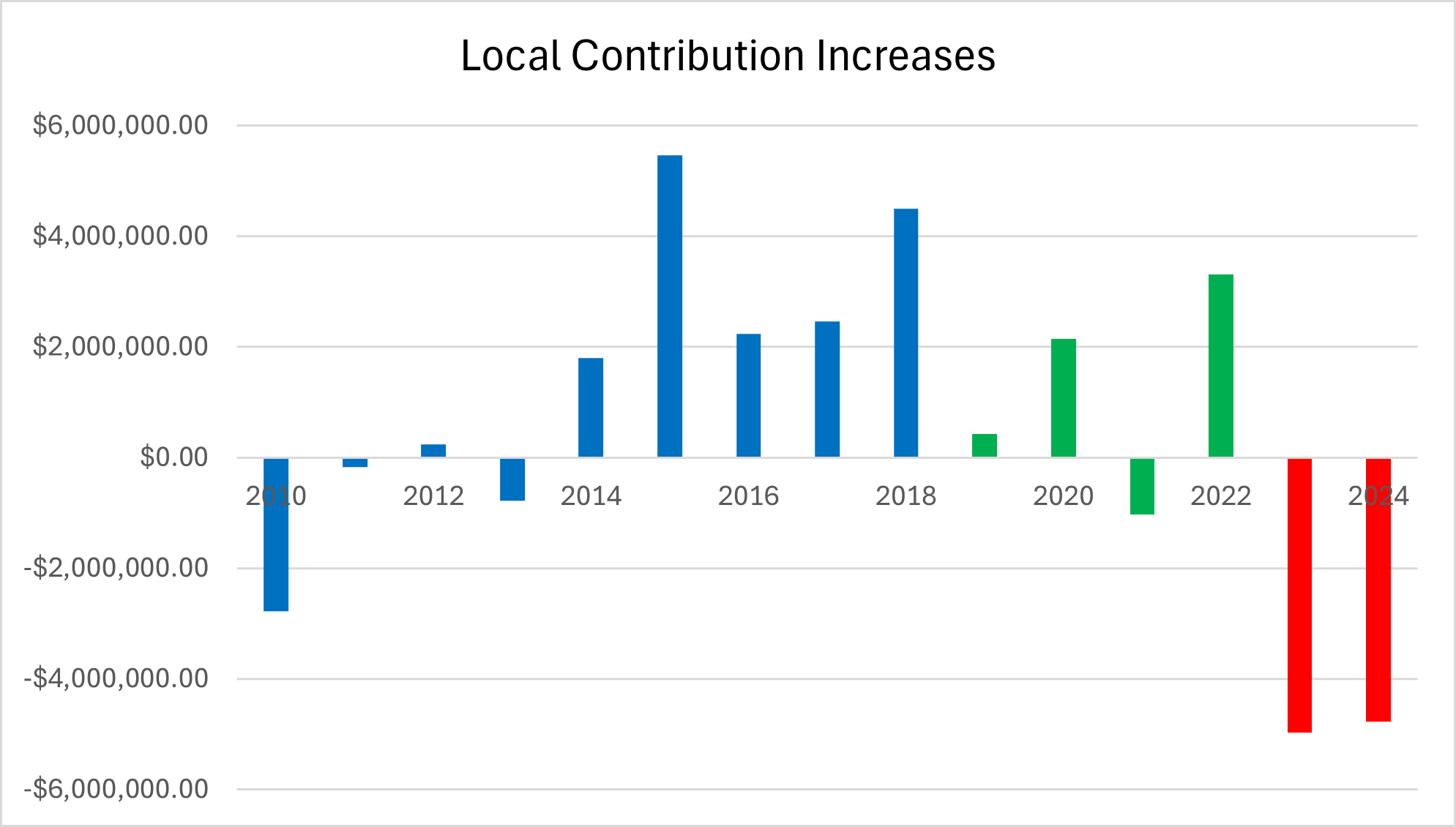
Charlie, George, and Mike will blow a gasket over that proposal, but it should be remembered that in the last 2 fiscal years, they engineered a cut of $10 million/year in city funding of the school district. In FY23, they cut the schools budget taxpayer funded piece of the budget - the Local Contribution - from $90 million to $85 million. Then in FY24, they cut it another $5 million from $85 million to $80 million.
The city took this money away to fund cityside operations and now it is time to give it back to the schools.
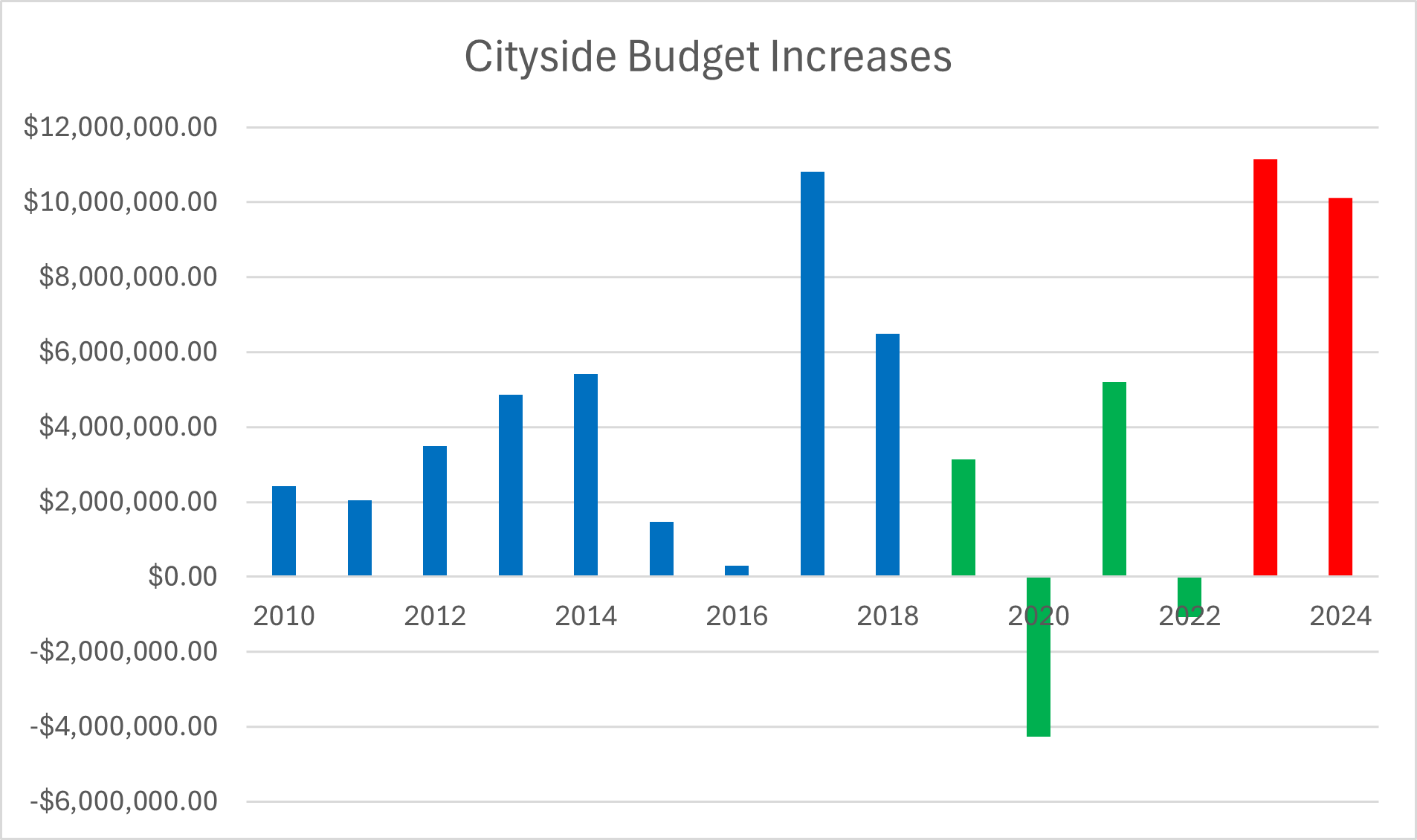
I will end with two charts which illustrate the taking of education money from the schools and how in the last two fiscal years that education money was crucial to propping up cityside operations, which have been starved of tax revenue.
The charts show data from the past 14 years.
Remember that:
- Local Contribution increases are the increases coming from property taxes to fund the schools.
- Cityside budget increases are the increases funding city operations like roads, water & sewer, trash collection etc.
Red denotes the last two years, when those huge cuts to the schools Local Contribution funded almost 50% of the cityside budget increases.
Also, the colors indicate different administrative periods:
- Red – Sisitsky administration
- Green – Spicer administration
- Blue – Town administration