Business & Tech
Business of the Week: Noble's Camera Shop
Physically preserving your precious "Moments in Time".


Patch interviewed Brian Noble, owner of who was happy to talk about the past, present and future direction of image reproduction.
When did you open your business in Hingham?
BN: My dad started the company in 1956 and I joined when I graduated from college. Prior to that I was around emptying waste bins and being a pain in the neck. I was born in Hingham, my mom and dad are from two different worlds; dad was from Maine, mom from Fall River. Apparently Hingham is in the middle, so the first Nobles was opened here.
Find out what's happening in Hinghamfor free with the latest updates from Patch.
At one time, the company had several locations. What happened to them?
BN: During the halcyon days of film processing, it was important to have retail locations convenient to where customers wanted to drop off film. At that time we also had a relationship with Hallmark Cards so it was a perfect synergy between the two ideas. In 2005, I took my daughter to college in North Carolina and on the way home I said something to my wife about the fun we’d had. She told me it was the first weekend that I had taken off in 18 years! That was when I decided that we needed to be a smaller company and we started to divest. We sold three of the stores and let the lease expire on the others. Perversely, I think that we did it at just the right time.
Find out what's happening in Hinghamfor free with the latest updates from Patch.
Was the divestment influenced by the explosion of affordable digital cameras and the increased popularity of e-commerce?
BN: Yes, 17 percent of all our business comes in online so we’re selling hard goods (cameras, accessories, tripods) on the web as well as the photo-finishing services. We can do everything now. We take it from your Facebook, your hard drive or your cell phone…it’s a thriving business. When you think about it, the Internet is 24/7, 365 days of the year with no staff or electrical bills. It’s really a smarter way to go.
You offer a variety of print options including the self-print facility at the front of the store. Is this popular?
BN: Clearly the customer wants the control, although there are still a number of people who are happy to hand me a memory card and ask me to print them like it’s a roll of film. That’s fine with me, I’ll do it anyway the customer wants to do it. A lot of customers love the control aspect of sitting down to decide the size, where to crop, the magnification etc. I am perfectly happy to provide that; they are investing their time as opposed to me. They are using their time to make their product.
The art of photography has changed somewhat in the last few years, it was once considered to be capturing a moment in time but that moment can now be manipulated. Is that a good thing?
BN: The nice part of it is that we used to say that the creative part of photography was in the darkroom and not in shooting the picture. Now the creative part is in shooting the picture…so many people can manipulate an image in Photoshop, which is an expensive program and requires a long education period or they can find easier programs to change it (iPhoto, Picasso). So the customer gets what they want and not what we want, they’re much happier with their product.
So you don’t have an onsite darkroom anymore?
BN: (Smiles) No. You had to hire the right kind of person to work in a darkroom…all day. They were a very interesting personality type in that position, but we don’t have to deal with that anymore.
Noble’s has a reputation for being staffed by camera experts. Is that a fair expectation?
BN: I’ve had people here for, like, a million years. The depth of talent and the length of knowledge amazes me. I had a customer come in with a 1928 camera that I couldn’t figure out how to open so I picked up the phone to my father and said ‘I’m sure you don’t remember this camera’…he did! These are resources that you have to go back to all the time.
One of my concerns is that we’re seen as a Company that is only in the past. Alternatively, do customers see us as somewhere that knows what to do with the image? We try to stress that it’s no longer just a bag of 24 pictures and here you go. What did you do with those pictures? Half of them you threw away, in a weird sense we made our living on waste. Now every picture that is taken is taken for a reason. Most people overshoot but they need to do something with the image. They need to print it.
That is how photographers of the past presented their images, in a physical rather than virtual form…
BN: I can’t tell you how many mothers have come in here crying because they had all their images on their hard-drive and it crashed. They don’t have any prints; they’ve lost 4 or 5 years of family memories. When you see pictures of disasters like Katrina, people aren’t walking out of their destroyed homes with a hard-drive; they’re carrying photo albums. The key is that a memory is a printed image, a tactile world. How many people watch a slideshow on a computer? Very few.
It’s all about the idea of building an image, doing something with it. Putting it on a phone case or mounting it as artwork, making it into a pillow or a cup. Better yet, why don’t you print it and put it into a photo album!
How has the business changed since you first opened the doors?
BN: Dramatically. We were processing over a thousand rolls of film a day at our peak. Now we do maybe fourteen a day but the image processing has gone up. It’s no longer a transactional world, it’s now a project, and building the image they want. If you know what you want, I’m at a disadvantage because you can go on the Internet and order it any way that you want. But if the customer needs help…that’s what we’re here for, to give guidance. We spend an awful lot more time on education than we used to.
What makes Hingham special?
BN: Hingham has always been special. It’s always been a bedroom community to Boston but because of its distance from Boston, it has maintained a gentility and sense of community. That’s really clear when you have an event like Fourth of July; it’s a hometown experience. I have a buddy in Boston who owns a camera shop, if he leaves a camera on the counter, it probably gets stolen. If I did that here, I get a lecture from a customer about being careless. That’s the difference, a better sense of community.
Where are your customers from?
BN: Hingham, Cohasset, Norwell, Scituate. People will travel because they can’t find a shop like this near them. When they’ve got a problem…they’ll drive.
What’s new in Noble’s?
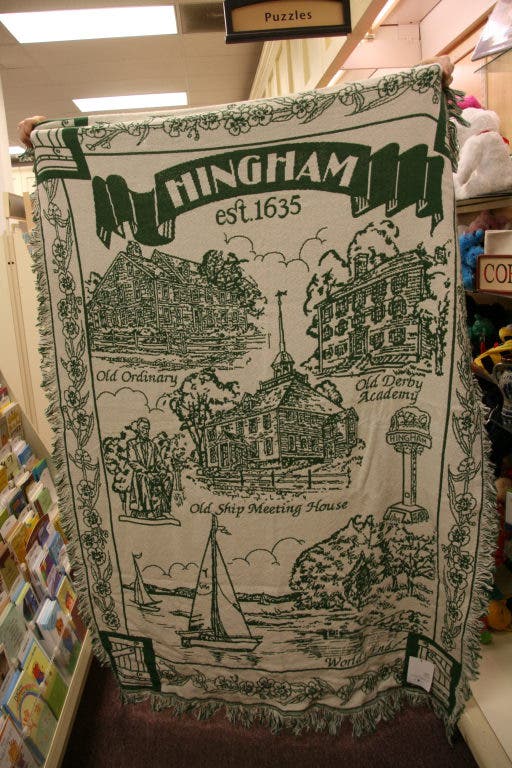
BN: We offer mass customization. The idea is that I sell a lot of something but that it’s unique for every buyer. For example, a mug with a family picture on it…I sell a lot of mugs but the pictures are always different. Mouse pads, t-shirts, something with Hingham on it instead of just Massachusetts. We make products unique…just for you.
Do you use social media?
BN: It’s a tough thing. I haven’t mastered it yet. I’m not a big personal Facebook-er, but I have slowly warmed up to it. As my children have moved away, it means that I can keep up with what is going on in their lives.
If you look at our website, we offer customers the option to download pictures from Facebook and get prints made. Facebook is “the thing” at the moment but we’ve been through this before. What happens if Facebook “goes away”? How are you going to get your pictures off and what are you going to do with them? The best (and only) solution is to print them so that you’ll have them forever…in a physical form.
What would be Noble’s tagline?
BN: (Laughs) That’s difficult. More than just a camera store is the logical answer but I can’t say just bring us all your problems…I’m not prepared for that!