Community Corner
Lexington Landscapes: Meadow Mist Farm
Go down two dirt roads to see what Lexington was like long ago.
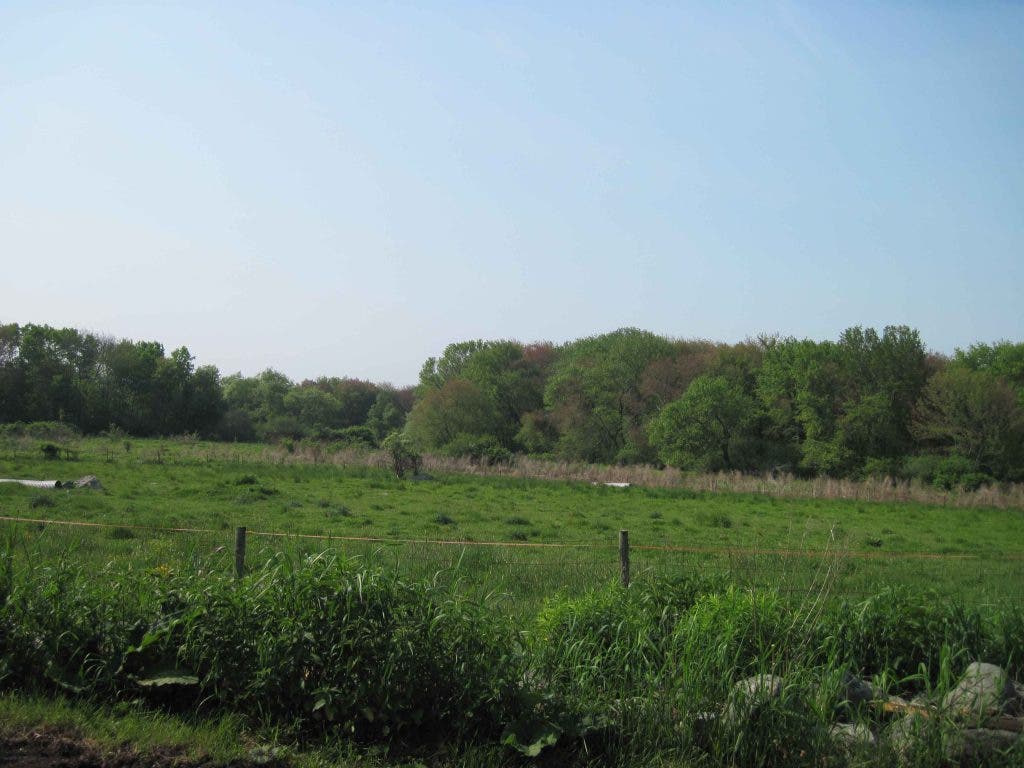


You have to travel up two dirt roads to get to Meadow Mist Farm. Did you even realize the Lexington has dirt roads?
The first one, Bacon Street, runs right off of Marrett Road, less than half a mile from the and the Waltham Street snarl. Go a quarter mile up Bacon Street, past a wet meadow to an intersection shaded by sugar maple trees and turn left onto another dirt road, then turn right, and suddenly you'll be back at Grandpa's farm, or maybe the farm you wished your grandparents had owned. It's a clean, sweet-smelling place with chickens and cows and lambs and blueberries and a view of nothing but grass and the edge of the woods.
How on earth does Meadow Mist Farm do that?
Find out what's happening in Lexingtonfor free with the latest updates from Patch.
It helps that Meadow Mist is surrounded by open space. Although Meadow Mist itself is a mere 5.5 acres, Lexington's Dunback Meadow conservation land rings Meadow Mist, and the abutting property that isn't owned by Lexington is being privately farmed or left as wetlands.
John Moriarty has been farming Meadow Mist since 1987. His father left a farm in Ireland at age 15 to come to America. Moriarty was raised in Cambridge, then moved to Arlington where he had a garden. “I told the real estate agent I wanted a bigger garden,” Moriarty said. He found a dilapidated barn, a farm house built in 1870, and the center of the one-time Meek dairy farm, owned by a single family since 1910.
Find out what's happening in Lexingtonfor free with the latest updates from Patch.
Moriarty moved in, planted corn and raised pigs and chickens. Over time he added a bit here and there -- a small orchard, a field of blueberries, more gardens for raising vegetables. He built a new barn for sheep and beef cattle, and continued a long New England tradition by pulling enough rocks out of the garden beds to make several new stone walls around the property. He never started using pesticides, fungicides or any of the chemical smorgasbord larger farms use on their crops. “The farm is so small that the only way to have meaning [in farming] is to do it differently,” Moriarty said. The disadvantage of this approach is that Moriarty has lost some crops altogether.
Today, Moriarty and his partner Lauren Yaffee are starting to venture beyond mere vegetables and animals into integrated farming of cattle, chickens and grass. Fans of Michael Pollan's "The Omnivore's Dilemma" will recognize the method from Joel Salatin's Polyface Far. But not everyone is a fan of Michael Pollen, so here's a quick explanation.
Instead of having cattle wandering a large field, eating everything they like to nubbins and leaving the yucky plants to spread and grow, Moriarty uses a moveable electric fence to pen his three cattle inside a small paddock. The cattle eat everything inside the paddock down to about six inches high, then Moriarty moves the fence over to the next square of grass. This “pulsed grazing” is supposed to imitate how herd animals move in the wild—think buffalo!—and be good for the grass and soil, because they have a chance to recover between bouts of munching.
When Salatin moves his cattle around at Polyface farm, though, he follows the cattle with chickens. The chickens tear apart the cow dung looking for undigested grass seeds and insects, scattering the manure so that it nourishes the grass better. The result is thick, lush grass, and thick, lush chickens. Moriarty has a portable chicken coop—called a “chicken tractor” by people who like to add the word “tractor” to other nouns—and he'd like to use it on the fields where his cows and sheep graze now.
Today, though, the chickens are staying in their coops. The egg-layers have their own small house, while the meat birds are sitting in their portable coop-cum-quonset-hut far above the wetland buffer. The problem is that Moriarty's fields lie in the 100-foot legal buffer zone for wetlands. The Conservation Commission began contemplating Moriarty's proposal for implementing the portable coop on May 24, and will continue to do so at their June 7 meeting, should you care to witness local government in action.
If you'd like to see a local farm in action, though, you can simply visit—as many of your neighbors already do. Starting about four years ago, Moriarty says, there was a surge of interest in the farm and the vegetables and grass-fed meat that Moriarty and Yaffee raise there. “It's been fun meeting people,” Moriarty said. There's been talk of having students at the Clarke Middle School walk across the meadow come and visit the farm, but Moriarty isn't organizing anyone; they come to him, perhaps after checking the Meadow Mist web site for updates.
“It's something of what Lexington was like a long time ago,” Moriarty says.”We're keeping one small piece of Lexington alive... I couldn't go back to the suburbs. It's too much fun doing this.”