Schools
Medfield High School Sophomore Attends Conference
Bethany Komine recently was invited to represent Medfield at the MassSTAR Conference at Lasell College. The Conference promoted community spirit and encouraged the students to become engaged in social interaction.
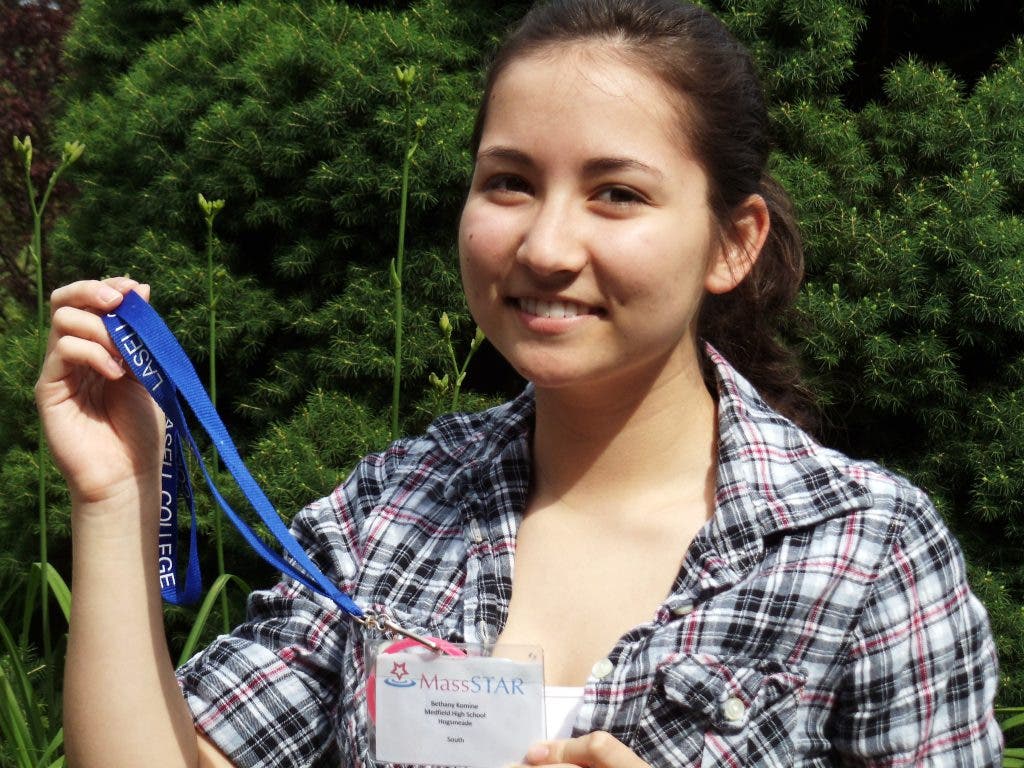
“People can be three feet away from you and you wouldn’t know what’s going on,” Medfield High School sophomore Bethany Komine said.
And that, apparently, was the lesson.
That revelation was, by design, exactly what the MassSTAR Citizenship Conference hoped for, during one of the many activities afforded attendees during the June 10-12 event, held at Lasell College, in Newton.
Find out what's happening in Medfieldfor free with the latest updates from Patch.
“It’s a leadership conference,” Komine said, “but it’s a lot more than that to me. We learned a lot about community service … doing things for your community and other people.”
Komine, who was nominated to the conference by MHS guidance counselor, Anne Lodge, was among 130 sophomores who were invited to attend the event, entitled “The Road Less Traveled.”
Find out what's happening in Medfieldfor free with the latest updates from Patch.
According to MassSTAR, a function of the Massachusetts Youth Leadership Foundation, the conference’s purpose is to “educate and inspire young people across the Bay State to become engaged within their communities, through a series of panel speakers, group learning activities and intensive small-group discussions." Students were also challenged to “dare to be different; dare to live out your ideas.”
A large part of the experience was promoting social interaction and “to explore, discover and begin to master the skills, practices and ideals of proactive citizenship.”
Upon their arrival, the students were instructed to make personal introductions to at least three people, whom they hadn’t previously met.
“I’ve never really been in that situation with young people,” Komine said, “where you could literally just go up to them and say ‘my name is' and have them react positively.”
The camaraderie was further strengthened through the assigning of students to various smaller groups.
“We were split into groups [of 10] and would go through the weekend together,” she said. “You get to know those people in your group, really well.”
Komine said one of the activities, used as a teaching tool, was called the “Ice Cream Game.” The groups were assigned one of four “flavors” and were asked to, independent of one another, physically construct a “community” using only “a sack of paper, markers and tape."
“They taped off sections of the floor,” she said, noting that the four teams: chocolate; strawberry; vanilla and mint, would compete to see who could build the most elaborate “community.”
“You’d have to go to other leaders and [buy] permits, so you could start building,” Komine said. “And there were ‘police officers’ and rules [which you had to follow] or you would go to ‘jail.’"
When the time limit was up, the groups took a step back to see the result of the competition.
“The [chocolate] group had towers and a bunch of structures,” Komine said, “the [mint group] had one or two big things, which were poorly done, but that looked okay. The other two groups were completely frustrated because they kept getting sent to ‘jail’ for no reason at all.”
Being sent to “jail” was a punishment purposely applied to members of some of the groups, to add a difficulty level to the task and to illustrate that, as with real life, there’s not always a level playing field.
Then, as the groups saw the result of their handiwork, it was obvious that several of the groups had great difficulty. During the building exercise, however, the successful groups were completely unaware of the struggles of their neighboring groups.
“The way it was explained to us,” Komine said, “was that people could be three feet away from you and [yet] you didn’t know [there were problems]. It was like, expanding your idea of the world. Like [living in] Medfield … a lot of people think that Medfield is the entire world, but there are other places, right next to you.”
By participating in the “Ice Cream Game,” the students received a valuable lesson in becoming more aware of their society, as a whole and how, by becoming more involved in the struggles of their neighbors, they might make a difference in the outcome.
“It’s not always going to be easy, helping other people,” Komine said, “but the problems aren’t going to come to you. You have to look around [to see them]. You can’t stay narrow-minded.”