Community Corner
Medfield State Hospital Master Plan Committee Update
The MSHMPC, along with the Medfield Planning Bd, met on Wednesday, July 12th with Erica Kreuter (Director, MassWorks Infrastructure Program.


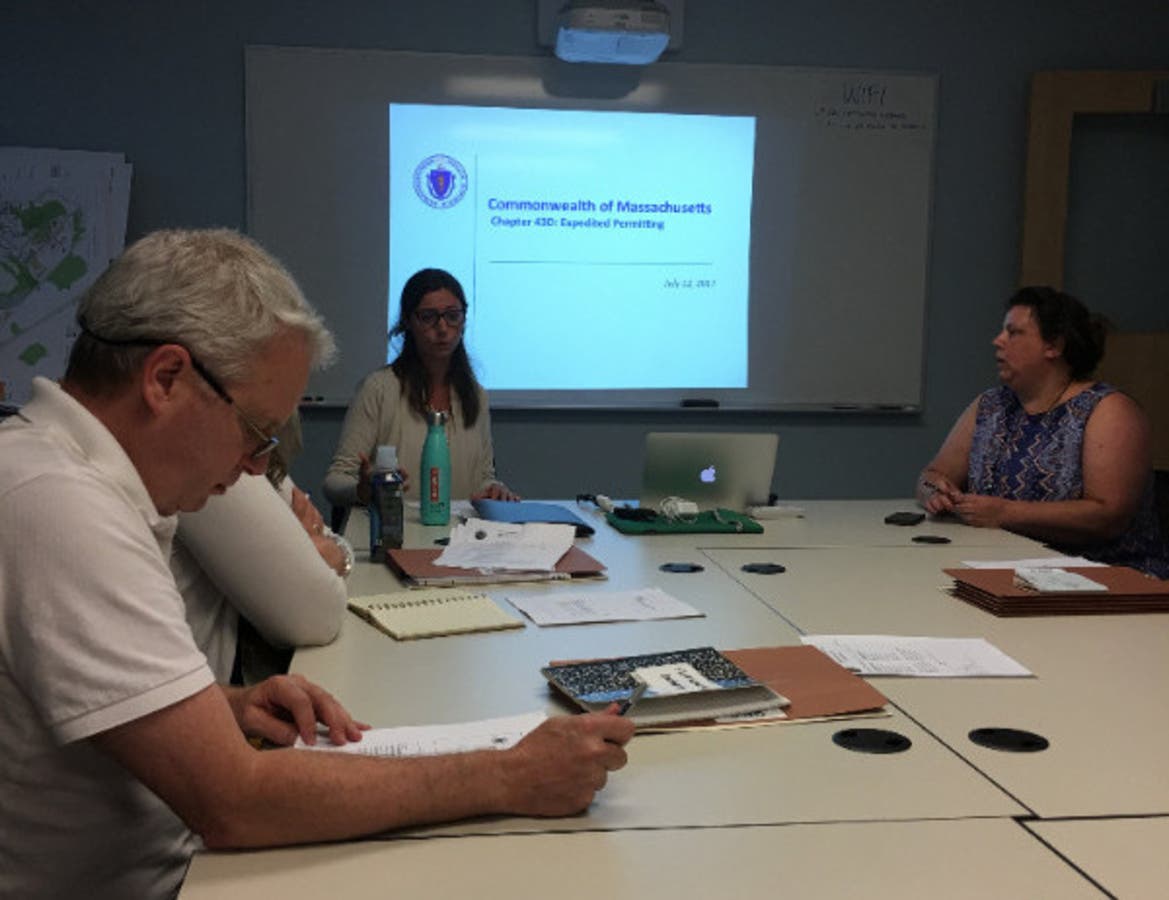

The following found on the MSHMPC newsletter. Slides from the 7/12 presentation on the Massachusetts Chapter 43D Program. Photos courtesy of Lucille Fisher.
Medfield State Hospital Master Plan Committee Update
The MSHMPC, along with the Medfield Planning Board, met on Wednesday, July 12th with Erica Kreuter (Director, MassWorks Infrastructure Program). The information session focused on the Commonwealth of Massachusetts' Chapter 43D, Expedited Permitting program.
43D is a zoning method designed to promote "targeted economic and housing development". Sites which qualify and are targeted as Priority Development Sites (PDS) are guaranteed to receive local permitting
decisions within 180 days.
Find out what's happening in Medfieldfor free with the latest updates from Patch.
Implementation requires local and state approval. Benefits to the Town include priority consideration for grants; economic development opportunities; financing, training and remediation assistance; and
promotion/marketing. Please see the State's definition below.
Many communities have created 43D PDS including Millis, Walpole, Medway and Sharon. It can be used for just specific areas of the MSH property and not necessarily applied across the whole site. Expediting the
permitting process has advantages and disadvantages. The committee is researching this program as well as others to see how they might be applicable to certain areas of the MSH site.
Find out what's happening in Medfieldfor free with the latest updates from Patch.
A definition of 43D from the mass.gov site:
Local Expedited Permitting - 43D Program specific information about Chapter 43D expedited permitting and the application process.
History
On August 2, 2006, Massachusetts General Law Chapter 43D was signed into law. The 43D Program was amended on August 7, 2012 in Section 25 of Chapter 238 of the Acts of 2012.
This program offers communities a tool to promote targeted economic and housing development.
Chapter 43D
- Provides a transparent and efficient process for municipal permitting
- Guarantees local permitting decisions on priority development sites within 180 days
- Increases visibility of your community and target development site(s)
The Benefits of Opting-in
- Priority consideration for the MassWorks Infrastructure Program grants, brownfields remediation assistance, and other financing through quasi-public organizations
- Online marketing of your site and promotion of your pro-business regulatory climate
- Improved municipal planning and permitting efficiencies
- Collection of special fees for priority development site permit applications
The Criteria for Priority Development Sites
- May be zoned for commercial, industrial development, residential or mixed use purposes
- Must be eligible for the development or redevelopment of a building of at least 50,000 square feet of gross floor area (may include existing structures and contiguous buildings)
- Sites must be approved by the local governing authority
- Must be approved by the state Interagency Permitting Board
The Obligations of Opting into Chapter 43D
- The community must identify a qualifying parcel as a priority development site, and obtain permission of its owner (if private) for participation in the program
- Within 120 days of adopting Chapter 43D, the community must
- appoint a single municipal point of contact for streamlined permitting;
- amend local rules, regulations, bylaws, etc. to comply with 180 day permit timeline;
- determine and make available the requirements for each permit;
- establish a procedure for identifying necessary permits for a project;
- establish a procedure for determining completeness of the required submissions.
- After the 120 phase-in period is complete, the town must render permitting decisions on priority development sites within 180 days
Protections for Communities
- The 180 day guarantee is suspended if the governing body determines:
- an application is incomplete
- an application contains false or misleading information
- that substantial changes to the project affect the information on the permit applications since the original submission