Neighbor News
Approaching Guide Dogs And Their Handlers
... safety tips when approaching a handler with a working guide dog... by Debbi Collar
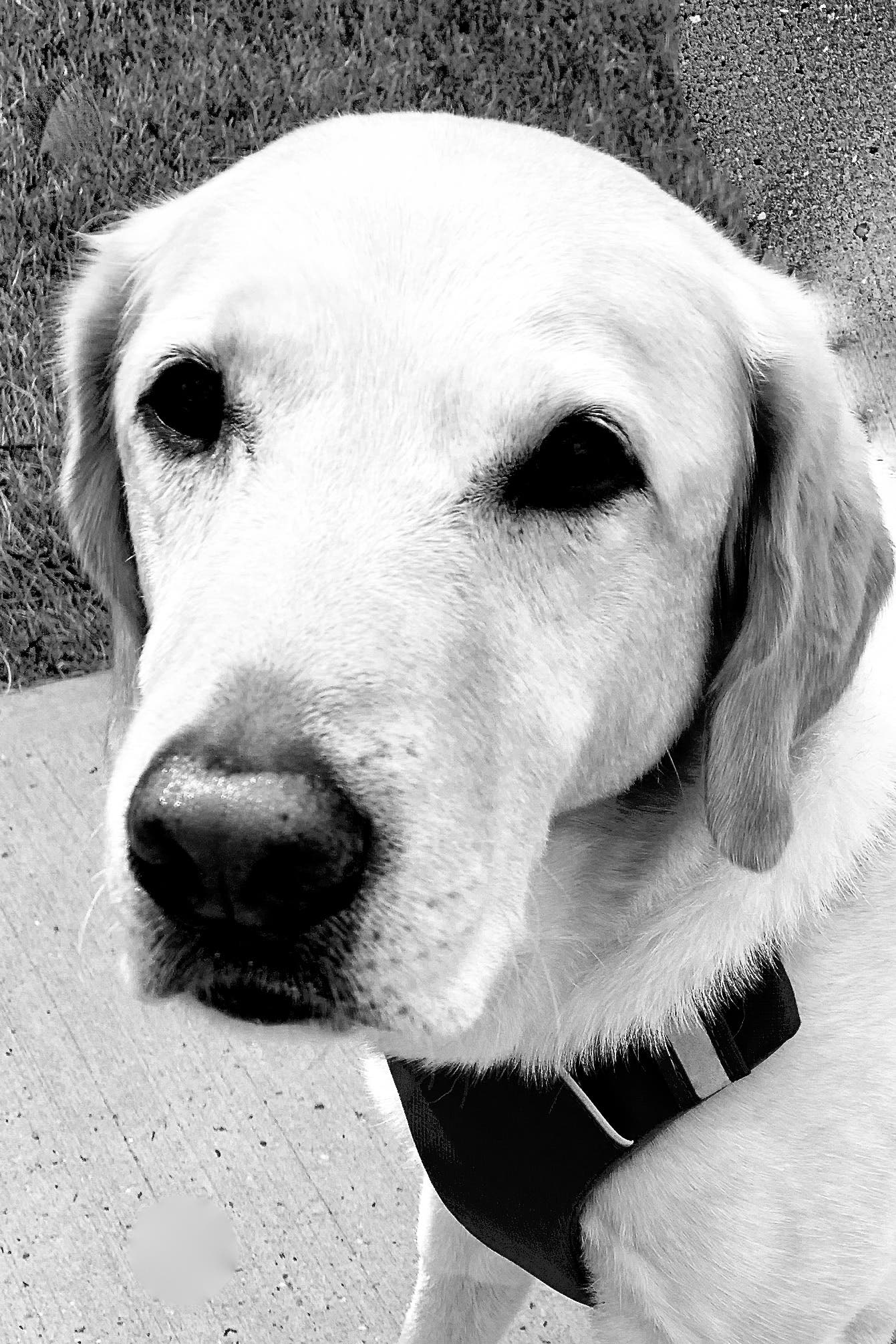
Aron - A Guiding Eye Dog, (photo credit, Kristine Carney)
September is National Guiding Dog Month.
Trainers and their handlers, along with the Guiding Eyes For The Blind organization have been asked to share safety tips to the sighted as to what to do and whether or not to assist when approaching a guide dog and its handler.
Find out what's happening in Melrosefor free with the latest updates from Patch.
Melissa Carney, Outreach and Graduate Community Support Manager for Guiding Eyes For The Blind, New York, explained various situations and provided The Melrose Mirror/Melrose Patch readers with a list to help all involved stay safe.
UNDERSTANDING THE DIFFERENCE OF GUIDE DOGS, VS. EMOTIONAL SUPPORT ANIMALS
Find out what's happening in Melrosefor free with the latest updates from Patch.
Sometimes people ask the question,"Are service or guide dogs the same as emotional support animals (ESAs)?
Carney has educated those who ask with,"No, service animals and emotional support animals are quite different. As defined by Title II and III of the Americans with Disabilities Act (ADA), a service animal is any dog that has been individually trained to do work or perform tasks for the benefit of an individual with a disability, including a physical, sensory, intellectual, or other disability. A guide dog falls under the general umbrella of service animal. Emotional support animals, on the other hand, do not qualify as service animals because they do not have any formal training to assist those with disabilities, and instead are pets who provide instinctual comfort. Legitimate service dogs, by law, are permitted to accompany their handlers into any place the public is allowed, including restaurants, hotels, stores, healthcare facilities, and so on. Because ESA’s do not have formal public access training and are pets, they are not legally allowed into these spaces."
This article is specifically tailored to Guide Dogs.
Although a sighted person may have good intentions in wanting to help those with limited vision or those who are blind cross a busy street, the offer may actually cause harm to b the dog's handler and the guide dog itself.
Why and how?
Carney explained,"A guide dog is a dog that has been specially trained to assist a blind or visually impaired person in independent travel. Guide dogs lead their handlers around obstacles, indicate stairs and street curbs, target doorways and other useful landmarks, among countless other tasks. The handler holds a harness secured around the dog’s body with a handle that enables them to feel the dog’s movements and communication."
She says,"It's important to make a clear distinction between the handler and dog's approachability. The dog should be completely ignored, as he or she is doing its job. The handler, however, is a normal person, and should not be avoided simply because they are blind. A guide dog handler should not be distracted while crossing a street, for example, because they must make difficult decisions and determine the traffic flow."
She relies on listening to the traffic around her and various noise sources such as construction sites to determine her location and the shape of the intersection. She, as the handler, will judge the circumstances first before giving directions to the guide dog as to when to move forward.
WORKING AS A TEAM
As to entering a construction site,Carney says, "It's loud, it's hard for me to stay oriented but my guide dog sees where they are digging up the sidewalk, he sees the construction tape and without a single signal from me he chooses the path that is the safest and he gets me out of that construction site. "We problem-solve together and share an equal responsibility to one another.”
INTELLIGENT DISOBIENCE
An example she gave of when guide dogs may not follow her signals is an experience in which she had a close call with an oncoming car when attempting to cross a busy city street. "I have to determine when it's safe to cross but the guide dog can practice what we call a traffic check. If a car comes out of nowhere the dog will back up or stop, refusing to move forward until the path is clear and keep us out of harm's way." Another example may be when a handler approaches the edge of a train platform, and the guide dog plants his feet in order to indicate to the handler that there is some sort of obstacle and/or drop off that is not safe to navigate. This is known as "intelligent disobedience." Carney says she cannot thank her guide dog, Aron, enough, "Let me tell you when that happens to you, like it did for me, you can't thank your dog enough because in that moment they've really saved your life."
Keep in mind as you approach any person and a canine in harness-safety first.
As each situation varies depending on location, Carney noted,"if they (the handler and guide dog) are walking or standing in a store aisle, you can choose to engage with them just as you would anyone else." Carney noted,"When we say distractions, we are referring to when a person talks to or pets a working guide dog and actively puts the team's safety in jeopardy. For example, if someone is trying to get the dog's attention, the dog could temporarily look away from an oncoming obstacle and cause the handler to walk straight into it. As far as assisting someone who is blind, it is the blind handler's job to receive directions if they so choose and communicate those directions to the dog. No one else is permitted to direct the dog."
A guide dog's handler not only communicates with the guide dog by giving signals to the guide dog but may communicate with others around him/her, again depending on the situation and the safety. "The handler,"Carney says,"may ask questions of someone, or they could just be striking up a regular conversation."
Carney also spoke about her own journey from losing her vision due to retinal blastoma (a form of eye cancer) to receiving and working with her guide dog, Aron.
She credits a support network throughout her life for helping her to achieve her own personal goals. Despite her vision loss, she says, "it didn't stop me from aspiring to my dreams and stepping out of my comfort zone."
At the age of 4 she began horseback riding and at the age of 8 she went downhill skiing for the first time, both with the encouragement of her parents. Carney added,"I went through a public school system - all of these experiences she says were "thanks to the wonderful support system I had - pushing me to reach my full potential."
Currently she is working at Guiding Eyes For The Blind in Yorktown Heights, New York sharing her experiences and giving support to others who have applied and are ready to be matched with guide dogs or have graduated with their partners.
She also discussed how she and Aron came together as a team and how much training is required for both guide dogs and their handlers. Carney received her guide dog from Guiding Eyes after freshman year at Mt. Holyoke in Massachusetts. As to her steps in the process of preparing to receive and work with her guide dog, she says, I really had to build up my cane skills and overall confidence before I applied to receive a guide dog." She also stressed"it's important to have that independence mind set established for yourself before you bring it to a team."
A guide dog’s journey does not happen overnight. Training takes time. Guide dog puppies are raised by generous volunteers who provide them a loving home, basic obedience skills, appropriate house manners, and socialization opportunities and exposure to diverse environments to prepare them for life with a guide dog handler. Once the puppies have spent time with a puppy raiser, it's off to school at the Guiding Eyes Training Headquarters for formal harness training. "On average, it takes 3 to 4 months to train a guide dog, but there are many factors that influence the length of training, such as handler availability and matching, organizational changes, maturity, and/or general readiness. Some dogs train for longer periods of time to be matched with handlers who have other disabilities in addition to blindness, such as balance issues, a cognitive disability, or hearing loss. Of course, training is also impacted by unforeseen circumstances, such as the COVID-19 pandemic. Guide dogs are then matched with their handlers based on a specific set of criteria. Following an application process, guide dog schools evaluate a handler’s pace, pull, environment, and controllability, among other factors, to pair them with a dog suitable for their individual lifestyle. Just as we thrive more in certain situations, guide dog trainers also evaluate each dog’s strengths and characteristics. Some dogs shine in city environments, others are more comfortable in rural settings, and a handful are adaptable to any environment. Some dogs walk at a 4:0 per mile pace, and are matched with fast walkers, and others are considered moderate or slower, and walk in the 3.0 to 3.6 range and 2.5 to 3.0 miles per hour, respectively. A blind person living on a college campus or commuting to work in a large city has much different needs than someone who is retired, and the temperament of the dog must reflect that."
After training has concluded for the pair, a graduation is held to celebrate the accomplishments of the handler, dog, and everyone involved in their journey. Still, the learning opportunities are not over, now the pair needs to practice their skills and work together in a variety of new situations. "I always say a guide dog team are two separate entities that have come together, because you both have to have the proper skills before coming into that partnership, and then maintain and develop those skills further once you have been matched."
THE MATCH
"Guide dogs are matched with their handlers based on a specific set of criteria. Following an application process, guide dog schools evaluate a handler’s pace, pull, environment, and controllability, among other factors, to pair them with a dog suitable for their individual lifestyle. Just as we thrive more in certain situations, guide dog trainers also evaluate each dog’s strengths and characteristics. Some dogs shine in city environments, others are more comfortable in rural settings, and a handful are adaptable to any environment. Some dogs walk at a 4:0 per mile pace, and are matched with fast walkers, and others are considered moderate or slow, and walk in the 3.0 to 3.6 range and 2.5 to 3.0 miles per hour, respectively. A blind person living on a college campus or commuting to work in a large city has much different needs than someone who is retired, and the temperament of the dog must reflect that."
She also discussed how she and Aron came together as a team and how much training is required for both guide dogs and their handlers. Training takes time and the process is step by step for each trainer and each dog. Before a match takes place of both guide dog and handler Carney defined how the process works.
SUPPORT
Carney also related that the handler, and guide dog are a team working together. That team has gone through many steps in the process of becoming a guide dog and actually being matched to a guide dog that will fit your needs.
Before giving a list of tips to assist kind hearted humans as to when it's best to approach the team and when it may not be the right time. Carney did not receive her guide dog until after freshman year at Mt. Holyoke in Massachusetts. As to her steps in the process of preparing to receive and work with her guide dog, she says, I really had to build up my cane skills and build my confidence with a cane before I applied to receive a guide dog." She also stressed"it's important to have that independence skill set established for yourself before you bring it to a team."
The team is not immediately matched. Training takes time. Guide dog puppies are raised and trained by others whose responsibility it is to train these dogs in a variety of situations that the blind/low vision may encounter. Once the puppies have spent time with a puppy raiser, it's off to school again for more intense training and later a graduation stating that the puppy, now a trained guide dog is ready to be matched with its handler. Still, training is not over. Now the pair need to learn to work together in various situations, "I always say a guide dog team are two separate entities that are working together because you both have to have the proper skills before coming in to that partnership."
BUILDING CONFIDENCE AND TRUST IN EACH OTHER
Carney says "A guide dog and handler work together to memorize routes and problem-solve. They take note of significant landmarks, turns, street crossings, changes in footing, and so on. While a guide dog is not a GPS, they can pattern to routes that are familiar to them, such as a handler’s doctor’s office or favorite coffee shop. Guide dogs are also trained to target specific doorways, escalators, locations on the train platform, or whatever landmarks are beneficial to the handler. To reiterate, the handler is always just as aware of their surroundings as the dog and memorizes each route alongside their four-legged partner."
Surprisingly, what the dogs learn in a period of 3-4 months, those being matched with a guide dog are given 2 weeks of learning and putting their trust in their guide dog. Carney says, "that's 2 weeks of official training on campus yet it's a lifelong endeavor. We're still learning and becoming better handlers each day." She continues to step out of her comfort zone with Aron’s encouragement to enhance their independent travel, confidence, and trust in one another. Both on and off harness, Carney is endlessly devoted to Aron’s care, medical needs, and happiness.
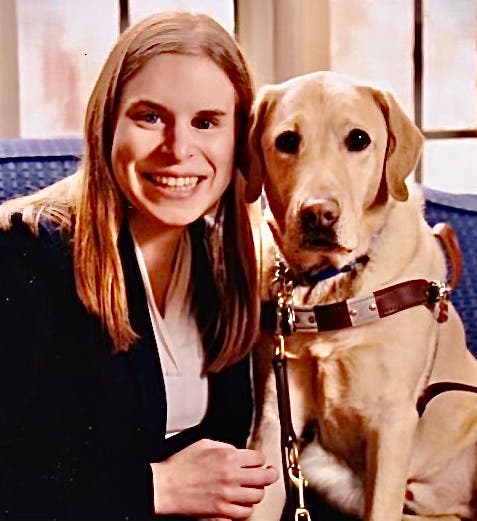
Melissa Carney and her best friend and confidante Aron.
WHAT DO I DO AS A SIGHTED PERSON WHO WANTS TO HELP?
Tips listed below on approaching Guide Dogs and their handlers were provided from both Carney and from her organization.
TIPS WHEN APPROACHING GUIDE DOGS AND THEIR HANDLERS
1: do not pet, feed, give direct eye contact and talk to, or otherwise distract a working guide dog.
A guide dog’s first responsibility is always to their handler, the blind or visually impaired person working with the dog. When in harness, they are constantly navigating around obstacles, indicating objects such as street curbs or stairs, and looking to their handler for commands and direction. As such, it is crucial that a guide dog be able to always focus on their work. However, guide dogs are not robots. If a person attempts to interact with them by petting or speaking to them, they may, understandably, become distracted and seek the extra attention as any normal dog would. If interactions are especially persistent and excitable, a guide dog may react to your affection, but that is no excuse to continue. Most guide dogs will ignore distractions altogether or once redirected by their handler, but even a momentary distraction could cause a blind individual to run into a pole or miss a turn down a particular grocery store aisle or sidewalk. Please respect the nature of a guide dog’s work. All verbal and physical praise and food rewards must come from the handler to further reinforce their bond as a team.
2: Do not give a guide dog commands.
As the word “handler” implies, the blind or visually impaired person working with the guide dog must have total control over the animal and any situations that arise. Guide dogs and their handlers are carefully matched using factors such as environment, temperament, and pace in order to facilitate a smooth transition to this type of travel. Handlers are taught to use strict commands as they grow comfortable together and establish a bond. It is essential that the dog only looks to the handler for those commands, so they are always on their best behavior while out in public.
3: When giving verbal directions, address the handler by name, not the dog.
When interacting with a guide dog team, you must ignore the dog, and only address the handler. Despite common misconceptions, such as the belief that a guide dog is a GPS and is solely in charge of ensuring the safety of the team, the handler plays an equal part in their relationship and independent travel needs. The handler actively gives directions to the dog, and they both memorize routes to targeted destinations. Both dog and handler communicate through verbal and visual cues to get where they need to go. Give specific directions to the handler, as vague phrases such as “over there” are ineffective at best.
4: Do not touch a guide dog’s equipment. This includes both the harness and leash.
Just as a handler is the sole caretaker of their guide dog, they should also be the one person with access to the dog’s leash and harness. Only guide dog handlers know the proper use of the equipment issued to them. Attempting to grab the leash or harness can result in confusion for the dog, inability to work, and in some cases, dangerous consequences to the team. For example, guide dog users are trained to listen to surroundings such as traffic flows to determine when it is safe to cross the street, and if you assume they cannot cross streets independently and react by grabbing the dog’s leash, you could put them in harm’s way and distract both members of the team from their decision-making process. Likewise, if you have been asked to assist a guide dog team, you should lead the handler, not the dog. Offer your elbow to the handler so you can guide then, or the handler may choose to direct their dog to follow you. Do not assume that people who are blind and visually impaired are not capable and always need your help.
5: Keep your pet under control when passing a working guide dog team outdoors.
Your pet may be the friendliest, most social animal in the neighborhood, but all of that is irrelevant when you encounter a guide dog team. Just as you can be a distraction, so can your pet, and in fact, your pet does not recognize whatsoever that the other dog is working. It is your job as a responsible pet owner to prevent your pet from playing with, attacking, or simply getting too close to a working guide dog team. Always keep them on leash. Off-harness, guide dogs love to play, but on-harness, they must remain focused on their work. If your dog has a history of aggression, take extra precautions, as negative interactions can lead to stress and trauma for guide dogs and their handlers."
WORK AND PLAY
Carney also says the work of guide dogs is often rewarded by their handlers, "Off-harness, a guide dog is just like any other dog. They love to play with people and other dogs, snuggle, sleep, and eat. While their time in and out of harness may vary, they are always given significant breaks. Many handlers are passionate about spoiling their dogs with toys, hikes, homemade treats, bed space, etc. It is crucial for guide dogs to be able to release their energy and have fun, as the balance to their job."
As to Aron and Melissa - the pair have been through several moves together where each one of them has made a variety of adjustments. Carney calls Aron her best friend. "I call him my soul mate dog. He's everything I could have ever wanted with four paws. He's my partner in crime, he's my confidante, he's the one I problem solve with whenever I get myself into a tricky situation when we're travelling. As a person nearly three years out of college he's seen me go through many transitions in life. We've lived different places from a small rural town in Connecticut to Boston and Washington D.C." They've also navigated around New York as Guiding Eyes For The Blind campus is in Yorktown Heights New York. Carney continues, "Aron has had to ride the waves with me and deal with my roller coaster of emotions. He's taken everything in stride. He's my best friend. I'm very lucky to have him in my life."