Neighbor News
Claflin-Gerrish-Richards House
A family Museum in Wenham, Massachusetts ...by Debbi Collar
OCCUPANTS OF THE CLAFLIN-GERRISH-RICHARDS HOUSE AT WENHAM MUSEUM.

As our Roadside History tour continues, readers will be introduced to various historic homes located along many streets in New England. The latest tour was the Claflin-Gerrish-Richards House at 132 Main Street, Wenham, Massachusetts.
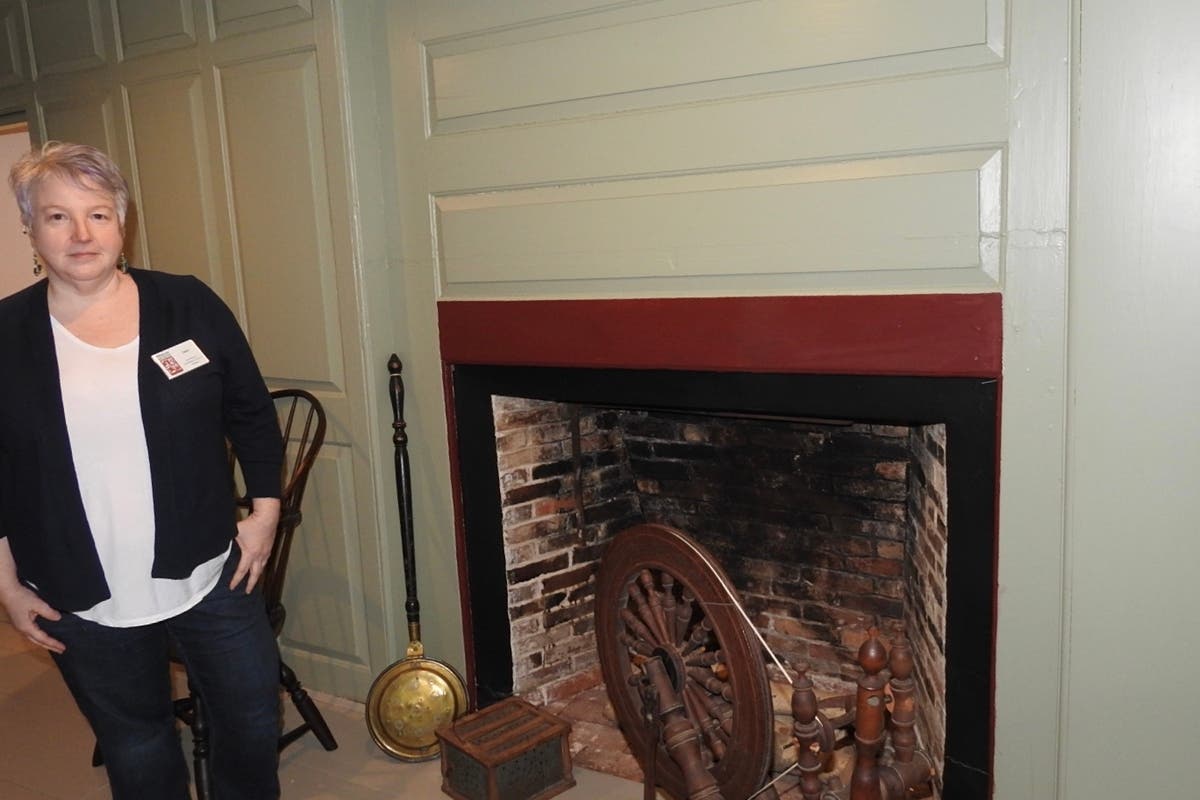
Exhibitions Curator and Manager Jane Bowers on duty discussing the lives of three families that resided in the house.
Find out what's happening in Melrosefor free with the latest updates from Patch.
Exhibition Curator and Manager, Jane Bowers was on duty recently giving a guided tour of the Claflin-Gerrish-Richards house. It is on a busy street and part of the Wenham Museum. Readers should definitely make it part of their New England experience when visiting the aea. It's worth the trip to see both the museum and the house.. Bowers related information about three families who were one time owners and occupants of the home over many years.
This article's focus will be on the house itself.
Find out what's happening in Melrosefor free with the latest updates from Patch.
The home is attached to one side of the Wenham Museum. Its entrance gained through the inside door. Unlocking the door, Bowers begins her talk discussing the Claflin family. "Robert Macklafflin" Claflin found his way to Wenham following a 10 year span in which "he was associated with the Saugus Ironworks." The background history of this owner/occupant of the house, Bowers says, is that "he was actually a Scottish prisoner who was sent here after he was captured at the Battle of Dunbar in 1650. In 1652 he was sent to work at the Saugus Iron Works as an indentured servant as punishment for his participation in what is now known as the Third English Civil War, one of the many wars of independence in Scotland. His sentence was probably 10 years - we know he arrived in Saugus in 1652 and that he came to Wenham in 1662."
His own children dropped the "Mack" form the name and subsequent generations have continued to do the same.
As to reasons why Macklafflin chose Wenham, it's uncertain. However, Bowers provides a possible explanation. "We don’t know why Robert Macklafflin came to Wenham specifically, but we do know why he stayed in the colony. Like most ordinary people at the time, he had few prospects for upward mobility in England or Scotland, or anywhere else in Europe. There were several reasons for this, but one of them was that Macklafflin was not well educated - we know he was illiterate because he signed legal documents with a mark rather than a signature. In addition, it is unlikely that he would ever be able to own land in England or Scotland because all the land there (and on the European mainland) was already owned by someone - it was still a feudal system - so the chances of someone like Macklafflin improving his social status or financial situation were very low. However, the British government was trying to get people to move to, and stay in, the colonies - the more British citizens who were here, the easier it was for the British to claim that this was part of England. (This is of course leaving aside the ownership by the indigenous people who were already here, which would be a whole other article.) In order to encourage people like Macklafflin to stay, the British government was giving them land in the form of land grants. People could apply to become a member of a town, and if they were accepted, the local authorities could give them land on which to farm, build houses, build businesses, etc. Macklafflin applied, was accepted, and was granted somewhere between 2 and 3 acres of land (we don’t know exactly how much because some records say 2 acres and some say 3.)"
Information regarding the interior of the house, was also explained in which it was said that the furnishing reflect the styles of each of the residents during the time they each lived in the house.
The hearth, the furniture, the tinderbox, and the various uses of items within the room were discussed. Some tools and their purposes were demonstrated. She was even able to produce a spark from materials used in the days when no matches as we know them to be today. were available.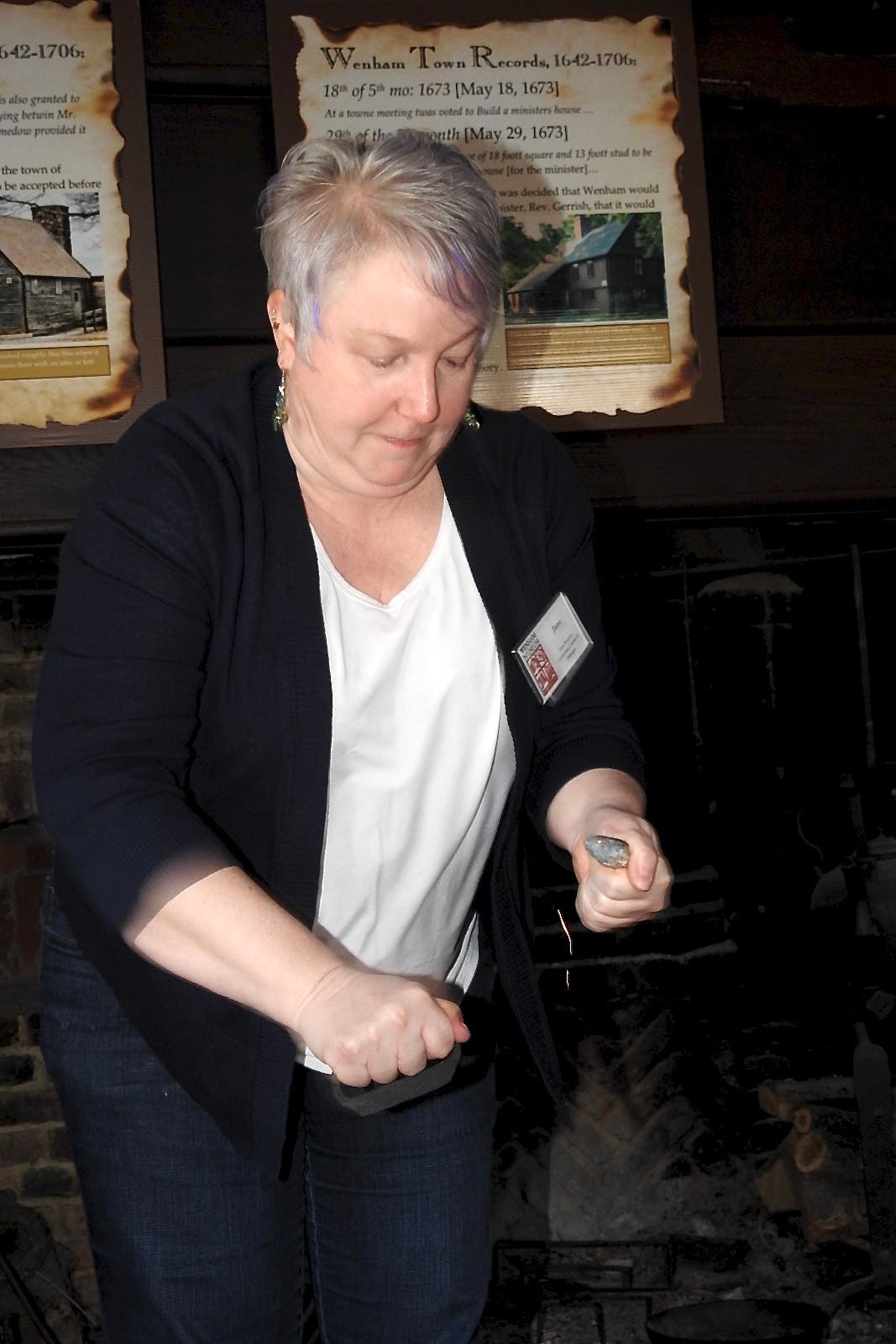
Look closely at the spark as Exhibitions Curator and Manager, Jane Bowers tries her hand at demonstrating how a spark was produced to light fires in the olden days.

The Claflin- Gerrish-Richards home located along a busy roadside in Wenham.

The"kitchen" area in which it wasn't unusual to see tools and furniture that served many a variety of purposes.
Bowers explained each of the furnishings within each of the rooms not only had a purpose but could easily be moved from room to room depending on need.
NEW ROOMS FOR THE NEW MINISTER IN TOWN
She then went on to another area of the home. Furnishings there were set up for the time period when a 22 year old minister who had studied at what was then called Harvard College, Reverend Joseph Gerrish resided in the house.
Bowers detailed what happened regarding a move by the first occupants of the house and the reasons behind their move.
"Robert Macklafflin married Joanna Warner of Ipswich after he came to Wenham and they had four children while they lived in what is now the Claflin-Gerrish-Richards House, so there were six people living in what was a one-room house at the time. The town bought the house from the Macklafflin family in 1672 in order to house the new town minister, Joseph Gerrish. In exchange for 15 acres of land elsewhere in Wenham (in Wenham Neck, the area near Gordon College), the town got the house and the 2 or 3 acres around it. After moving to their new property, they had four more children, so eight in all."
Once the town had purchased the home, it was decided that more comforts would be added for the minister. According to Bowers, who related extensive history on both the house and its resident of this time period,"When the town bought the house from the Macklafflins, they added a two-room, two-story addition, making it a three-room house when the minister moved in. While he was living there, Reverend Gerrish and his wife had at least five children, so it went from being a one-room house with six people living in it to being a three-room house with seven people living in, which would have been far more comfortable."
The minister was well liked and spent many years there. It iswas across the street from the church. Bowers explained how Gerrish became the next resident of the home "Joseph Gerrish was the town minister in Wenham for 47 years. He lived in what we now call the Claflin-Gerrish-Richards House for 21 years, from 1672 until 1693. After that, he built another house (no longer existant) across the street from the church on the corner of what is now Main St. and Arbor St, where the current Wenham Veterans Memorial is."

The room representing the time period of the minister, Reverend Joseph Gerrish.
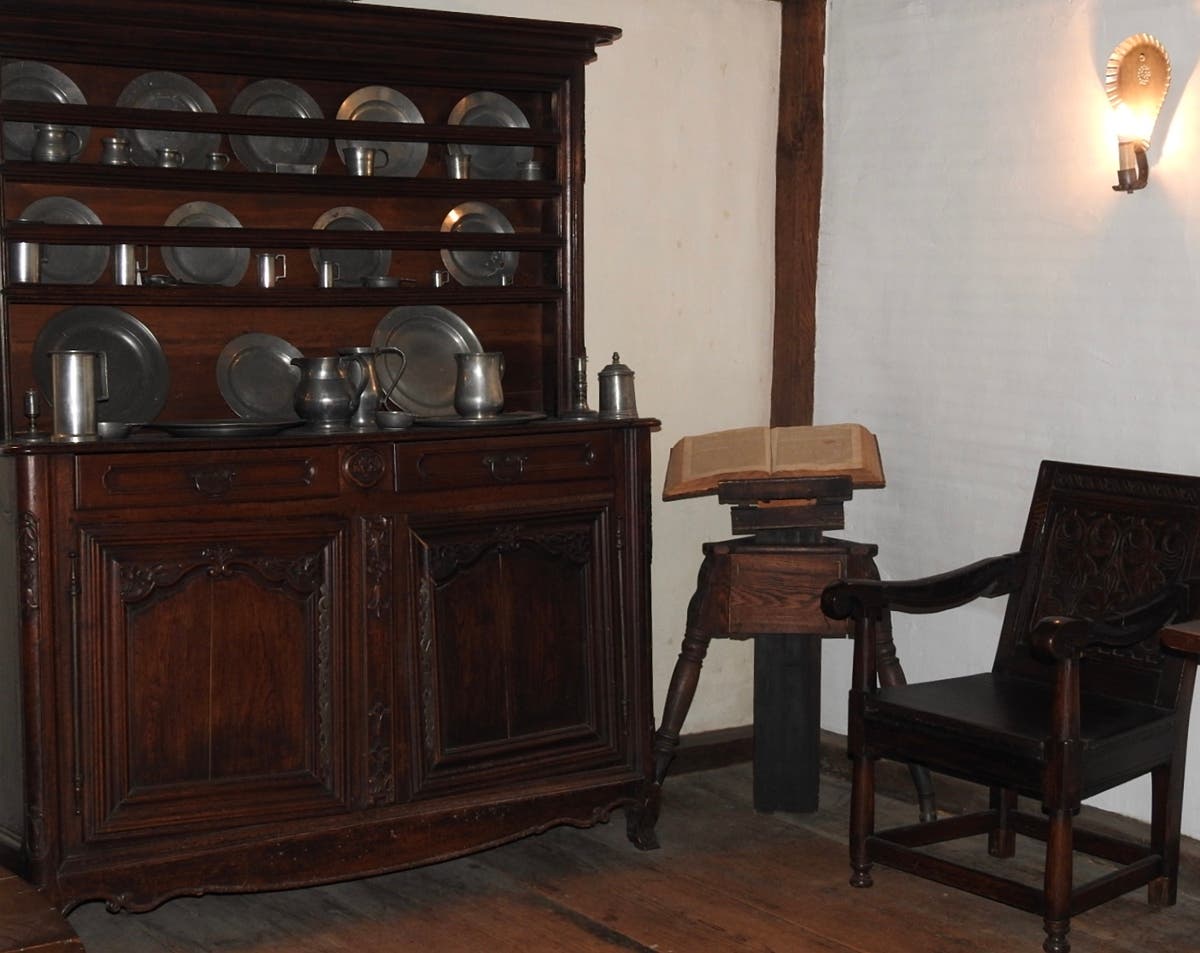
A chair believed to be from the 1700s would be where the minister would have sat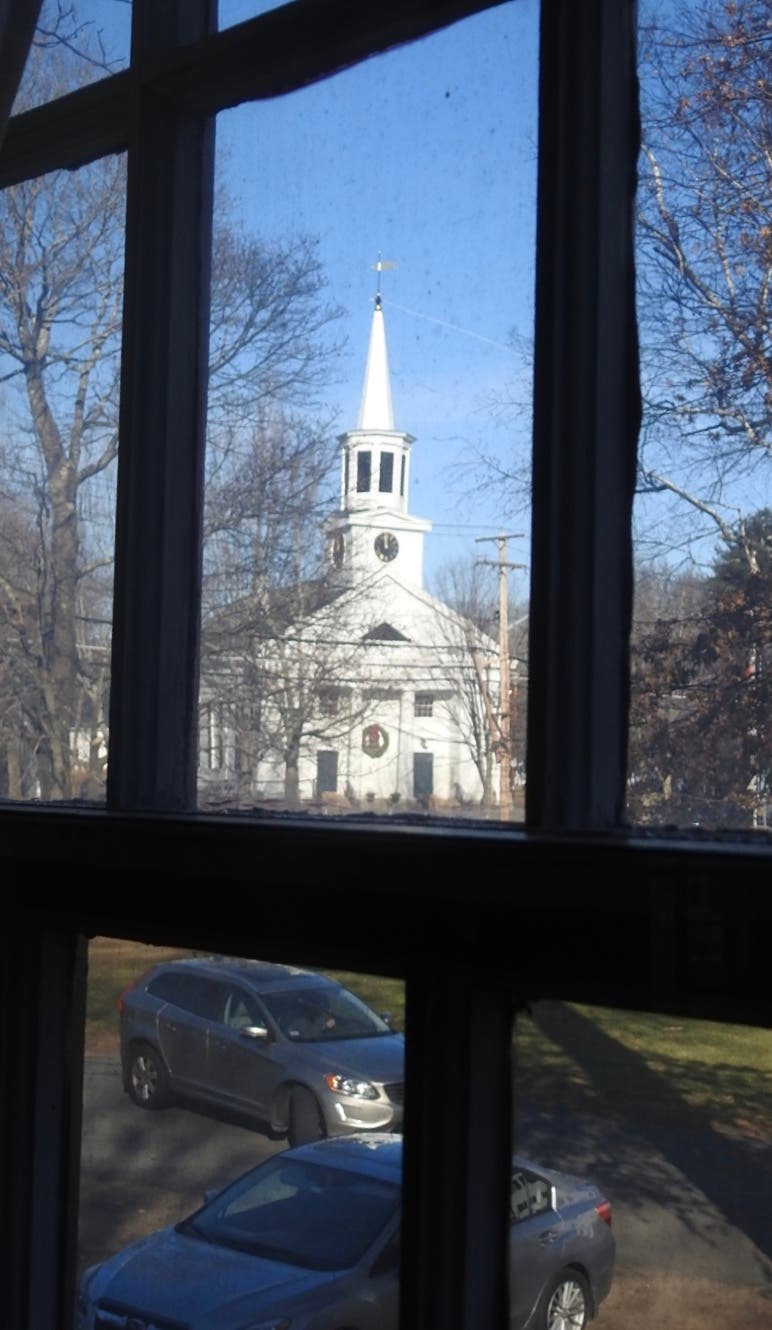
The minister's view of his church. Telephone wires and modern day cars would not have been present at that time.
Bowers added, "The parish is now known as the First Church of Wenham, but at the time Wenham was founded, in 1642, it would have simply been known as “the church” or “the meetinghouse,” as would every church in every town in the Massachusetts Bay Colony. The people we now call Puritans believed that theirs was the only true religion, and everyone in the Massachusetts Bay Colony was required to attend services at the local church or meetinghouse. Because they did not recognize any other religion as valid, there was essentially no need, from their perspective, to refer to their religion by any name.Originally the term “Puritan” was a derogatory term used by non-Puritans to describe certain Protestant groups as extremist. The people called Puritans wanted to “purify” the Church of England because it was still too similar to the Roman Catholic Church, claiming that the Church of England had not been fully reformed and needed to become more Protestant. Most people in England and the rest of Europe thought they were going too far, and were extremists. "
Each one of the residents within the structure played a significant role in the history of the home.
Gerrish is also said to have been instrumental in influencing another minister, Reverend John Hale of Beverly, to change his views on the witch trials that were happening in the area during the hysteria.
"Initially, Rev. Hale was fully convinced that witches were active in the Salem area, Bowers stated. She also noted,"it’s important to note that the hysteria affected the whole North Shore area, not just Salem; people from Andover, Saugus, Topsfield, and so on, were accused - about 150 people were arrested and jailed, 19 people were convicted and hanged, and one, Giles Corey, was pressed to death because he refused to enter a plea of any kind."
"Although Hale was an enthusiastic supporter of the trials, over time" she explained, adding,"as more and more people were accused and arrested (and some were convicted and hanged), he changed his mind. One of the things that might have finally convinced him of his error occurred near the end of the hysteria: one of Joseph Gerrish’s parishioners in Wenham, Mary Herrick, claimed that the specter of Rev. Hales’ wife, Sarah Noyes Hale, came to her, along with the ghost of one of the women who had been executed for witchcraft, Mary Easty, and “did sorely afflict her.” Mary Herrick told Gerrish of the incident and Gerrish invited Hale to Wenham to speak with Herrick"
An account of the matter was also provided by Bowers at a later date and is believed to have been written by Reverend Joseph Garish. It was written at the time the incident is alleged to have happened. Gerrish wrote "An Account Received from the mouth of Mary Herrick, aged about 17 yeares having been Afflicted the Devill or some of his instruments, about 2 month, [April]. She saith she had oft been Afflicted and that the shape of Mrs. Hayle had been represented to her, One amongst others, but she knew not what hand Afflicted her then, but on the 5th of the 9th [November 5th] She Appeared again with the Ghost of Gooddee Easty, & that then Mrs. Hayle did sorely Afflict her by pinching, pricking & Choaking her. On the 12th of the 9th [November 12th] she Came again & Gooddee Easty with her & then Mrs. Hayle did Afflict her as formerly. Sd Easty made as if she would speake but did not, but on the same night they Came again & Mrs. Hayle did sorely Afflict her, and asked her if she thought she was a Witch. The Girl answered no, You be the Devill. Then said Easty sd & speake, She Came to tell her She had been put to Death wrongfully & was Innocent of Witchcraft, she Came to Vindicate her Cause & she cried Vengeance, Vengeance, & bid her to reveal this to Mr. Hayle & Gerish, & then she would rise no more, nor should Mrs., Hayle Afflict her any more. Memorand: yt Just before sd Easty was Executed, She appeared to sd Girl, and said I am going upon the Ladder to be hanged for a Witch, but I am innocent, & before a 12 month be past you shall believe it. Sd Girl sd she speake not of this before because she believed she was Guilty, Till Mrs. Hayle appeared to her and Afflicted her, but now she believeth it is all a Delusion of the Devil.This before Mr. Hayle & Gerish, 14th of the 9th 1692 [November 14, 1692]."
Due to this experience of the accused being his own wife, the Reverend Hale was later inclined to write a book.
Hale's book was entitled, "A Modest Inquiry into the Nature of Witchcraft, which challenged the legal proceedings and religious principles of witch hunts in general. The book was published after Hale’s death, but it is clear from this work that he had changed his mind about how the devil works. In a nutshell, when the accusations first began, Hale believed that it was not possible for the devil to take the form of an innocent person. However, eventually he was convinced that the devil could take the form of any person, innocent or guilty, and one of the reasons he probably came to believe this was the fact that the form of his own wife, whom he knew to be innocent, appeared before Mary Herrick."
Bowers easily continues imparting her knowledge on each part of the house and of each person's history without any notes. It is obvious she knows and understands the history of the house and of its occupants very well. "As for Gerrish’s beliefs regarding the witch trials, his most overt act regarding his objections to the witch trials was in signing “The Return of Several Ministers,” dated June 15, 1692. This is a public statement that cautioned the colonial court against the use of spectral evidence, urging the authorities to treat the crime of witchcraft as it would other capital offenses in England, i.e. by specifically refusing to hear spectral evidence because it was not permitted in the courts in England. The document was signed by 14 local ministers."
In an unusual move by the Reverend Joseph Gerrish, he continued what Bwers terms his "progressive" practices for that time
Today, the minister is considered to have been somewhat ahead of his time. "Upon his death, he left his entire fortune to his wife, something that was not common practice at that time,". Bowers explains. "Evidence of Gerrish’s generally progressive attitude can be found in his last act towards his wife, Anna Gerrish. By law, all men were required to leave a minimum of a third of their estates to their widows, known as the “widow’s third,” so that’s what most of them did. Gerrish, however, left the entirety of his estate to his wife (with the exception of some money he left to charity and to their children), and made her the executrix, this is unusual because the executorship of wills was almost always left to the sons, brothers, or other close male relatives of the deceased. We do not have a letter or a diary that says “Rev. Gerrish was very progressive,” but the fact that he did leave his estate, and his affairs, to be managed by his wife after his death is a clear indication that he felt great respect for her. I have read dozens of colonial era wills, and this is the only one I have ever seen in which a man left virtually his entire estate to his widow. If he had not had great respect for her he would not have left her the estate and trusted her with its management."
THE FINAL ROOM OF THE CLAFLIN-GERRISH-RICHARDS HOUSE
As we entered the upstairs portion of the house, changes had been made again to reflect the styles of another time period. This time, painted walls and floors, along with wallpaper, Bowers pointed out that it was becoming more commonplace to purchase items used for decorating the home. Calling the use of machinery to make items that were once made by hand the"technology of the day, Bowers said ," it was making life a bit easier for the residents. Although furniture was still set up in some areas to serve a purpose, the then"modern" look was considered to be "just pretty," and "gave parents and children more leisure time" though he chores of yesteryear were not gone completely."
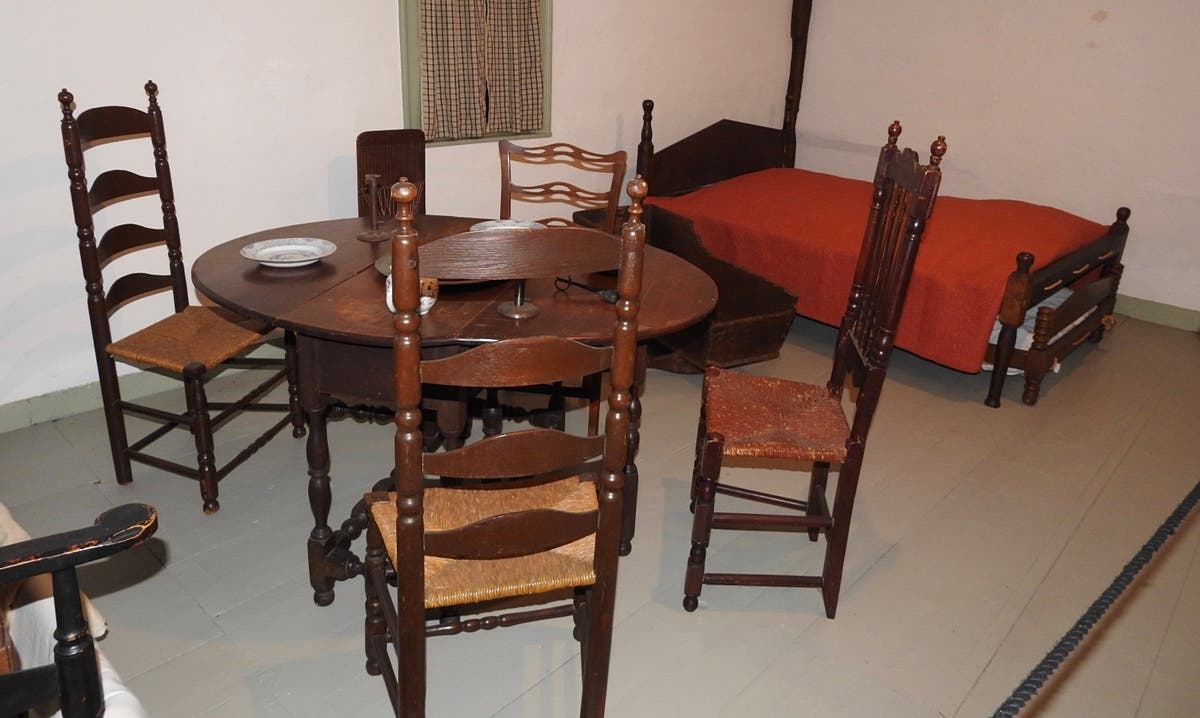
Painted floors and walls in the upstairs room of the Claflin-Gerrish-Richards house.

Times are changing, new styles introduced.
Another significant person taking up residence in theme was Elizabeth Horton. Her doll collection and her "marketing skills,"according to Bowers is one of the reasons the museum exists today. She is also the last child to have grown up in the house. "
Asked whether the child made her own dolls, Bowers stated, " Elizabeth did not make her own dolls, but she collected dolls from around the world, many of which were hand-made from objects found by people from the culture from which they came - she actually called it the International Doll Collection."
She then elaborated on the marketing skills of the girl at such a young age."Elizabeth Richards managed to connect with " Celebrities and important people who would donate to her collection." Adding to that,the girl's "strategy" Bowers related, "was to get people to see the doll displays later in her life in order to raise money for children’s charities.
She was in her late 50s, Bowers said. "She was born in 1837 and she did her first public display around 1895. She had a personal interest in dolls throughout her life and into her adulthood. She started collecting dolls from famous and important people when she realized that the doll displays were really taking off as a way to raise money. She donated the collection to the Denham Museum in 1922 when she found out her childhood home was being turned into a museum, but she did not live there after the age of 19 when she left to become a teacher in Ohio
If it had not been for her donation of the doll collection, it has been said, "others would not have been inspired to donate the other toys, dolls, and artifacts of childhood which make it the museum of family history it is today. Elizabeth Richards Hortson raised over $100,000 for children’s charities in the time she was showing the doll collection herself, from about 1895 to 1914 - adjusted for inflation that’s almost $3 million."
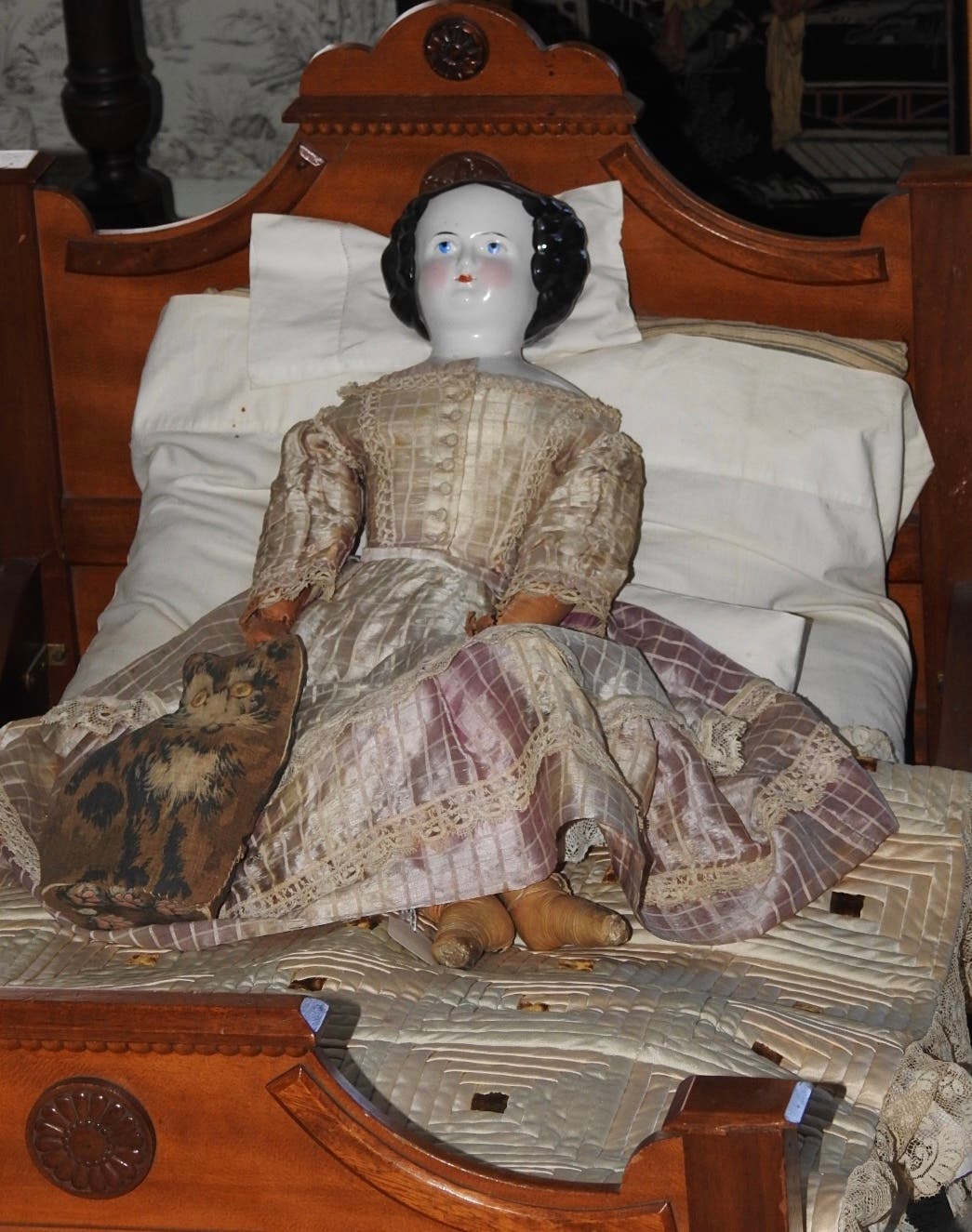
One of the dolls from the collection.
"She had dolls made from all sorts of materials from all over the world, including dolls made from coconuts from Brazil, dolls made from dried fish from Australia, dolls made from seashells from South Africa, etc., as well as dolls from US and European countries made from wood, porcelain, paper, cloth, etc. In all, she donated about 750 dolls to the museum in 1922. It’s believed that at one time she may have had as many as 2000 dolls in the her collection, but at the time of the donation there were about 750. "
***The article above pertains only to the historic home portion of the museum. However, the Wenham Museum is truly a family museum in which small children and adults can enjoy. It is a hands on museum in which children are allowed to look and touch, Much of the museum is hands on,although there are some items that have a no touching sign in front of them, such as delicate clothing articles from early on. There are operating train collections, an area which showcases art and Burnham Hall for programs the museum presents. the latest of which was a live owl presentation given by "Wingmaster.". As to the Claflin-Gerrish-Richards house, guests at this time, must ask for a guided tour at this writing but within the New Year, there are plans to make the house an open part of the museum and to make it hands on for the children and adults.
Wenham Museum is itself a non-profit institution dedicated to protecting, preserving and interpreting the artifacts of childhood, domestic life, and the history and culture of Massachusetts’ North Shore.***
Museum events/programs page: http://www.wenhammuseum.org/programs/