Neighbor News
Highly specialized peripheral artery disease procedure saves man’s leg
When Don Boutin began losing feeling in his lower leg, he needed an advanced procedure performed to fight his PAD and save his leg.

Don Boutin has never liked going to doctors’ appointments. The 52-year old Pelham, NH auto parts salesman has made it a point over the years to not visit a physician unless absolutely necessary.
“It’s nothing personal,” he laughs. “They do great work. I’ve always felt that if I had an issue, my body could take care of it on its own.”
Unfortunately, a trip to a physician did become necessary for him recently when the pain and intermittent numbness in his left leg and foot became increasingly worse over “the better part of year.”
Find out what's happening in Melrosefor free with the latest updates from Patch.
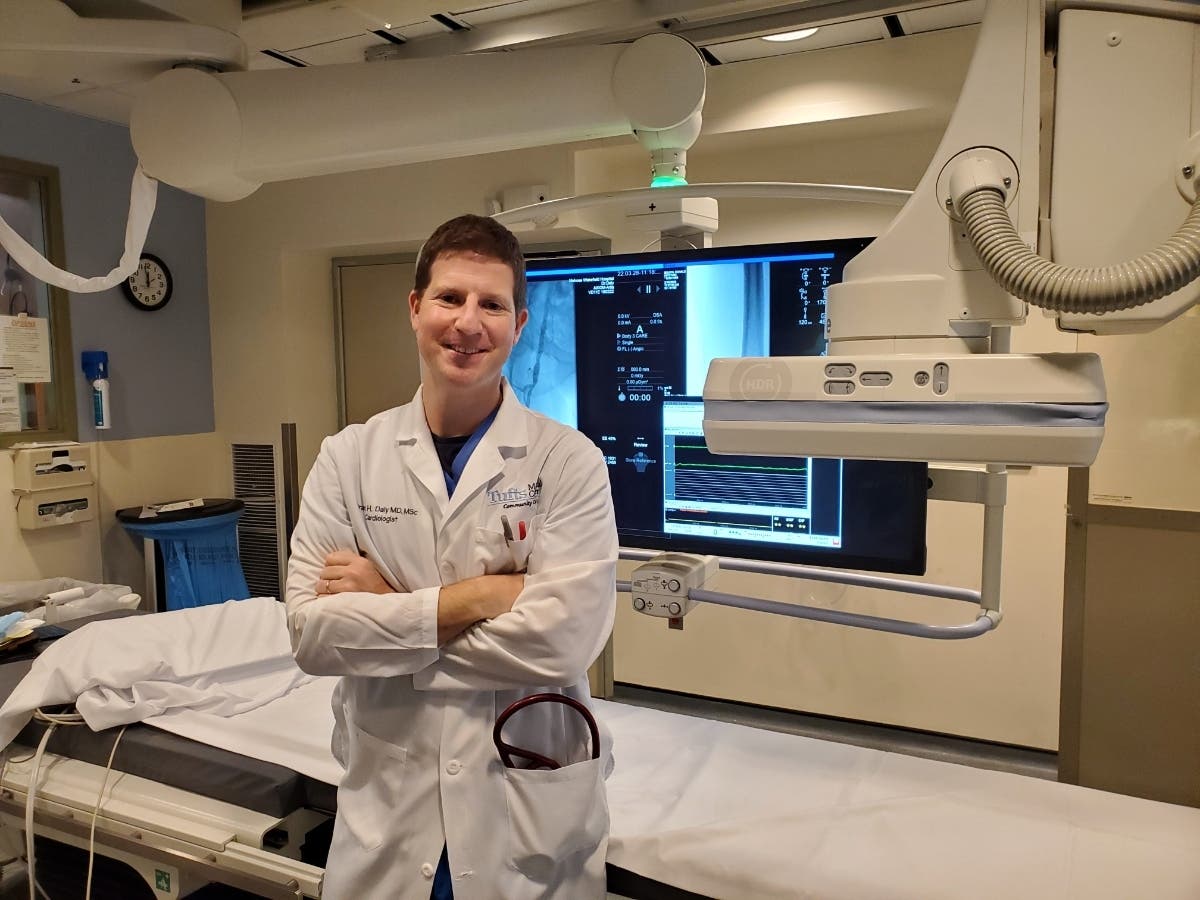
Mr. Boutin, who has a family history of heart disease, realized that what he was experiencing wasn’t going to get better on its own. He chose a primary care doctor in Peabody, MA, who quickly diagnosed the leg issues as peripheral artery disease, or PAD, and made a referral to MelroseWakefield Hospital cardiologist Dr. Gerard Daly.
PAD develops when the blood vessels (arteries) that bring blood to the internal organs, arms, and legs become completely or partially blocked as a result of plaque within the artery walls, known as atherosclerosis. Having untreated PAD, even without symptoms, increases a patient’s risk of cardiovascular death by approximately six times.
Find out what's happening in Melrosefor free with the latest updates from Patch.
Signs of PAD may include pain, weakness, tingling or cramping in your legs while walking or climbing stairs, cool or shiny skin with loss of hair on the legs, or unhealing sores or wounds on the feet, however 40% of those affected do not experience any symptoms at all.
Mr. Boutin, who is typically on his feet for 10 hours-a-day, knew that he was experiencing something beyond typical aches and pains. Over the course of a year, his left lower leg and foot had been growing numb and cold. One day, the numbness did not go away. “I knew at that time that I was having an issue that wasn’t going to fix itself,’ he said.
Upon evaluation, Dr. Daly took immediate steps to help Mr. Boutin. “It was clear that he had severe disease and imaging quickly confirmed my fears: a complete artery blockage from his mid-thigh down to his knee in his left leg,” said Dr. Daly. “Mr. Boutin’s advanced PAD was categorized as critical limb ischemia and if we didn’t do something right away, he was in danger of losing his leg, or even worse.”
After meeting with Dr. Daly, a time was scheduled for Mr. Boutin to come to the MelroseWakefield Cardiovascular Center
at MelroseWakefield Hospital for a procedure to break through the blocked artery and reestablish blood flow to the lower leg.
In 90 to 95 percent of these procedures, a catheter is thread through the femoral artery in the groin of the leg opposite of where the blockage occurs. The catheter travels through the aorta and down to the blockage. This approach was unsuccessful in Mr. Boutin’s case because the blockage was so severe. Dr. Daly, who has particular experience in peripheral vascular disease, instead performed a highly specialized procedure to gain access to the artery through his ankle.
“Don’s blockage was so severe we needed to think outside the box to fix it. Ultimately a non-traditional approach, accessing the artery through his left ankle, was required” said Dr. Daly.
“Attempting to access the artery through the ankle is a rare occurrence,” said Dr. Daly, who is trained in the procedure. “It is used in only about five percent of cases, primarily because it is only practiced in a small number of specialized training programs. We were successful and thankfully this story ends up with a happy ending. He has regained normal feeling and blood flow to his leg, foot and toes.”
“It was amazing,” said Mr. Boutin. “As soon as they broke through the blockage, I started to feel warmth in my foot immediately.”
The four-hour procedure was the first of its kind performed in the MelroseWakefield Hospital cardiac catheterization lab, bringing a new level of patient care to the award-winning lab. MelroseWakefield Hospital is one of the few community hospitals in the region to operate a catheterization lab.
“PAD is sadly both underdiagnosed and very common,” said Dr. Daly. “He could very well have continued on without diagnosis and found himself in a much worse condition. His next steps may have been his last with boots on, as he would have likely required foot amputation and/or bypass surgery.”
Mr. Boutin and his family are thankful. “I’m a pretty damn lucky guy. I most likely would have lost my leg if I hadn’t found Dr. Daly when I did. I now have the absolute best people looking after me, and I’ve changed my thinking about visiting doctors! If you are having a medical issue, the worst thing you can do is nothing. Keep up with your health and visit your doctors…not only for yourself, but for your kids.”
For more information or to find a doctor, visit www.melrosewakefield.org