A Little About Dawlish
…It seemed rather surprising to him that anybody could live in Devonshire without living in Dawlish. ~ Jane Austen, Sense and Sensibility, Chapter 36, published in 1811.
…Mr. Godfrey Nickleby purchased a small farm, near Dawlish in Devonshire, whither he retired with his wife and two children…~ Charles Dickens, Nicholas Nickleby, Chapter 1, publ. 1839
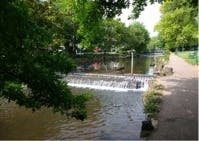
Dawlish Brook, with the black swans soaking up the afternoon sun.
Long before novelists visited Dawlish and later recalled it in their novels, and before Romantic poet John Keats made the town popular in 1818 with his poem Dawlish Fair, the sleepy little fishing village on the south Devon coast had become a destination. After a visit to Sidmouth by King George III in 1781, towns along the coast became popular ‘watering places’ for people of means to ‘take the sea air’ and was especially recommended for invalids. Dawlish still retains some of the regency buildings from that time of growth. In 1846 Isambard Kingdom Brunel’s famed South Devon railway line opened, hugging the coast with bridges and tunnels making access to coastal towns more convenient. Dawlish evolved into the popular seaside resort it is known as today.
One feature that has defined Dawlish is Dawlish Water, known locally as “the Brook,” that flows briskly through the middle of town over a series of weirs on its way to the sea. Along the banks is the public park known as The Lawn. It is here, on this section of the Brook, that our famous Black Swans reside.
Find out what's happening in Melrosefor free with the latest updates from Patch.
About the Black Swans
In the United Kingdom, all swans are protected by the Crown. A select number of mute (white) swans who live on the Thames river and in some Crown properties belong exclusively to Her Majesty Queen Elizabeth II. Her Majesty keeps the swans for ornamental purposes in ponds and rivers, and to give as gifts. Every year an event known as “swan upping” is conducted to count and record the existing swans in the Queen’s keeping. Any offense against any swan in the United Kingdom – theft, injury or killing of a swan is a crime punishable by law.
Find out what's happening in Melrosefor free with the latest updates from Patch.
The black swans of Dawlish were first introduced to the town in 1906 by former native John Nash who had emigrated to New Zealand. There he discovered the black swan, a native of Australia and the south seas, and brought a mating pair of black swans back to his home town. Black swans have been a main attraction in Dawlish ever since. The current residents live in the brook, alongside a small urban sanctuary and hatchery for the waterfowl that inhabit the park. The sanctuary and swans are owned and maintained by the Dawlish Town Council and supported by public and private donations.
During my visit to Dawlish in June of 2018, I met with wildfowl warden Don Phillips, one of the caretakers of the waterfowl. Don and his colleagues offer waterfowl talks and walks alongside the brook where the public can learn about the work of the sanctuary, study incubating eggs in the enclosure and hold a fluffy chick. Don was kind enough to spend some time with me answering my questions, showing me the enclosure, and talking about the work of the wardens in protecting and caring for the brook’s wildlife. Don is clearly dedicated to the care of the swans and waterfowl and to educating the public in protecting them.
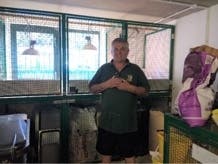
Don Phillips holding a recently hatched goose chick.
Don says there are currently nine swans on the brook. There is one nesting pair, one single male with a male offspring and five cygnets. This year, one almost-adult cygnet helps take care of the younger siblings from two clutches. ‘Mum and dad’ will typically push their cygnets away to fend for themselves whenever they return to mating. Don reports that there are now up to three clutches a year as the climate seems to be warmer for longer periods and the swans are more active throughout the year. Don tells me he keeps the swan population at no more than nine as this is manageable, especially with other wildfowl to care for. A local wildfowl enthusiast with a farm nearby takes all the extra offspring and finds homes for them.
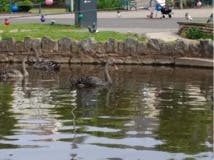
A few of the young ’uns.
The single males are a father-and-son team that like to ‘hang out’ together further up the brook. The father, now 4 years old, has had two mates and lost both. Don said the swan was devastated by the losses of his mates but recovered and now finds comfort in being with his son. Swans will typically mate for life. It is expected and hoped that when the cygnets from downstream mature, the father will select one of them. Father and son are not related to the downstream birds.
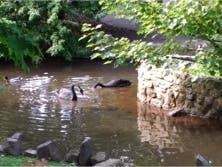
Father and son getting to business looking for food upstream.
The swans are not given names. Adult males and females are identified by colour-coded rings on their ankles. Last year, only two new offspring survived. The sharing of public spaces by swans and people can be both rewarding and troubling. It is a joy to watch them and follow their progress. But familiarity has led to the swans, especially the young who have not yet learned survival skills, becoming too comfortable around people and their pets. Only two cygnets survived last year’s hatchings. A cygnet may have no fear of an approaching fox which resembles a dog. The fox will attack the young and vulnerable first. This year two cygnet deaths have been attributed to local people letting their pet run free, resulting in the dogs attacking the young swans. Another cause of death is from helpful-minded people who misguidedly think it is good to feed the swans. Don warns that when the swan swallows food such as bread and then drinks water, the bread can expand in its throat resulting in choking. Bread crumbs and other foods can also attract dogs and eventually foxes to the swans’ proximity. The Dawlish swans are typically fed a diet of corn and lettuce. Their favourite food, Don reports, is grass! However, although there is an abundance of grass in the area, access is restricted by the presence of people and their pets and the grass is kept short. Don says the birds are safer in the water foraging and dining on corn.
A nest sits on an island in the middle of the brook. It was originally built by the upstream ‘father’ swan for his first mate. It is no longer used for nesting, but the swans and other waterfowl regularly share it to sit in the sun and preen. This nest was made in about three hours due to the swan’s easy access to branches, sticks, and useful materials!
Another man-made nest can be seen under the bridge that crosses the brook. This is the one where the mating couple lay their eggs.
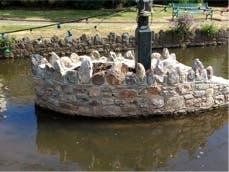
The mating swans’ nest can be seen to the left of the pole.
Swanning Around
During my visit, I frequently walked along the Brook and spent time observing the habits of the swans and other wildfowl. The habitat is clearly a popular destination for tourists and especially families. The swans did not seem at all bothered by folk walking alongside the path and stopping to watch them forage in the water or preen themselves in the shallow areas. It is good for us all to take time out to observe and appreciate a simpler, slower pace of living amongst the usual frenetic pace of our lives! The Black Swans of Dawlish and Mel and Rose in Melrose have a lot to teach us about life!
The author on the pathway next to the Brook.
For more information on the black swans, go onto the internet and search for “black swans of Dawlish” for photos, videos and articles about the swans. On both sides of the Atlantic, there are opportunities to support the swan communities through donations, volunteerism, and especially through educating people about the care and protection of swans, in order that we may continue to enjoy their presence among us for many more years.
Update: Don reports on 21st July that the mating pair are sitting on 5 eggs on the nest you see in the picture above. They are due to hatch around August 20th. We look forward to seeing more fluffy chicks on the Brook soon!
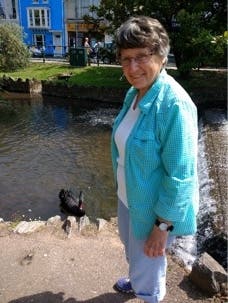
The author, Sylvia Willis, on the pathway next to the brook.
About the author: Sylvia Willis is a retired educator and former resident of the Massachusetts North Shore who enjoyed visiting Melrose to watch the swan family as they nested and welcomed their new clutch of chicks each spring. She now resides in the Pacific Northwest but still enjoys following the escapades of Mel and Rose, and now the families in Dawlish! The Tundra swans of the northwest are also fascinating to watch in the winter, when they fill our fields and valleys to nest and raise their young ready for the spring flights to the north.