It starts out as a tiny, off-white or yellow spot on the underside of a milkweed leaf. A caterpillar forms a chrysalis and later emerges as beautiful butterfly. Its most common coloring is orange and black, yet there are other varieties including blue, white and yellow. Most often it is the black and orange coloring that attracts the eyes of onlookers as it flutters through beautiful gardens.
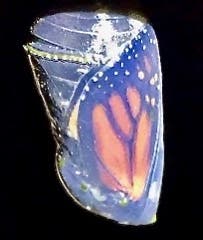
Monarch butterfly viewed inside its chrysalis (photo by Jeanne Oliphant)
This is the story of the Monarch butterfly. The Monarch is unique as to being known as the only butterfly that migrates in two directions as do birds. The two way annual migration of North America’s Monarch butterflies begins in the month of August and Monarchs return to the continents from which they originated. The wings of the Monarch are strong and carry them on the journey where millions of that same species meet at one location and hibernate throughout the winter. Their trip takes place each fall. North American Monarchs depart from their summer breeding grounds to various wintering grounds. It is also said that “East of the Rocky Mountains the Monarch butterfly’s trip to central Mexico is believed to be about three-thousand (3,000) miles. Monarch butterflies arriving at the same location from the west have a shorter journey.” Not only is the life span of the Monarch and its travels significant but its five (5) “instars” as well, according to Jeanne Oliphant , a current Massachusetts resident, who raised Monarchs for 91/2 years. Her interest in the Monarch butterfly began during the time she was a volunteer at Gumbo Limbo Nature Center in West Boca Raton, Florida. She recently shared a wealth of information in a recent interview, from her experiences and her home experiments as she learned how to care for these butterflies. While away from the Center, she carefully observed and photographed each stage of their lives in their habitats which were located on her property. She stated “I created 6 gardens.”
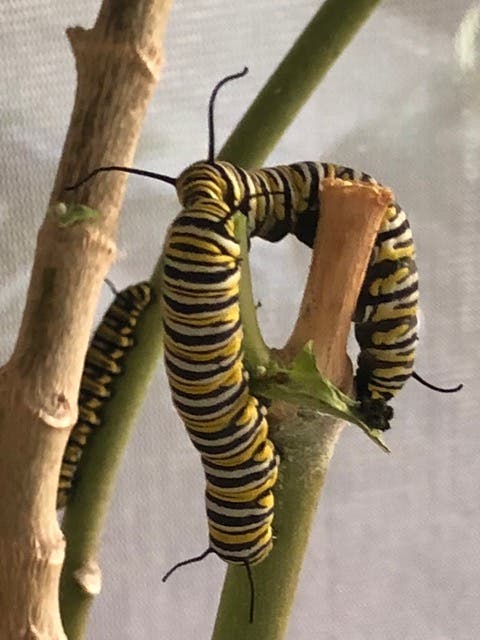
Two adult Monarchs, each one preparing to spin its chrysalis. (photo by Jeanne Oliphant)
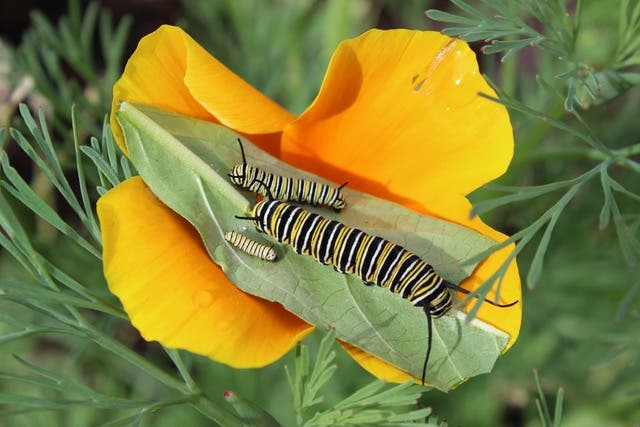
Oliphant added that she kept herself informed about Monarchs during her time as a volunteer and was concerned about, “the decline of the Monarch due to pesticides and climate change." In one of her many photos, Oliphant noted that three caterpillars on the same milkweed leaf were in various stages of molting.
The length of each body describes each of the 5 "instars" of Monarch butterflies. (photo by Jeanne Oliphant)
The 5th instar taking place during the pupal stage when the transformation from larva to adult is completed. To her amazement, she discovered that there are occasions when caterpillars take part in territorial battles over gaining the special spot on a milkweed leaf. Another interesting observation is that there are times when a Queen butterfly will spin a pink chrysalis rather than the usually jade green color with gold spots. of a Monarch.
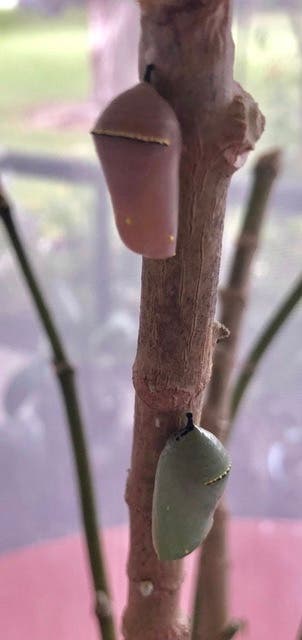
Color variations of a Queen butterfly chrysalis.
Queen butterflies have displayed a chrysalis in shades of green, white and pink.It is not certain as to why there is a difference the chrysalis color. However, Olipahnt noted, referring to the photograph above, " the pink one is a Queen. The green one could be a Queen or a Monarch. "
Monarchs also are recognized by various cultures and are noted within these cultures as having special symbolism and spirituality. The arrival of the Monarchs in New Mexico is said to be the return of the souls of ancestors and coincides with the "Day of the Dead" - a celebration of those who have passed away. Spiritually, Monarch butterflies, to indigenous people on both sides of the border are considered “sacred.” In America, Native American tribes have several variations as to each group’s interpretation of the symbolism and/or spirituality of the Monarch butterfly. Many, however, use the terms "change and transformation, comfort, hope and positivity.” Others may refer to the symbolism and the spirituality with the words, “ strength, endurance and trust.” In Ireland, it is said that the sighting of a yellow Monarch means “Success will soon come your way.”
The views expressed in this post are the author's own. Want to post on Patch?