Neighbor News
The Nuts and Bolts of Modern Day Schools:
An Ounce of Prevention is Worth a Pound of Cure
There is another story to tell as we head towards an override decision on April 2; it is the backstory of why we are struggling to fund our schools - not just in Melrose, but in every district in Massachusetts, and beyond. Today’s public schools look much different than the schools of forty years ago, and even different from the schools of ten years ago. The public school landscape has shifted so dramatically that it is impossible for most of us to make a truly informed decision without some education about education. Whether you agree or disagree with these shifts, we are obligated to follow them under law. It is also why we need to continue talking about funding for schools even if the override passes, and it is my hope that Melrose can be a leader in that conversation. If the override does not pass, the impact of the cuts may inadvertently be that instead of cutting costs, we actually increase our costs.
21st Century School Mandates and Funding
Federal and state mandates on public schools have grown exponentially in the last 45 years. These mandates are largely unfunded, meaning there is no state or federal aid attached to them. There is increased accountability for schools being enforced at the federal and state level, but the funding responsibility to support these mandates is delegated to the city level. Since public schools are largely funded by local taxes, more often than not, these mandates translate to property tax increases. There are some mechanisms for state and federal reimbursement, but our city often doesn’t benefit, and more recently, much of the state/federal funding we have been granted has been cut. The upshot of these mandates is that public schools are now tasked with educating the “whole child”. This means that schools must attend to the social/emotional, physical and academic well-being of each student. Educating the “whole child” is an enormous task, one that as an educator and a parent, I passionately believe in. Under these mandates, it has become our generation’s responsibility to provide our school children with the resources and services to help them develop into productive and well-adjusted citizens.
Find out what's happening in Melrosefor free with the latest updates from Patch.
School Mental Health Responsibility
As we have increased the breadth and depth of what we ask our public schools to do to support our children, funding has not matched the need. Schools are often referred to as “the fiscal last man standing”. There is no other state agency that a caregiver can turn to that is mandated to service the whole child. If you take mental health as an example, the numbers of students requiring mental health support to access the curriculum is rising exponentially. “An estimated 32 percent of adolescents have an anxiety disorder, according to the National Institute of Mental Health. Twelve percent of youth between the ages of 12 and 17 say they have experienced one major depressive episode in the past year, according to the U.S. Department of Health & Human Services. The suicide rate among teenagers has been steadily on the rise since 2007. It's gone up 30 percent among 15- to 19-year-old boys and doubled among girls, according to data from the federal Centers for Disease Control and Prevention. It's the second leading cause of death in that age group.” (Education Week, October 19, 2018). School districts continue to be on the front line of need, without the resources to support the need. No other state agency has the same obligation. The Department of Mental Health can review an application for a student, but does not have to step in to provide services. A psychiatric hospital may assess a student for safety, but if that student is not at imminent risk to themselves or others, they do not have to admit them. Schools are required under federal law to ensure each student has access to a free and appropriate public education (FAPE) in the least restrictive setting possible. Therefore, districts are mandated to address any mental health needs that impact a student’s ability to access school.
Find out what's happening in Melrosefor free with the latest updates from Patch.
MTSS and Melrose Public Schools
There is a silver lining to this slow burning fiscal crisis; educators have been forced to be innovative and creative with the funding they have, and by many accounts Melrose Public Schools have been leaders in that effort. Our administrators have leveraged Massachusetts MTSS (Multi-tiered System of Support), which is a tool developed by the Department of Elementary and Secondary Education (DESE) to ensure that students receive equal access to public education under the weight of the growing mandates. MTSS is an instructional framework for best practice that includes:
- Universal Screening of ALL Students
- Multiple Tiers of Instruction and Support Services
- Data Driven Assessment System to Inform Decisions about Targeted Interventions
- Applicable to all areas of instruction: Literacy, Math and Social Emotional Learning (SEL)
Students move fluidly from the largest tier, Tier One (commonly general education) to Tier Two (more supportive intervention) to Tier Three (even more support, possibly small group setting or 1:1 services) and even students requiring Special Education can be supported in all three tiers.
You can see MTSS at work in schools in things like: reading & math assessments in elementary schools to catch struggling learners and for early identification of learning disabilities, collaborative problem solving, restorative practice, bullying prevention programs, peer mentoring programs, counselors who support all students, middle school “team leaders” who actively reach out to families and assess for progress, blended learning opportunities, universal design for learning and professional development to help ensure implementation
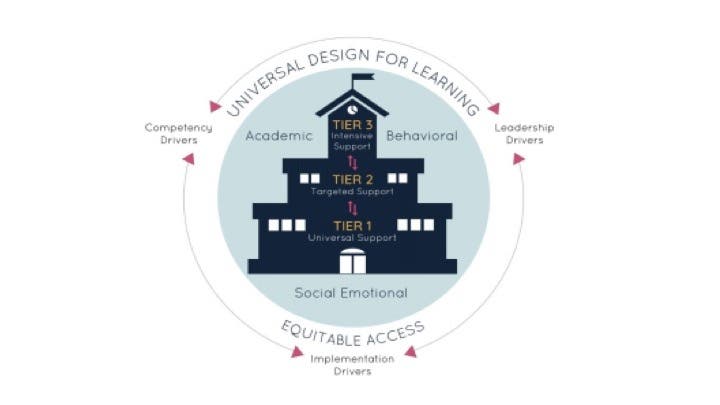
MTSS is a mechanism to infuse support and enhancement at all grade levels, which is crucial to meet the needs of all learners. Educators are also asked to maintain the safety of the students in their care - both emotionally and physically. Some of the mandates you may see in action:
- Statewide bullying laws that are important and valuable for the safety of our students
- Safety drills and protocols in place to ensure students are safe in the event of a true crisis (intruder, fire, etc.)
- Laws supporting English Language Learners and the requirement that all teachers in Massachusetts attend supplemental 40 hour programs (SEI) to ensure they can teach these students in a general education setting
- McKinney-Vento legislation that gives students designated as homeless the right to education in their community
- Case law that requires school districts to provide adequate transitional services for students in Special Education with certain disabilities to ensure they are fully prepared to be independent after graduation.
Real Time Cuts to MTSS
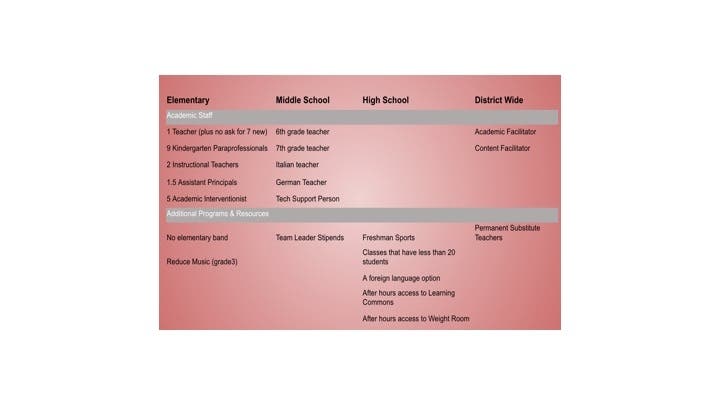
Melrose Public Schools currently use MTSS. Below is table that highlights the list of possible cuts at the end of this year.
All of these proposed cuts will affect the current MTSS programming in Melrose Public Schools. These are cuts to the general education programming. What these cuts will look like in real time is a valuable and important conversation.
For students who are accessing MTSS in Melrose Public for advancement/enrichment of curriculum, these cuts indicate that their services will be diminished.
- These students may begin to look bored and struggle to engage in a school that is no longer challenging for them.
- Blended learning and independent curriculum (which are innovative ways to accelerate curriculum) for students will be reduced
- District Wide Academic Facilitator will be lost (this is the person who oversees this)
- Reduced music (3rdgrade)
- 6th grade foreign language option is cut
- Specialized programming at the high school (classes of less than 20 students) is cut
- No space for middle school students in High School classes
- Eliminated Technical Support person for Middle School
- Enrichment to their extracurricular activities may be largely curtailed or lost
- Elementary band is cut
- No after-hours access to High School Learning Commons (Modern Day Library)
- They may begin to act out or withdraw
- These students may be misunderstood or not identified at all
- They may begin to act out or withdraw
For students in general education, who are largely doing well:
- Unable to flag struggling students early
- Increased Class Sizes
- Lost ability to track and collect data on students so that remediation and intervention can be provided in a timely manner
- Eliminated/Reduced Student Support Teams
- Increased requests for Special Education testing due to seemingly new issues
- No Middle School Team Leaders to meet with families and students - contact is now limited and teachers lack the understanding of what is happening in the home
- Fewer students that can be served at ECC, limiting the ability to catch students early
- Middle school teachers are now dealing with the bank of learners whose reading/literacy needs weren’t caught in elementary school.
- Academic needs may start to look behavioral
- Eliminating 5 academic interventionists - means students who can’t access the literacy/math curriculums may struggle to remain in class and may disrupt others
- Students with unidentified learning challenges may struggle to sit in academic classes
- Behavioral disruptions may become more frequent
- No assistant principals to support with the social/emotional/behavioral needs
- Students with already identified special needs may become more needy with less general education supports for inclusion
- Classes may be cleared more often, with more students requiring behavioral intervention, resulting in increased time off of learning for all students
- Reduced Professional Development
- New teachers are not receiving the daily support they need for their instruction and behavior management
- Diminished Social Connections
- No Freshman Sports
- Students who need more social support and require that structure may look like they are struggling more and this could result in increased discipline
- Increased needs for counseling services
Students already in Special Education, start to need even more specialized instruction.
- Students on IEPs may struggle to make effective progress
- Students may start to need more restrictive settings
- Larger class sizes impact students with sensory needs
- Decrease in inclusion ability as needs grow
- As needs increase, need for small group learning also grows
- Increased need for out of district placements
- The cost of an out of district placement can run anywhere from $35,000- $100,000 per year (and this is without transportation costs - add at least $20,000 per year for this).
What happens if the April 2nd override does not pass?
Without fully funding and supporting MTSS, costs may begin to spiral out of control and students are no longer adequately serviced. This is not to say that the district does not have work to do in the model as it currently stands, there may be gaps and students may be struggling within the current model. However, the federal and state mandates placed on schools do not go away when a budget gets cut and if there are places we are struggling in now, those places will grow in size and magnitude. Districts are mandated to educate the whole child, regardless of budget cuts. The MTSS pyramid may flip such that we live in the Tier 3 level of MTSS, with many more students looking like they will fall under the federally mandated umbrella of special education. When this happens, money will be restricted for special education, which will pull even more from the MTSS and general education. This becomes a vicious cycle where less and less money becomes apportioned for students in general education.
Written by:
Sheilah M. Gauch, M.Ed., LICSW
Chair of Melrose Special Education Parent Advisory Council (SEPAC)
Parent of two children in Melrose Public Schools