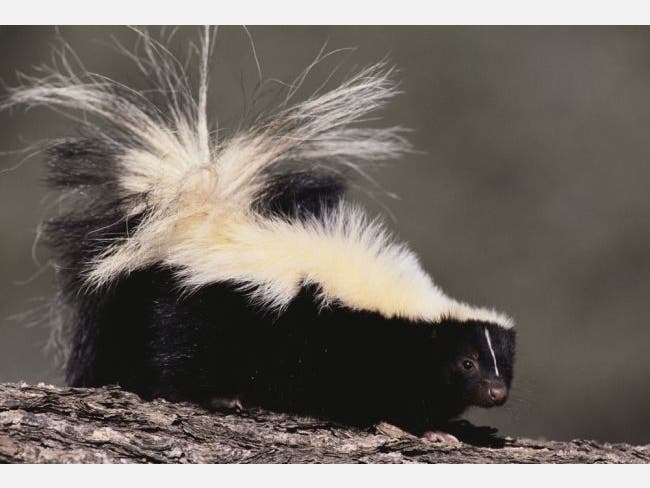
Skunks are small, furry animals with black and white stripes. Some skunks are striped, and some are spotted or have swirl patterns on their fur. No matter the pattern, the black-and-white coloring is a warning sign to anyone who may harm this small creature. They pack a wallop of a defense mechanism — noxious odors produced from their well-developed scent glands.
Skunks are typically around the size of house cats. They grow to 8 to 19 inches (20 to 48 centimeters) long and weigh around 7 ounces to 14 lbs. (198 grams to 6 kilograms). Their tail adds another 5 to 15 inches (13 to 38 cm) to their length.
The skunk’s most memorable trait is its smell. When frightened, skunks will shoot a smelly, oily substance from a gland underneath their tails with a range of up to 10 feet (3 meters), according to National Geographic. The scent from this gland can last for days, but isn’t harmful. Most animals leave skunks alone unless they can’t find other prey. Before spraying, a spotted skunk will do a handstand on its front paws and aim its tail without taking its eyes off its attacker.
Find out what's happening in Melrosefor free with the latest updates from Patch.
Skunks are nocturnal and forage for food while most animals and humans sleep. Though you typically see skunks by themselves, they gather to mate. A group of skunks are called a surfeit.
Female skunks give birth every year. Their gestation period often lasts around two months and they give birth to two to 10 offspring at a time.
Find out what's happening in Melrosefor free with the latest updates from Patch.
Baby skunks are called kits. Kits are blind when born, since their eyes are sealed shut until around the age of 3 weeks, according to the San Diego Zoo. They are weaned at 2 months old. After they are weaned, they leave the den and at to 10 to 12 months old they are ready to have their own kits.
Skunks have very short lives and often live only around three years. In captivity they can live a little longer, usually seven to eight years.
Source: Livescience.com