Neighbor News
Wildlife Etiquette
...by air, by land and by sea ...article by Debbi Collar photos by Debbi Collar and Jamie Hayes
 Ducklings following their mom in a local pond (photo by Debbi Collar)
Springtime brings out a flurry of cute, fluffy newborns on land, in the sea and other waterways. as well as in the air. The animal, aquatic and aviary worlds bring out the best in our hearts as we humans consider the challenges in knowing what to do when encountering injured birds, turtles, deer, reptiles.
Whether aquatic, aviary or land animals, we humans tend to inadvertently, at times, interfere.
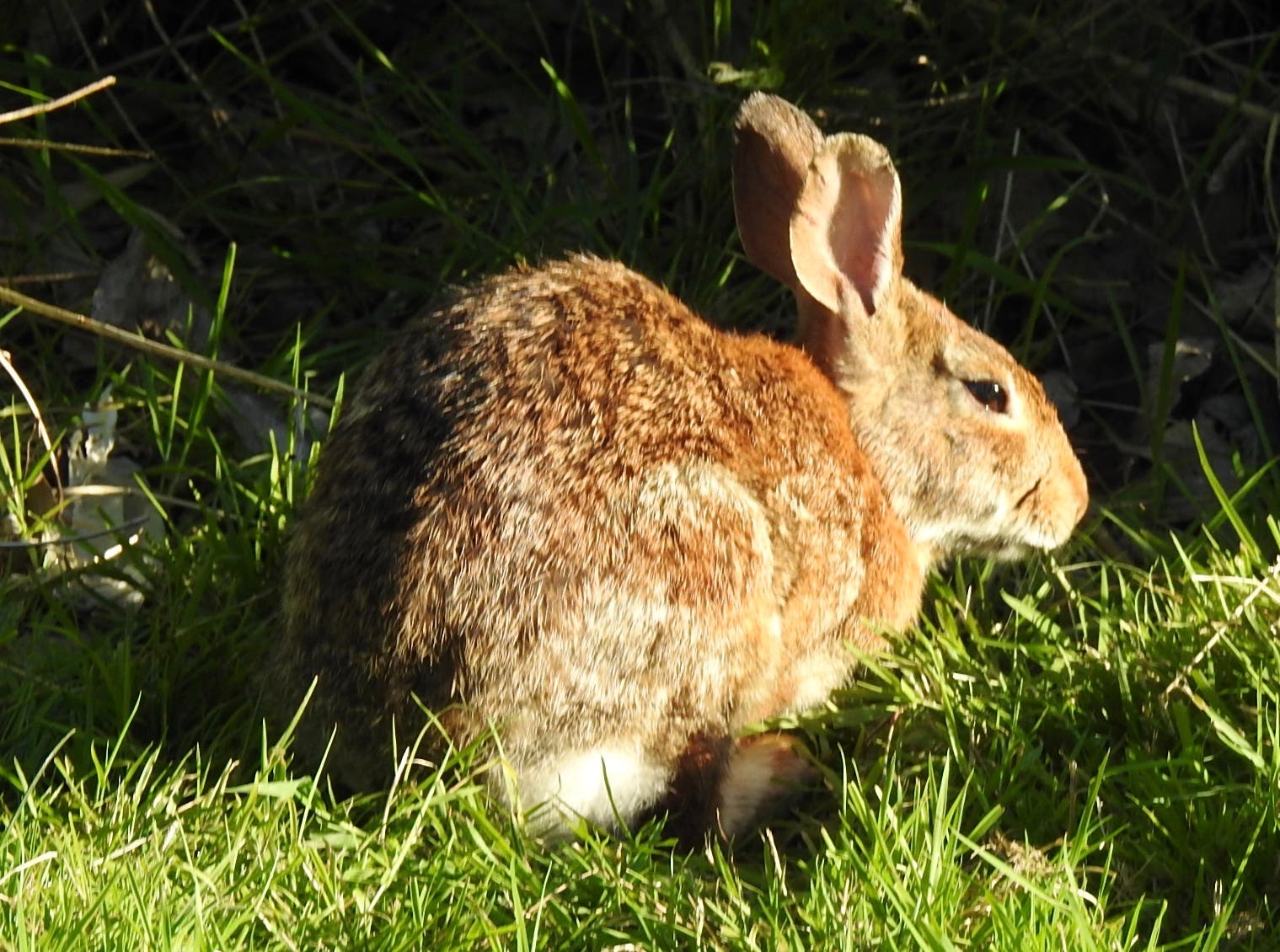
Rabbit enjoying its breakfast (photo by Debbi Collar)
Find out what's happening in Melrosefor free with the latest updates from Patch.
Our willingness to help sometimes hinders the growth process of various wildlife trying to teach their young.
A check with several wildlife agencies brought on agreement by experts that is best not to interfere with nature.
Find out what's happening in Melrosefor free with the latest updates from Patch.
Usually.
Marj Rines, a naturalist at the Mass Audubon Society Headquarters in Lincoln, Massachusetts stated that at this time of year, (Springtime) centers for animals "are full up," and nine (9) times out of ten(10), there is nothing wrong with the animals or waterfowl."
Still, should we see injured animals, our own natural instincts point us toward helping them ourselves and/or finding them assistance through other resources..
However it's best to be observant of the situation, as well as educate yourself on the stages of life as to whichever animal you might run across.
"Another of the problems that occurs at this time of year," Rines says is is that" it is "baby bird season."
Rines added that she fields many calls concerning baby birds as well as a variety of other animals."I get calls for injured animals that are not really injured. It is just an immature animal that is acting a little odd and hasn't learned to be an adult yet."
Due to the season, many licensed rehabilitators and wildlife rehab centers are "full up,"according to Rines.

One excited chickadee jumps for joy at learning to fly. (photo by Debbi Collar)
Although the ducklings are cute and year after year, a favorite way to pass time is to bring children and grandchildren to various waterways to feed bread to these waterfowl, Rines says, "Bread is the worst possible (food) you can feed animals."
Why?
"It is human, not animal food," She adds to that statement, "it increases the nutrients in the water. and that can change the entire eco-system."It may draw other animals to the pond as sometimes, "the bread falls to the bottom and rots and increases the amounts of nutrients getting to the water and can cause all sorts of increases in vegetation. It's nasty- it really is." That's not all, " Rines continues, "The other thing is that this time of year, it (the bread) is particularly bad because you have baby waterfowl and artificial feeding can cause a condition called angel wing which comes from, "artificial feeding" Rines related that " it can cause feather growth to get out of whack so that the feathers and the body form at at the wrong rate and can cause a deficiency where the wings stick out. It is debilitating and you know it (the bird) will never fly."

Gosling checks out its new residence at a local pond. (photo by Debbi Collar)
She also said, "the bread lacks any nutritional value."
Rines suggestion for parents and grandparents who want to spend time with their children and grandchildren visiting the ducks at the pond, would be not to feed the waterfowl but instead consider different ways to "engage the children." when visiting any wildlife areas." Rines says, " Bring pencil and paper and have them draw a picture of what they observe."
What can be done if there is an abandoned or injured animal, bird or aquatic animal in danger?
Many agencies have some tips online. Always check on hours, especially during the COVID-19 pandemic.
Educating yourself regarding the habitats and habits of wildlife you may observe, whether they live in the ponds, streams, rivers or oceans, forests and other land areas can be a useful source when considering whether the behaviors of a variety of wildlife are normal or if the wildlife is in need of assistance. it will also help you determine whether or not to contact a licensed rehabilitator or animal control persons about the potential injury or injuries you may be observing.
Rines again states,"Very often there is nothing wrong. People get very concerned about wildlife that they think is not acting correctly and really it is just a matter of not understanding the particular species or that particular stage in the animal's life."
She should know as she fields many of the phone calls into the Mass Audubon Society at its Headquarters in Lincoln repeats,, "I get so many calls from people who have seen what they think is an injured bird and nine (9) times out of ten (10) it is a fledgling and should be left entirely alone. "

Robin awaits the return of its mother for a feeding.(photo by Debbi Collar)

Feeding time ( photo by Debbi Collar)
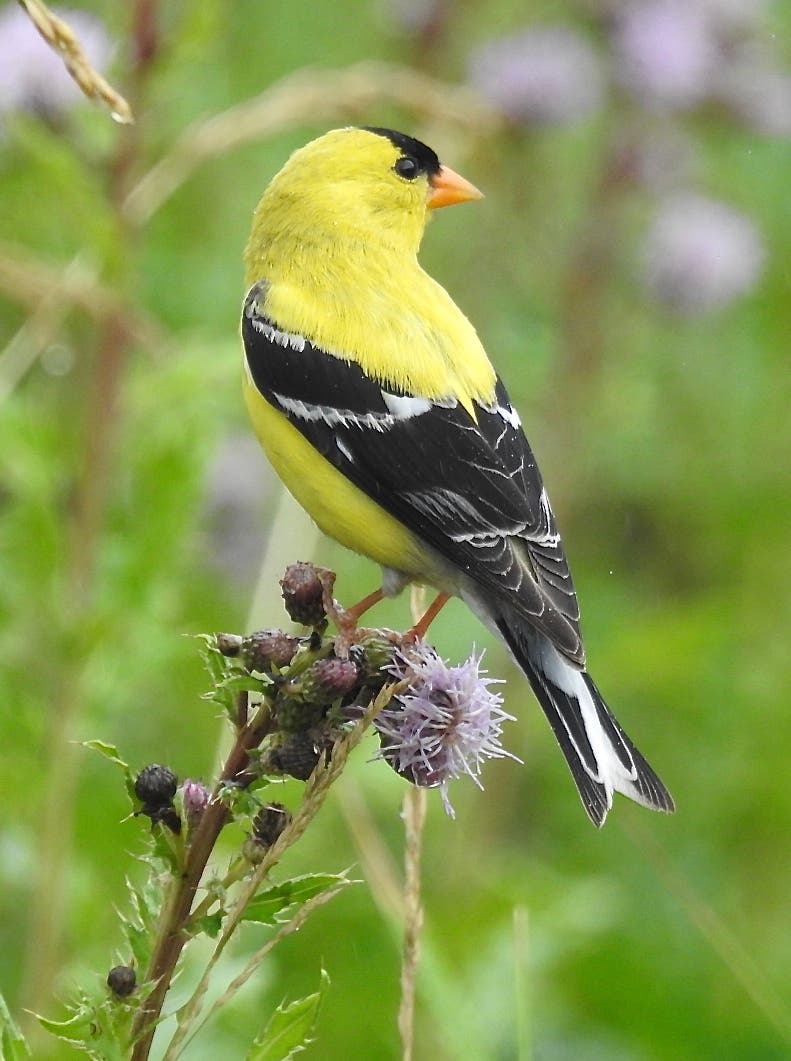
American Goldfinch enjoying healthy breakfast of berries. (photo by Debbi Collar)
Another thing I get,'is a lot of calls relating to a goose or turkey that has a limp.. Again, they pprobably have been living with that limp for months, if not years, . If it is not bleeding, it should be left alone."
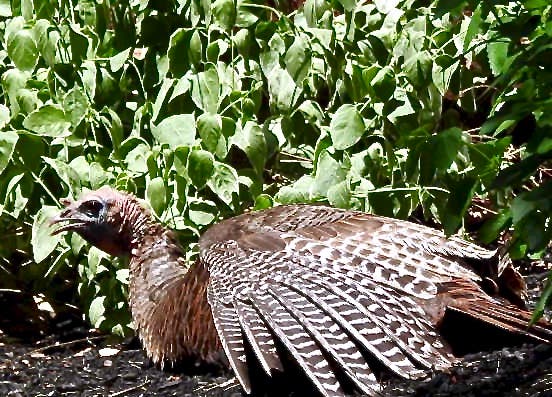
Juvenile turkey rests in the shade (photo by Debi Collar)
These wild turkeys (Jenny (female) and Jake (male)) set out for a morning stroll (photo by Debbi Collar)

Family outing, Canada Geese and goslings (photo by Debbi Collar)
Turtles ae another issue for humans. What can you do when coming across a turtle on land that appears to be in distress?
Again, the answers, it's best to leave it alone and/or be observant of the situation and if still concerned, contact a professional.
It might have just laid its eggs and is returning to the water. The mother does not stay with the eggs until they hatch. She buries them and in a period of approximately 72 days, the babies aset off on their own to find the nearby sea or stream.

Turtle found on land (photo by Debbi Collar)
If there is a turtle in the roadway, it's best not to turn it around. Again, contacting licensed processionals is the best way to deal with the situation but if that is not possible, keep in mind that tulles can also carry disease. Cellphones can make this situation a bit easier as you contact wildlife agencies as to whether you should prod it across the street with a stick, being carful not to harm it. Does the turtle have a cracked shell is it bleeding? What would be the best way to keep it out of harms way while waiting to be connected to a wildlife agency?
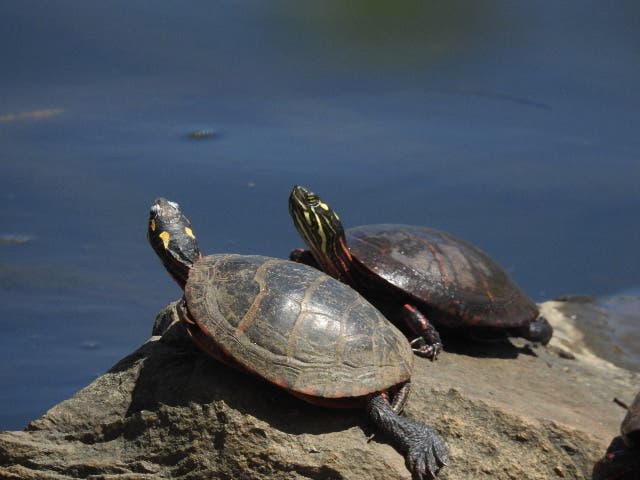
Turtles taking in the warmth of the morning sun (photo by Debbi Collar)
Let's not forget about ocean life as well.
One recent visitor to the Cape Cod area, Jamie Hayes, of Pensacola, Florida followed the rules of nature suggested. The photo below is that of a seal pup, originally thought to be alone on the sand and rocks, its mother not anywhere in sight. Hayes first thought was " Is the seal injured?"
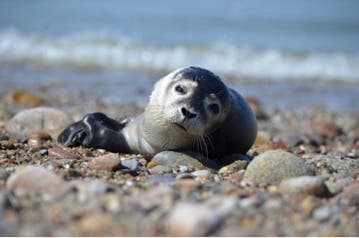
Photo by Jamie Hayes
Instead, It was basking in the sunshine.
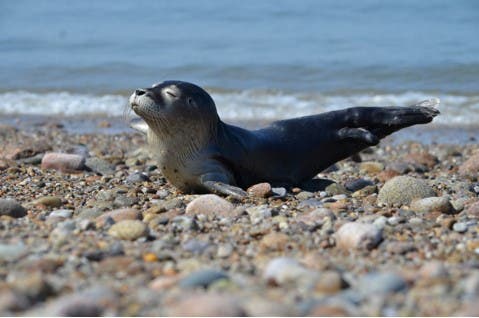
Photo Jamie Hayes
Hayes and her aunt, who also owns a home in Melrose, continued to observe the seal. Hayes, says it was her aunt who first pointed out the pup,"She told me there was a seal on the beach. It wasn’t injured or scared. It was just having a good old time rolling on the rocks and sunning itself. It stayed on the shore for about an hour and then its mom poked her head out of the water and off the little one went. I love wildlife and we don’t have seals where I live so I am very excited to have had the opportunity to photograph that sweet baby! "
Once again, the best advice, agreed upon by naturalists, is to let nature run its course. As with all parents, there is a time for teaching the young how to swim, to forage and to fly.'
******************************************************************
Several resources are listed below should you encounter any wildlife you may feel could be in need of help..
As it is not possible to list more than a few links, please keep in mind that each f these agencies may be able to connect you with licensed rehabilators in the areas where you might see injured wildlife.
Rehabilitators don't charge for their services, but will often accept donations to help cover their costs.
Check online or call ahead for hours of operation during the COVID-19 pandemic
Drumlin Farm, Lincoln,Massachusetts
781-259-2200
Ipswich River Wildlife Sanctuary
978-887-9264
New England Wildlife Center
Weymouth,Ma
781-682-4878
Massachusetts/New Hampshire
Stranding Hotline: 508-349-2615
Robert Prescott (Co-Coordinator, South of Boston, Cape Cod)
Massachusetts Audubon Society
Wellfleet Bay Wildlife Sanctuary
P.O. Box 236
South Wellfleet, MA 02663
rprescott@massaudubon.org
Phone: 508-349-2615
Stranding Hotline: 617-973-5247
Connie Merigo (Co-Coordinator, Boston North and New Hampshire)
New England Aquarium
Rescue Program
Central Wharf
Boston, MA 02110
Phone: 617-226-2102
For in-water entanglements, call the Center for Coastal Studies at 800-900-3622.
It's much better to call and seek advice from a professional
Tufts Wildlife Clinic
North Grafton,Ma
508-839 -7918
Ma. Environmental Police
1-800-632-8075
Animal Rescue League of Boston
1-657-777-2762