Sports
Milton Runner Focuses on the Journey Through 100-Mile Ultramarathons
Dave Humphreys, who has lived in Milton since 2001, recently completed his fifth ultramarathon.

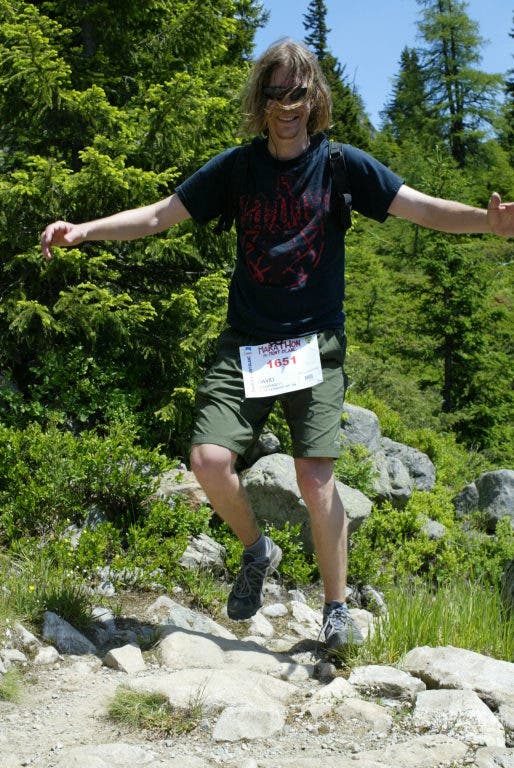
Staying in the moment and focusing on the journey rather than the destination are philosophies used by more and more people to avoid stress and enjoy life. They are also mantras employed by Dave Humphreys, a Milton attorney, who recently completed his fifth 100-mile ultramarathon.
In a run where the goal is to finish in less than 24 hours, using brute force to push through the fatigue and focusing on the journey are the only ways to cross the finish line.
Humphreys ran the Vermont 100 Endurance Race on July 16 and 17, marking his third entry in the race. The 40 year old finished in the top third of his age group, but he said it’s more about finishing than racing the other participants
Find out what's happening in Miltonfor free with the latest updates from Patch.
“I ran the best run I can run,” Humphreys said. “That’s good enough.”
Aside from the running he was forced to do as a Marine, Humphreys, who moved to Milton 10 years ago with his wife Lori, said he wasn’t a runner until 1995.
Find out what's happening in Miltonfor free with the latest updates from Patch.
As a volunteer at the 1995 Special Olympics in Washington D.C., Humphreys was inspired by the marathoners. After that experience, he trained from nothing and ran a marathon later that year. His running career progressed from there.
Over the next 11 years he ran about 20 marathons until he qualified for the 2006 Boston Marathon.
“Getting that Boston qualifying time, for me, was a major goal,” Humphreys said.
While many runners seek to improve their time after accomplishing a goal, Humphries went a different route, focusing on distance. He said the biggest hurdle for getting into ultramarathons is in a runner’s head.
“If you can run a marathon you can run a 100 [mile race],” said Humphreys. “It’s all mental.”
His first race beyond marathon distance was the Vermont 50 Ultra Run, which is held at Ascutney Mountain Resort in Brownsville, VT in the fall. Humphreys has participated in the Vermont 50 three more times, but it took just one 50-mile run to prepare him for a 100-mile ultramarathon.
“I did the 50 and just figured I was ready,” said Humphreys.
Living in Milton, at the foot of the Blue Hills, has served as one of Humphreys’ biggest motivators for ultra running. Humphreys spends a lot of his time running and mountain biking on the 700 miles of trails on the Blue Hills Reservation.
“I might as well run these races because I’m training,” said Humphreys, adding the races justify the fun he’s having in the Blue Hills.
Humphreys stays in shape with running, biking and yoga. With high overall fitness, Humphreys works out a training schedule as an ultramarathon approaches.
The schedule focuses on back-to-back or sandwiched long runs. On consecutive days, Humphreys will run for five or six hours at once. He doesn’t worry about distance, just the time he’s running, to get accustomed to fatigue.
The day before the Vermont 100, Humphreys and his crew member, Ken Diesenhof, arrived in Vermont. After a medical check-up and dinner, Humphreys set up camp near the starting location. At 2:30 a.m. he woke up, ready to run.
“You start running at 4 and you keep moving, keep trucking,” Humphreys said.
Throughout the course there are aid stations where runners get food, change equipment and take a quick break.
At nine stops, runners meet up with their crew. Diesenhof keeps Humphreys posted on how he’s doing and carries all of his equipment like a flashlight, jacket and fresh socks.
Diesenhof also checks Humphreys’ feet and helps him change equipment.
“We are absolutely religious about taking care of my feet,” Humphreys said.
In the four ultramarathons he’s run with Diesenhof, Humphreys hasn’t gotten a single blister; a devastating ailment in such a long run.
Diesenhof also keeps track of Humphreys’ pace between aid stations. Humphreys said he prefers not to know his split times. Instead, his crew either tells him he’s “good” or he “needs to make something happen,” indicating he is on pace to finish in under 24 hours or he needs to speed up slightly to reach his goal.
Humphreys said that the biggest sense of accomplishment doesn’t come when he crosses the finish line, but rather the moments along the trail where Diesenhof tells him he needs to make something happen, and he does.
“That’s where the race is,” Humphreys said. “At the end, you’re just done.”
At stops with his crew, Humphreys tries to be back on the course in less than five minutes. At aid stations without Diesenhof, Humphreys tries to breeze through in under one minute.
Throughout the race, Humphreys is eating. He eats runners’ gels and goos and drinks sports drinks, but aid stations offer a wide range of food that aren’t necessarily associated with athletics.
Food like cheeseburgers, gummy bears, coffee, soda and one of Humphreys’ go-to foods, potato chips, are all available.
Humphreys doesn’t stop to eat either. He loads up a baseball cap and snacks along the way.
“I tend to grab whatever looks good,” said Humphreys.
Regardless of the on-trail meals, ultramarathon runners are burning more calories than they can replace.
During the race some runners will literally nap on the course, while others will sleep at aid stations. Plenty of other participants, including Humphreys, push through without sleep.
The physical exertion and the exhaustion make these long races a serious challenge, but a challenge Humphreys and his fellow runners understand.
“You’re going to be exhausted,” Humphreys said. “I think that’s the point.”
Eventually, Humphreys would like to go out west for an ultramarathon. He said that would probably come in a few years when his sons Jackson, 9, and Aidan, 7, are a little older and can make the trip.
In the meantime there are the races closer to home, which he already taken on one step at a time for the full 100 miles.
Get more local news delivered straight to your inbox. Sign up for free Patch newsletters and alerts.