Politics & Government
State Rep. Candidates Discuss Economy, Casinos & Seniors in Needham
The Needham League of Women Voters sponsored Thursday night's event.
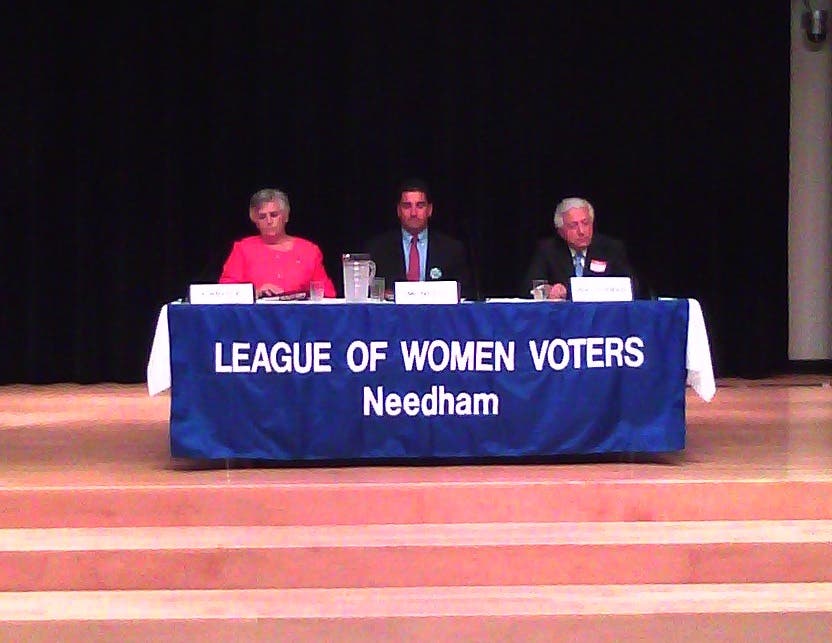

Whether voters are looking for years of government experience or a fresh face, Thursday night's District 13 debate in Needham offered something for everyone.
Thursday's state representative candidate's debate was sponsored by the Needham League of Women Voters. The democratic candidates led things off, which featured Denise Garlick, Gary McNeill and Jerry Wasserman. Following the democrats were the republican candidates Joshua Levy and John O'Leary.
Bolstering the Economy
Find out what's happening in Needhamfor free with the latest updates from Patch.
McNeill, who said that he is not a politician but rather a businessman ready to use his skills, made it clear throughout the debate that his number one priority was to help build up the economy. He said he wants to create jobs that are both long term and viable. He also said that he would look into supporting small businesses through tax credits.
"The economy is the most important aspect at this time," said McNeill.
Find out what's happening in Needhamfor free with the latest updates from Patch.
Wasserman, who has 20 years of government experience, including 11 years on Needham's Board of Selectmen, said that he was the only one on the panel with the experience to get things done in this tough economy.
Wasserman said that to build the economy, the state must bring in industries that are not currently here. He related that the next representative needs to help build a market right down to the individual community. Wasserman feels that the economy is enhanced when specific aid is brought to specific communities, in an attempt to attract new businesses.
"Jobs don't go to a state, they go to the local communities," Wasserman said.
Garlick, a registered nurse and vice chairman of Needham's Board of Selectmen, said that it's all about, "Jobs! Jobs! Jobs!" She explained that the state needs to create help for workers of all types and statuses, including mid level employees and students coming home from college entering the market. She also said that the state needs to look for tax incentives for small businesses and build around growing markets like green technology, biotechnology and life sciences.
O'Leary has led three agencies under Governor Romney and served as V.P. of organizations in both the Financial Services and High Tech sectors. He also recently wrote a book called, If We can Put a Man on the Moon: Getting Big Things Done in Government.
He believes that in terms of strengthening the economy, taxes need to be lowered and the workforce needs to be well educated.
"I think the government is heading in the wrong direction and we need to get it back on the right track," said O'Leary.
Joshua Levy grew up in Needham where he attended and graduated from the Needham Public Schools. He received degrees in linguistics and music from McGill University in Montreal, Quebec.
He said that the first step in creating jobs and a better overall economy is to recognize that the tax rate is one of the highest in the nation. He explained that the government needs to be sympathetic of the needs of businesses and that over-borrowing needs to stop.
"We have rising taxes each year just to make up for short falls," said Levy.
Looking at Climate Change
The candidates were next asked about climate change. Garlick focused on green technology and said that efficiency starts right in your own home and community. This includes things that people can help with within the community like building energy efficiency.
"We can do this in our home and we can do this in our state," said Garlick. "The nation also needs to do it on the same level."
McNeill said that it was all about the economy and that financial motivation and incentive is needed. He said that he feels most people choose alternatives that are cost efficient.
Wasserman believes that while incentives are an area where the government can help encourage the use of renewable energy, it is much more than just the economy and financial motivation.
"Everybody talks about incentives, but I think the state can do other things like provide technical advice," said Wasserman.
Wasserman said that while working with Green Needham, he ran a show on The Needham Channel explaining how to get energy audits for households and how they work. He said that during his time with Green Needham, he was working on the proposal for a wind turbine and other energy efficient projects.
Wasserman said that there is a lot that needs to be done locally and even more that the state can do to help. He cited making it easier for communities to have green technology, whether it is for cost or availability.
O'Leary said that he believes the best thing to do in regard to climate change is to reduce taxes by five percent and raise a tax on gas and oil. This, he said, will make alternative energy more competitive and it will make use of incentives that people naturally respond to.
"This is essentially a tax on pollution," said O'Leary.
Levy disagreed and said that the number one thing is to make sure that there is sustainability in both the economy and the environment. He said that if the air and water within the community is dirty, overall health diminishes.
"We need to make sure our environment is good to live in," said Levy.
Making Life Easier for Seniors
A hot issue around the state and in district 13 is what the candidates can do to make life easier for seniors. Wasserman, who is the chairman of the Suburban Coalition, filed for a senior circuit breaker. According to massresources.org, the Circuit Breaker Tax Credit is a state income tax credit for eligible Massachusetts residents age 65 or older who paid rent or real estate taxes during the tax year. Even though the credit is based on property taxes, the state government, not the city or town, pays the credit.
Wasserman also said that he led the fight for a volunteer fund at the local level to get help for seniors. A second fund was also created, which matches the volunteer fund.
In terms of nursing homes compared to home-care, Wasserman said that if seniors want to stay in their homes everything should be done to make that possible.
"We can't throw seniors out of their houses," said Wasserman.
McNeill said that he has worked hard in an attempt to get the town of Needham a senior center in the near future. He said that the seniors are the people that made these towns great, and gave him and others the opportunities to succeed.
"This is my opportunity to deliver on promises and make sure they're taken care of," McNeill said.
McNeill added that this issue is, once again, all about the economy. He said with Medicaid it is not just about rebalancing the same pot of money, but instead trying to find ways to create more money.
Garlick said that the best way to help local seniors is to improve the local economy and increase revenue. She explained that there is a need for affordable housing within the community, and that means suitable housing that they can afford.
"Seniors' fears about property taxes and their homes are very real," said Garlick.
In terms of Medicaid, she said that Massachusetts is a leader in health care reform with 97 percent of the state covered. But she said it is important to have home health care as well, in an attempt to keep seniors at home receiving the help and treatment they need.
Levy touched on the fact that there is a need for a senior center in Needham. He said that it is his hope that it can be pursued without politics getting in the way, and said that he hopes the same for the other towns in the district.
"The problem is that most seniors are living on fixed incomes," said Levy. "Towns need to be welcoming of people of all ages."
O'Leary said that they need to make it so seniors are happy, but also provide for the future. Levy responded to this by saying, "I am a member of the next generation and not just a proxy for one."
O'Leary explained that the state should see if there are in-home services that would make sense, in regards to the care of seniors. He said that the state needs to rationalize the services and cost that it takes to provide them.
Levy felt that if it is possible to have in-home care, it would be something he would definitely support. He also said that the costs need to be feasible, because current costs are far too expensive for seniors.
Casinos in the State
While the effort to bring casinos into Massachusetts was recently voted down, it was a close vote and will likely come up while the winner of the upcoming election is in office. Each candidate chimed in on this subject, with Wasserman and Garlick opposed while McNeill supported casinos in the state.
Wasserman said that he was opposed because he felt the projections of cost compared to revenue will not be anywhere close to the actual amount. He stressed that the forecasted income is overblown and the costs to build and maintain the casinos are drastically understated.
Wasserman also said that it is a matter of public safety, with a negative impact on the social community. He is also concerned with the way that it will impact the surrounding communities and explained that the casinos do not bring in long lasting jobs, and many would be out of work once the casinos were built.
"We are better off spending money on things like medical equipment, etc.," said Wasserman.
Garlick agreed with Wasserman, saying that the state should be able to create jobs elsewhere. She said that Massachusetts needs good jobs for families with good pay.
"We cannot be feeding the casinos and starving the communities," said Garlick.
McNeill supported the use of casinos, because he felt that it would be beneficial to the state's struggling economy. He said that it would provide countless business opportunities and that it can be managed appropriately, as well as help fund local aid and social services.
"I do support casinos," said McNeill. "I think it is a driver of revenue opportunities."
Both Levy and O'Leary support casinos, as well. O'Leary said that he thinks that it would bring in much needed jobs and, in turn, increase revenue and help turn around a failing economy. He and Levy both agreed that it was a sign of dysfunction and disagreement between parties that this was not done before.
Levy said that he supports casinos and gambling, not because it is a revenue builder, but because, "We are adults and should be able to spend our money as we please."
The State Primaries will be held on September 14.