Community Corner
Newton Hero: Coryn Bina Founder Of Bina Farm
The Celtics recognized a the founder of Bina Farm, a nonprofit designed to bring people with special needs and able-bodied together.


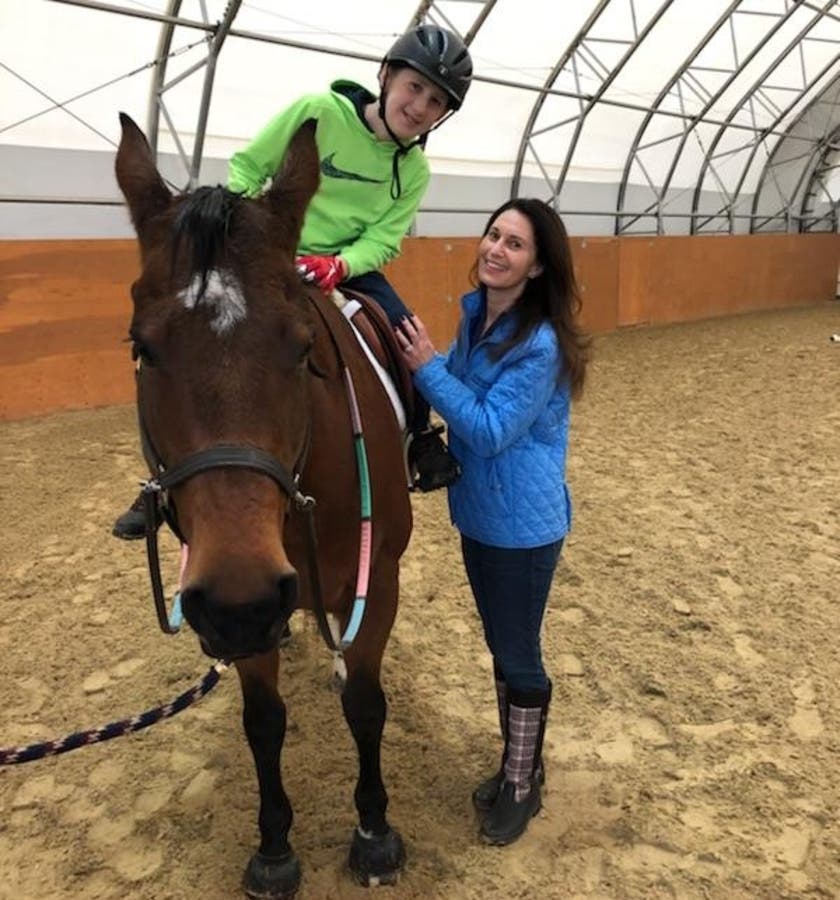


NEWTON, MA — After a particularly horrific fire a number of years ago, Shriners Hospital treated a set of twin girls about 4- or 5-years-old, who lost their mother in the fire. One was quite severely burned, the other was not. The one twin who wasn't burned had stopped talking to her sister and wouldn't even touch her. That's when Shriners connected with Bina Farm. The non profit was started in 2009 by Newton resident Coryn Bina and Therapeutic Riding Instructor Terry Snow.
The BINA Farm Center was created with the mission to bring horse-related Activities and Therapies as well as a number of inclusive programs to as many children and adults as possible, including both able bodied and those people diagnosed with anything from autism to various physical or mental challenges. It was among the first to model an approach that included siblings in treatment, according to Bina, who was recently recognized for her work helping people by the Celtics.
It was Bina who recommended the girls take up therapeutic riding lessons at the farm.
Find out what's happening in Newtonfor free with the latest updates from Patch.
A mental health professional worked with the girls at the farm for several weeks. At one point, it was time to go tack the horse. And that's when it happened: The girl that was not burned put her arm behind the burned girl and walked to the horse together. A therapist snapped a photo and it was the beginning of a major step forward for those two little girls.
"It was a very moving moment," said Bina. She said it was that moment she knew without a shadow of doubt that the non profit was doing what it was supposed to be. "I was like: Ok. I get it. The horse is the bridge for healing. It really is."
Find out what's happening in Newtonfor free with the latest updates from Patch.
Helping hundreds
Newton resident Coryn Bina grew up knowing that if she was going to take up space on this earth she'd have to make sure she helped others in some fashion along the way. A career in the hospitality industry, two kids, countless projects and hours upon hours of volunteer work later and in her wake she has done just that - despite funding challenges and challenges finding the right space and horses for the farm.
Nine years after she and co-founder Terry Snow started the non profit, the duo - together with other instructors and therapists and volunteers who come in all kinds of weather to help - have helped hundreds of children and their families, veterans and, she hopes, inspired a good chunk of young people to carry what they've learned into the future.
The beginning:
It was 2009, and Bina had taken her 4-year old to a horseback riding lesson. It was going well and afterward she noticed her son playing with a little girl diagnosed with autism who had also come to take riding lessons. Bina smiled at the duo, delighted that her son didn't seem to notice the girl's differences.
A flurry of things happened in the next 30 seconds: Bina wondered whether the horse or the lesson had anything to do with the children's delight. Then she saw as the little girl's mother seemed stressed and her sister bored. She noted that that wasn't a dynamic that was working for that family. She wondered why they weren't part of the little girl's lesson, why weren't they riding? Why wasn't she, riding? Clearly the daily stress that comes with caring for someone who has a disability was stressful. "Something needs to be improved," she thought.
Bina and her husband had been talking about starting a non profit, but something about this scene clicked with Bina. What if she started a non profit that brought families of people with disabilities together with those who were typically developed and therapeutic horseback riding?
"It just clicked. In a matter of 30 seconds I saw the whole thing," said Bina.
She went home, told her husband what she had seen, and asked him. He was all in. She turned to the theraputic horseback riding instructor and asked her to meet up.
"The goal is to bring together people of all abilities," she told her, she remembers. "Let's focus on our kids' generation and change the way they all work together and grow something."
What happened next has changed her life, and hundreds of others people's lives, she said. And she attributes much of that to Snow. "Because of the magic she brought, really," said Bina.
They started with one horse and about a dozen clients each week and by word of mouth both numbers grew. Today Bina Farm, the Lexington-based therapeutic horseback riding facility, has seven horses and serves more than 200 veterans, domestic violence survivors and children diagnosed with disabilities and chronic illnesses every week.
How it works:
Anybody can participate in one of the programs on the farm. From Therapeutic Horseback Riding (riding skills plus a focus on cognitive, physical, emotional and social well-being of individuals with special needs), to Hippotherapy (utilizing specific horsey movement to address functional therapy goals as part of a patient’s integrated rehabilitation plan of care) to experiential psychotherapy that involves horses.
Some young people the farm see go from therapy session to therapy session.
"This one is camouflaged around the horse," said Snow. "They're just having fun. We're doing things like obstacle courses, toss games, executive function and building good core strength."
Parents and siblings can participate, or help. And although the programs are subsidized by donations, there's also a scholarship program available, says Bina.
The veteran's program, which comes in cycles, is free, she said.
Healing:
Both Bina and Snow say there are too many moments to quantify success on the farm. There are children who were able to speak their first words while working with occupational therapists during a riding lesson. There have been vets who were able to start healing from post traumatic stresses. Parents have reported that their child has overcome problems with washing hands or wearing hats, major victories for some.
Snow said the smile on the little boy who is confined to a wheel chair because of a degenerative disease he's been diagnosed with is a success.
"When he gets up there [on the horse] he just wants to trot. For him it's the freedom of being able to go fast and the thrill of it," she said.
And in the process the horse is moving in a way that helps give the boy exercise in a way that he doesn't get because he can't walk, she said.
Siblings, one who is diagnosed with something and the other who is not come and bond over their experience here together, said Bina.
"Parents that bring both kids say 'you give us time,'" said Bina. Typically kids who are siblings don't come to the therapies. "When you have a child with any challenge there's a lot of time and energy into helping that child be the best they can be. A family has to move as a unit sometimes. wouldn't you like to take something that everyone can do?"
And then there's the benefit to those who volunteer (and both Snow and Bina continually point out how grateful they are for those volunteers) and work with the folks who come to the farm.
"In our society everybody is willing to help out a cute little child. That child grows up into a grownup they need just as much support and love and friends as a cute adorable child: That's what this is," said Bina. "I wanted my son's generation to grow up helping those in their generation," she said. "For it to be the norm."
That seems to be working.
"One thing that I've learned, is that it has a spiral effect on the community," said Snow. With each lesson they need volunteers to walk along side the horses, and lead the horse as well as a teacher. They end up working together as a team. "It's that feeling of being part of a team really builds into love. Besides that group it affects so many people."
**
As if spending her days on the farm wasn't enough, Bina is has several projects in the works, all with a social component that she says she learned that from her father. She'll be launching a new public school funding "marketplace," to help reduce a funding gap many public schools face, and she's working on a film that she says is pertinent with the times.
Photos courtesy Coryn Bina
Get more local news delivered straight to your inbox. Sign up for free Patch newsletters and alerts.