Community Corner
Spring Street: A Path Through History
It's been the path to a spring, a cow path between barns and a crowded street.
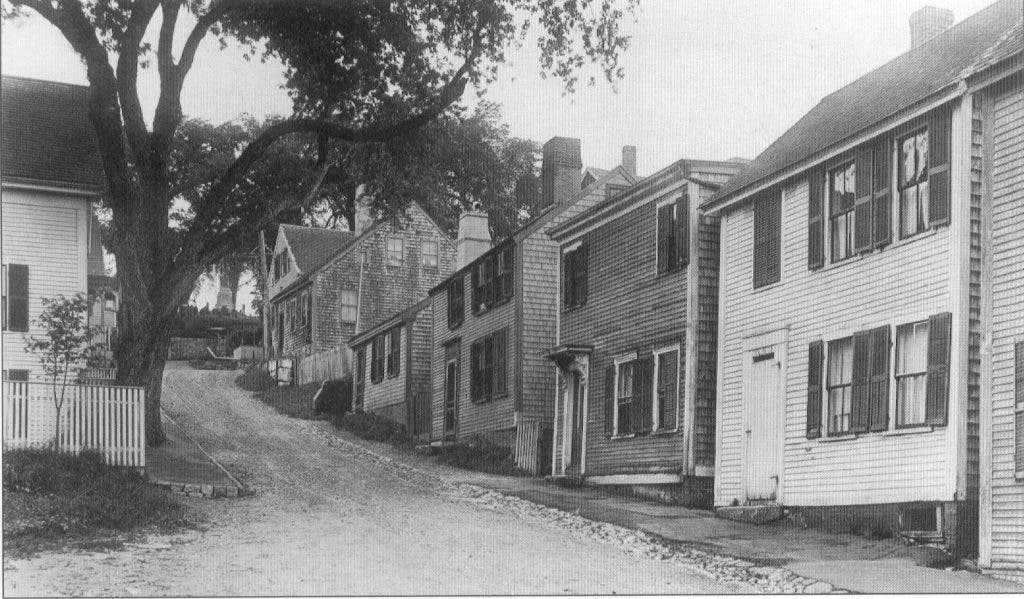


It may not look historic, but the path up to Burial Hill from Summer Street is actually one of Plymouth’s oldest lanes—Spring Street. Over the last four centuries, it’s been used as a path, an alley lined with barns, a narrow, steep residential street, and, after urban renewal, a path again.
The Pilgrims set up their town along what’s now Leyden Street, leading from their fort at the top of Burial Hill down to the waterfront. Since the water from Town Brook could be brackish, the colonists took advantage of the many springs along the stream. Colonists who lived near the fort walked down the south side of the Burial Hill to a spring at the base of the slope near the grist mill. Over the years the path became known as Spring Street.
As it was quite steep, the lane was not a prime location for building. By the 1720s,
many of the artisans who lived near the Town Brook erected barns, workshops and other outbuildings along Spring Street. Since it was not uncommon for cattle to graze in the town-owned cemetery, the path was sometimes called Cow Lane.
By the early 1800s, land near the town center was in demand, and speculators began developing some of the hilly terrain on the side of Burial Hill. Merchant John Bishop, who owned a substantial house at the northwest corner of Spring and Summer streets,*began buying the barns on either side of the lane. He sold the narrow lots to artisans, who built small houses with scarcely any space between.
The 1860 census shows that the modest dwellings were owned or rented by laborers and artisans, including many who worked in the mills and iron foundries along the Town Brook. Over the first decades of the 20th century, as Plymouth’s fashionable district moved north, the area around Summer Street became a lower-income neighborhood, occupied by workers and immigrants from countries as diverse as England, Russia and Greece. After World War II, many Cape Verdean families, both tenants and owners, lived there. Over the years, the majority of the neighborhood houses were divided into apartments, even the small homes along Spring Street.
In the late 1950s, the land along Summer Street, including Spring Street, was slated for urban renewal. The town purchased more than 100 houses and other buildings, and the entire area was razed and regraded. The hotel that is now the John Carver Inn was built c1969. The footprint of the historic lane was retained, although it became a pedestrian footpath to Burial Hill. Today you can walk up what used to be Spring Street, past the Carver’s swimming pool and Mayflower slide. While its use has come full circle today, the quiet path resonates with all of the people who have lived there and used it over the past 400 years.
*The Bishop House was moved to the south side of Summer Street as part of the urban renewal project.