This post is Part III in a four-part series about Reading’s Budget. Click here to read the rest of the series:
- Part I: Reading’s Split Tax Rate (covers the constraints we're under)
- Part II: Why Reading’s Budget is Tight ("How Did We Get Here?") (covers the sources of the revenue gap problem)
Note: text in green is hyperlinked, throughout.
*******
Find out what's happening in Readingfor free with the latest updates from Patch.
Part II left off on the fact that Reading is a highly residential, low commercial town, with some mandated common costs (notably for health insurance and education) that are rising faster than revenues.
This post will review some of the progress made over the past 4 years, with more to come!
Find out what's happening in Readingfor free with the latest updates from Patch.
First Thing’s First
Reading has a Town Master Plan, but it is not sufficiently focused on economic development, and is updated every 12-15 years (revisions in 1991, then 2005, and due for revision ~2019). Reading needed something more accurate, more detailed and focused on redevelopment of existing commercial parcels.
Good news! In 2014, in my first term on the Board of Selectmen, the town engaged Northeastern University’s Dukakis Center for Urban and Regional Policy to perform a ‘self-assessment’ study of Reading’s strengths and weaknesses. The 200+ question EDSAT (Economic Development Self-Assessment Tool) highlighted Reading’s unique set of strengths, weaknesses, and economic development objectives. The result was a revealing and pointed summary of the work that lay ahead.
Once Reading had defined its risks and opportunities more clearly and understood the baseline from which it was starting, the town could begin to move forward with planning for economic development.
Online Promotion
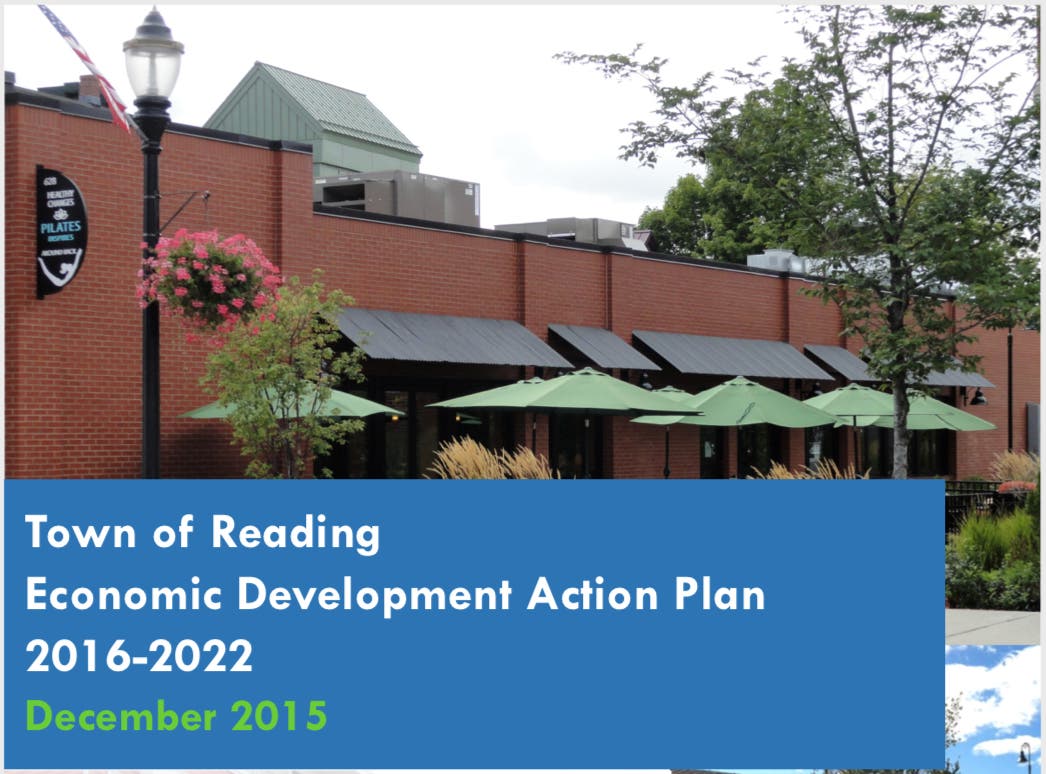
In 2015, the town developed and made public (online) its Economic Development Action Plan to guide its activities around economic development.
Volunteer Economic Development
Reading is truly blessed to have hundreds of volunteers serving on dozens and dozens of boards, commissions, committees, clubs, and groups for the town, schools, athletics, arts, and other civic purposes. I count myself lucky to live in a place where such high levels of volunteerism are the norm.
Volunteer groups do have natural limits to their time and energy. For example, until 2015, an Economic Development Committee (“EDC”) staffed by appointed volunteers met to provide inputs and responses to and from businesses to the Town and Board of Selectmen. The group's accomplishments were several - they helped launch Reading's first Fall Street Fair, and generated our first 'Business Passport', a guide to new business that helped explain the Town Hall processes required to set up shop in Reading.
The committee’s purpose was laudable, but its Economic Development results were impacted by several realities:
- Its membership was volunteer and over longer periods of time, transient.
- Volunteers met on a weekly or bi-weekly schedule. This did not provide sufficient time for large-scale planning and execution.
- Members, though very interested in economic development, were not necessarily subject-matter experts in large-scale development, construction, economic planning, finance, or business.
- Outreach to external developers and potential new commercial firms requires full-time, day-time resources; active industry experience; and a robust set of contacts.
As a result, the EDC's focus over time naturally narrowed to appropriately-sized projects, such as street signage and façade improvement projects valued to several hundreds of dollars. While certainly helpful to the benefited businesses, these efforts could not be on the scale needed to significantly grow Reading's commercial segment.
I continue to value citizen and business-owner participation in all phases of this effort highly. Interested individuals have participated in prior economic development sessions at the Senior Center, the Library, and in projects before the Community Planning and Development Commission (CPDC).
Thinking Bigger
To fill the now urgent need for dedicated resources in economic development, in late 2016 Reading added a full-time Economic Development Director (Andrew Corona). Andrew worked with Assistant Town Manager Jean Delios and Community Development Director Julie Mercier, helping Reading’s branding and outreach to put Reading into the minds of local developers.
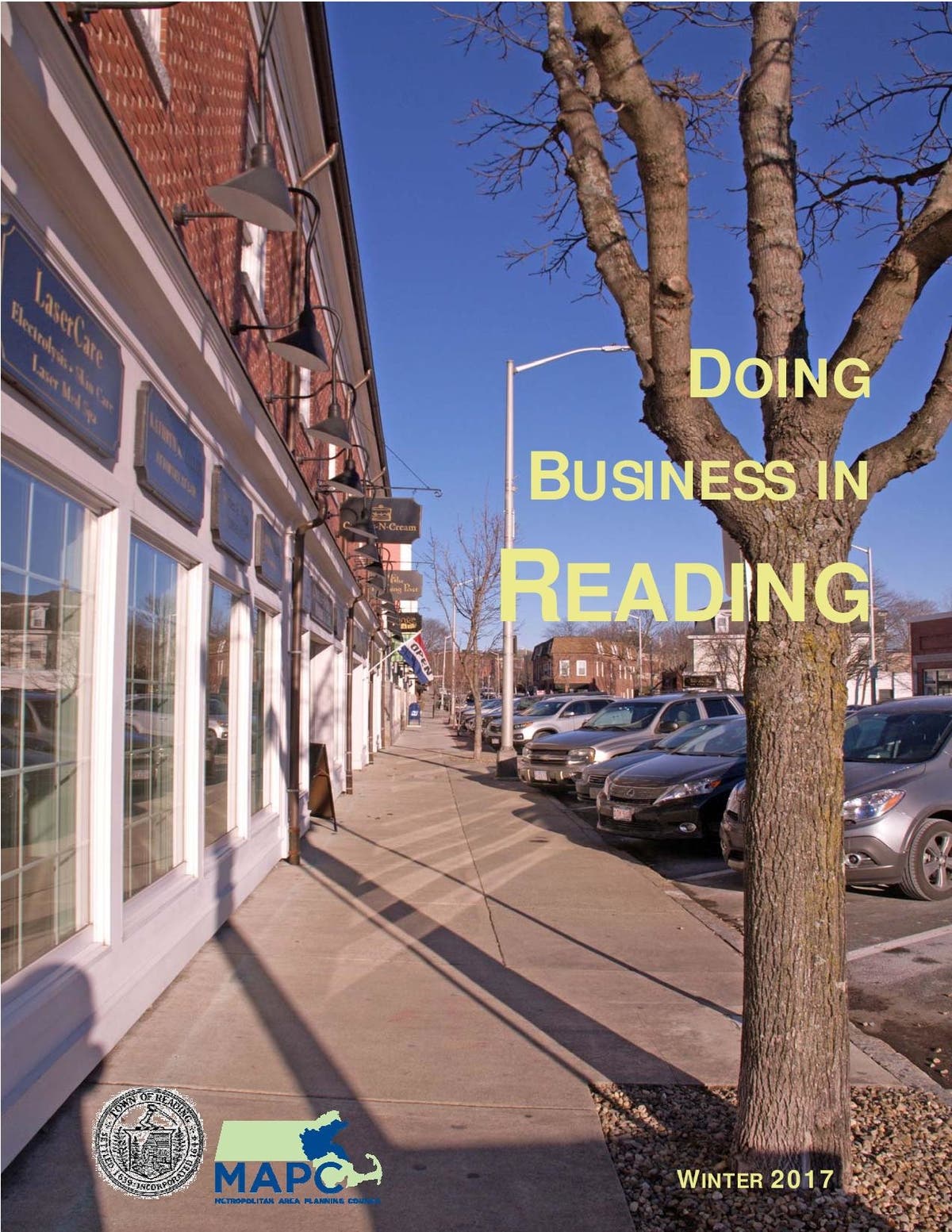
Jean, Julie, and Andrew developed a brand and promotion strategy and developed print and web pieces (such as the town’s guide to “Doing Business in Reading”). Andrew identified available properties with re-development potential and advertised our Smart-Growth district expansion to interested developers.
(Note: Andrew left Reading a few months ago to return to the West Coast; the search for his replacement is underway.)
Improving our Local Control
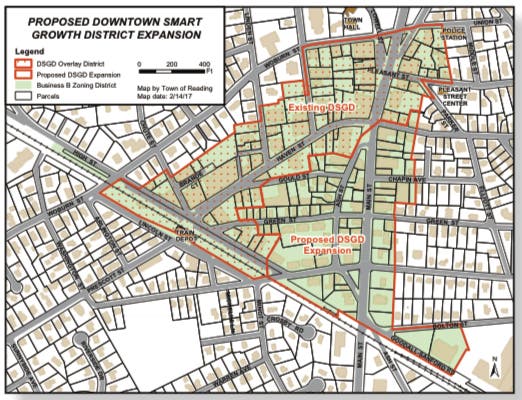
In April 2017 the Board of Selectmen supported an effort by the Community Planning and Development Commission (CPDC) to expand Reading’s “Smart Growth District” boundaries. Under Massachusetts state law (Chapter 40R), properties within a town-established Smart Growth District qualify for mixed-use zoning (commercial with a residential component). Also by law, the entire Smart Growth zone is protected from state-authorized, unregulated high-density development under 40B. The Smart Growth District puts control over town development back in Reading’s hands.
The original district was created in 2009 for a portion of Haven Street. The newly expanded region now contains 47 acres of land within the downtown area—bounded by Main, Haven and Washington streets.
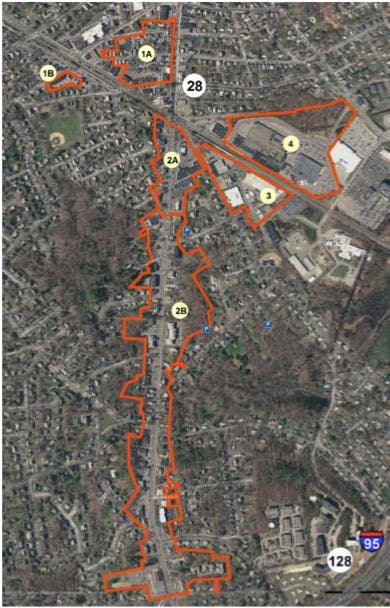
In the same discussions, three other areas were highlighted for potential future Smart Growth District expansion:
- A commercial site on which the former General Rubber facility sits (site 4)
- An industrial site on which RMLD, cutlery, and warehousing facilities sit (site 3)
- South Main street from the railroad tracks to Stoneham border (site 2B)
Getting Community Feedback
In April 2017, the town published a first economic analysis of Reading vs. Peers Communities, comparing Reading to its neighbors in terms of important economic metrics and demographics. This was followed in October 2017 with the final report on Economic Development Factors, which outlines key elements our peer towns have that benefit commercial and business development.
Also in October 2017, Reading ran an Economic Development Survey among residents and business-owners, assessing respondents’ awareness and preferences around economic development, as well as collecting their input. Reading uses surveys to collect data from large numbers of residents, in an efficient and consistent manner.
The Groundwork is Laid
Our current budget woes are a consequence of how Reading is designed. I have been focused on opportunities for increased commercial development in Reading since 2012 when I first joined the Board of Selectmen, with a focus on keeping Reading, Reading in that process. As shown above, the Board of Selectmen has made significant progress in the last four years in laying a foundation that will support added commercial and industrial growth, which will ultimately help our property tax revenues and our operating budget.

In Part IV, I’ll discuss some thoughts about the road ahead. I sincerely hope I'm allowed to remain on the Board to see these plans through for our town... Stay tuned!
Election Day is Tuesday, April 3rd! Please mark your calendars and make a plan to vote (and tell your friends to, too): Arena for Selectman!
Find pieces like this and more at www.JohnArenaforSelectman.com