Politics & Government
State Works To Save Peregrine Falcons
Peregrine falcons are known to nest across the state.


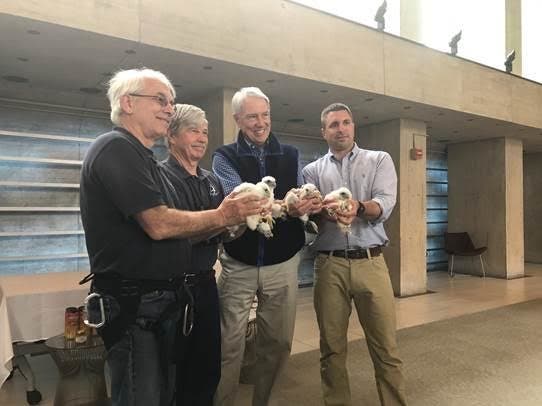
MASSACHUSETTS—Highlighting the Baker-Polito Administration’s efforts to restore peregrine falcons and other endangered species in Massachusetts, Energy and Environmental Affairs Secretary Matthew Beaton on Thursday assisted MassWildlife biologists and MassAudubon representatives in banding four falcon chicks at the former Christian Science Center Building in Boston, according to an announcement. Over the next few weeks, young falcons across the state will be banded and monitored by wildlife officials as part of a decades-long restoration effort.
“The restoration of the peregrine falcon to Massachusetts is a tremendous success story,” said Energy and Environmental Affairs Secretary Matthew Beaton in a statement. “As a result of the tireless work of the Department of Fish and Game, the contributions of numerous conservation organizations, and the creation of the Natural Heritage and Endangered Species Fund successful restoration efforts have resulted in over 30 pairs of falcons nesting in the Commonwealth.”
Known as the fastest bird on earth, the Peregrine Falcon is capable of diving from great heights at speeds just over 240 miles per hour, hunting and snatching birds on the wing.
Find out what's happening in Shrewsburyfor free with the latest updates from Patch.
Peregrines are found nesting mostly on bridges and buildings and some historic cliff nesting sites in communities throughout Massachusetts. Communities with known nesting sites include Amherst, Boston, Bourne, Brockton, Cambridge, Cheshire, Chicopee, Deerfield, Erving, Fall River, Great Barrington, Haverhill, Holyoke, Lawrence, Leominster, Lowell, New Bedford, Northampton, Peabody, Quincy, Milford, Russell, Sandisfield, Saugus, Springfield, Swampscott, Taunton, Watertown, Wilbraham, Worcester and Woburn. In 2016, 20 nests produced at least 54 fledglings (young birds hatched and survived to fly), and earlier this year the peregrine falcon’s Massachusetts Endangered Species Act Status improved from Endangered to Threatened.
Pictured, left to right: Natural Heritage & Endangered Species Director Tom French, MassAudubon Blue Hills Trailside Museum Director Norman Smith, Mass Audubon President Gary Clayton, Energy and Environmental Affairs Secretary Matthew Beaton. Photo submitted
Find out what's happening in Shrewsburyfor free with the latest updates from Patch.
Get more local news delivered straight to your inbox. Sign up for free Patch newsletters and alerts.