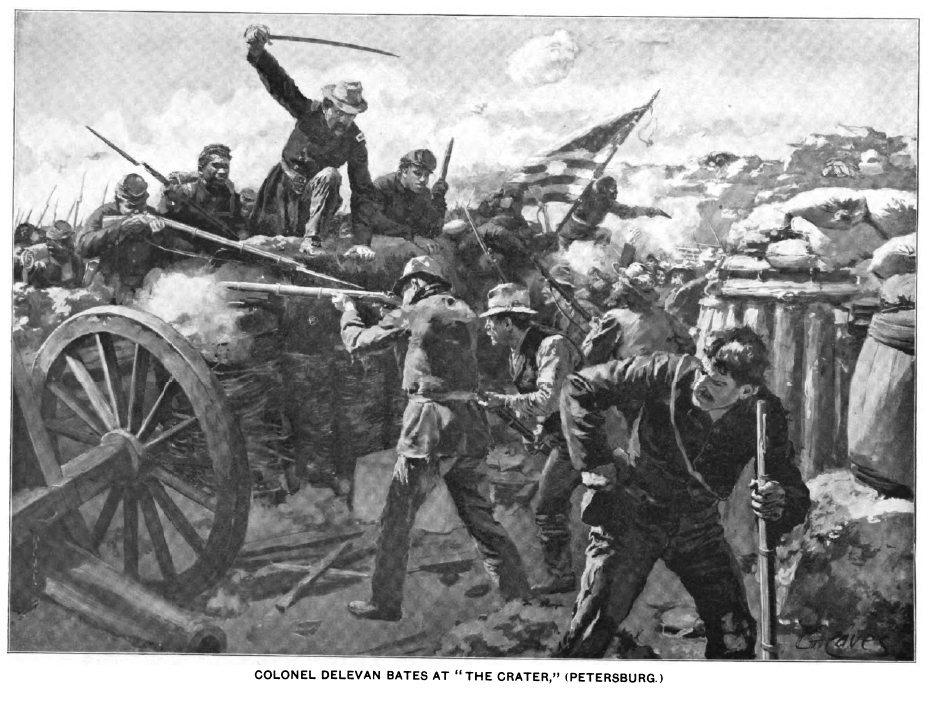
The explosion was deafening. Tons of red earth blew up into the sky. The shock could be felt at the Army hospital ten miles away. It started at 4:45 a.m., Saturday, July 30, 1864, as the Union army, including a brigade led by Colonel J. Parker Gould of Stoneham, readied for the attack.
For months the Union army under General Ulysses S. Grant had been engaged in a desperate campaign to reach Richmond, the Confederate capital. In battles, raids and skirmishes, military forces had pressed on, despite enormous casualties, twice and sometimes three times that of General Lee’s army.
Colonel Parker’s Massachusetts 59th Regiment, with Grant’s forces in the Battles of the Wilderness, had been reduced from a thousand to a hundred officers and men.
Find out what's happening in Stonehamfor free with the latest updates from Patch.
Now, encamped in a stalemate outside Petersburg, the Union army would again try to take the city, a major supply depot just nineteen miles from Richmond. An earlier attack had brought them to within 400 yards of the Confederate ramparts—close enough for a daring new plan.
The proposal came from Maj. Gen. Ambrose E. Burnside, under whose command was the 49th Pennsylvania Infantry, made up of coal miners. These men had approached him with the idea of digging a tunnel under enemy lines, then packing in kegs of gun powder that would blow an opening in the defenses. Historian Stephen Oates suggests Grant was not thrilled with the plan but allowed it to proceed.
Find out what's happening in Stonehamfor free with the latest updates from Patch.
It has been called the Battle of the Crater, because the exploding mine, while it did blast a hole in the enemy fortification, also created a giant crater, thirty feet deep, 170 feet wide and sixty feet across. With steep walls on each side, this crater had to be scaled. Oates writes: “No one thought to supply them with ladders.”
That early morning of July 30, after the mine explosion, and the sound of falling earth and debris, came the roar of 110 cannons and 44 mortars, as Union artillery pounded the rebel fortifications. Then, silence, then bugles, commands of officers and the yells of men as three Union brigades, 15,000 men, surged forward. Included was the 4th United States Colored Infantry Regiment.
Colonel Gould, once dubbed the Fighting Major, led one brigade. Here’s how William B. Stevens, Stoneham’s 19th century historian, put it: Colonel Gould “took the field on the fatal advance on Petersburg, commanding the left of the brigade, and while standing on the brink of the mine was struck by a ball in the leg and carried from the field.”
The Battle of the Crater was a disaster by all accounts. The quick regrouping of the Confederates resulted in rebel soldiers firing down into the crater, a hailstorm of bullets and mortar shells that decimated the Union advance.
Pulling back, the Union counted its casualties: 504 killed; 1,881 wounded, 1,413 missing. It wasn’t until the next day that General Lee agreed to a truce so the armies could recover their dead and wounded, who lay hours in the hot sun.
The highest percentage of soldiers killed came from the black regiment, many of whose soldiers fought to the death rather than be captured, knowing the rebel practice of shooting blacks who surrendered.
Carried off the field, Colonel Gould was taken to the field hospital at City Point. The bullet had shattered his left knee, and as was common practice, a surgeon amputated his leg. In a letter to his family the hospital chaplain wrote: “He will be tenderly cared for, here, as he is widely known in the corps and beloved by all. He has an advantage from his freedom heretofore from intoxicating drink. I expect he will recover fast, and in a few weeks will be able to communicate with you personally.”
For three weeks after the battle, Colonel Gould lay in the tent hospital. Against his wishes, Stevens writes, he was then transferred to the Officers Hospital in Philadelphia. It may have been the transport that caused an artery in his wound to burst soon after he arrived. Although the bleeding was stopped, the colonel did not recover from the hemorrhaging. Soon after, On August 21, at age 42, he died.
Over three years ago, Captain Gould had left Stoneham with a company of men called The Grey Eagles. Next week I will conclude with his final journey home and the tribute paid him by the people of Stoneham.