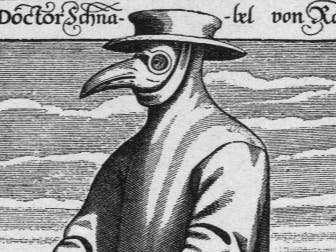
Last week I wrote about Geoffrey Chaucer’s Canterbury Tales, a collection of stories told by pilgrims on their way from London to Canterbury. Written in Middle English toward the end of the 14th century, the tales are a window into English society in the years following the Black Death, the bubonic plague that killed a third of Europe’s population.
Men and women, the pilgrims had a common goal--paying homage to St. Thomas Becket, the saint “That hem hath holpen whan that they were seeke,”--who had helped them when they were sick.
From the Black Sea to the British Isles, the plague had taken life on a scale we can only imagine. But it had also damaged the medieval structures of society, opening the door to a new middle class. This is reflected in the mix of Chaucer’s characters, pious and worldly.
Find out what's happening in Stonehamfor free with the latest updates from Patch.
Beyond the devastating effects of the plague, however, there was a terrible dark side. Across Europe, Jews had often been persecuted, usually when economies suffered. Now, with the Black Death ravishing communities, who better to blame but the Jews.
Tales of Jews poisoning wells and kidnapping Christian children for blood rituals spread across the continent. Despite two papal bulls issued by Pope Clement, exonerating them, rioting spread across Western Europe, often with the support of local authorities. Mobs rounded up and burned to death hundreds of thousands of Jewish men, women and children.
Find out what's happening in Stonehamfor free with the latest updates from Patch.
In England in the 11th century, William, the new Norman king, had invited Jews to settle in England. But the welcome didn’t last, and in the following years, Jews were again scapegoated. During the Crusades, as English knights set off to reclaim the Holy Land, Jews were considered enemies of Christendom. In 1290 Edward I signed an edict expelling them from England.
A century later, as Chaucer was writing Canterbury Tales, anti-Semitism was still alive. We know this from the tale told by the Prioress. Popular among medieval Christians, the story is about a widow’s son in an Asian town who, while singing a hymn to the Virgin Mary, is kidnapped by Jews, who cut his throat and throw him into an open sewer. Miraculously, the boy continues to sing. Found by his mother, he explains how he was killed, and the guilty Jews are rounded up and executed.
We don’t know exactly how this chilling story would have been received by Chaucer’s readers. Like all slander, it was probably welcomed by some, scorned by others. The Tale of the Prioress exemplifies, however, the impulse to blame those who are not like us.
The impulse to blame is common in human experience. But the consequences can be tragic. Sadly, as we struggle against the Covid-19 pandemic, it has been nurtured by our president, who targets the Chinese, the WHO, immigrants, the Democrats, anyone who disagrees with him. It’s a deadly game.
© Ben Jacques