For many years the people of Stoneham have gathered for an ecumenical Thanksgiving service, held in a different church each year. The Thanksgiving proclamation from the governor would be read, then someone would blow the shofar, the ram’s horn used on Jewish holy days. After that, everyone would rise and sing “Now thank we all our God.”
Over the years, the annual Thanksgiving service has drawn fewer townspeople, and this year, while similar services will be held in surrounding towns, no ecumenical Stoneham service has been planned. I feel bad about that. Coming together as a community to give thanks is important, even in troubling times. Especially in troubling times.
Take the year 1861, late autumn in the first year of the War of the Rebellion, as the Civil War was called. Over a hundred men from Stoneham had left for the front. Hundreds more would follow. A 17-year old boy was the first to be killed. Others would be shot, lose limbs, die of disease, or languish in Confederate prisons. Add to this the devastating early losses of the Union Army. Many found little to be thankful for.
Find out what's happening in Stonehamfor free with the latest updates from Patch.
Not so, however, for the Rev. William Whitcomb, Stoneham’s Congregational minister, who in 1850 had preached a fiery sermon against the Fugitive Slave Act. Having left Stoneham to pastor other churches, Rev. Whitcomb was invited back in 1861 to preach the Thanksgiving sermon.
The minister began by reading the proclamation from the governor. Then he acknowledged the hardships and difficulty of the times, the “stinging Bs” of early Union defeats, Big Bethel, Bull Run, and Ball’s Bluff.
Find out what's happening in Stonehamfor free with the latest updates from Patch.
Victory may not come soon, he said, and there will be much sacrifice, but it will come, “so sure as truth and virtue and liberty and knowledge and piety shall prevail over falsehood, crime, despotism, ignorance and wickedness.”
Like many, Rev. Whitcomb saw the Civil War as a necessary campaign to rid the nation of the curse of human bondage. The following spring, he, himself, would enlist in the Army as a chaplain. For over two years he would minister to sick and dying in Army hospitals in North Carolina, before he would succumb to yellow fever, and his body be returned for burial.
Now, as he looked out over a packed church, he called on the people of Stoneham not to lose heart. Instead, he said, “Let us rejoice, and thank God for the privilege of living and dying in this grand and awful time.”
Today, as we consider our conflicted society, the desperation of the marginalized, and the degradation of our environment, we are tempted to despair. Rev. Whitcomb’s Thanksgiving service reminds us that bad times can be endured and that right can prevail.
We can be thankful even in “troublous times,” Rev. Whitcomb said. His message, given in the white church on Main Street 158 years ago, was also a call to action, a call to repair a nation torn apart by racism and greed. His words resonate today.
© Ben Jacques
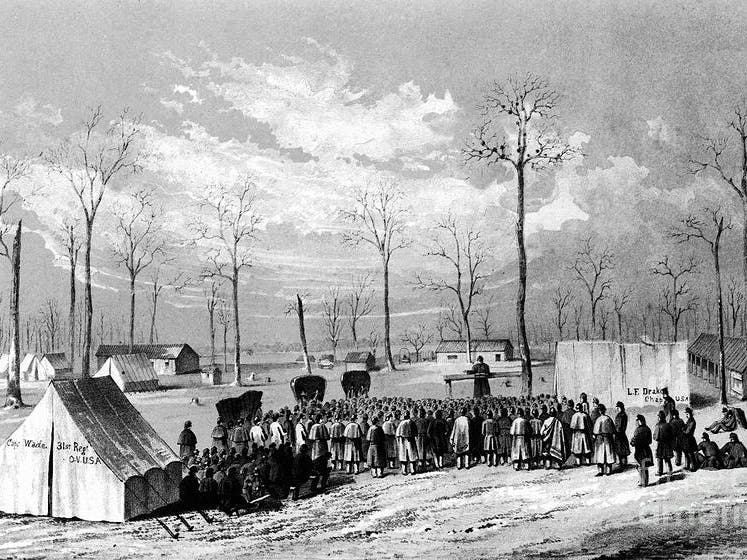
Photo: The Reverend L.F. Drake, Chaplain, 31st Ohio Volunteers, preaching at Camp Dick Robinson, Kentucky, 10 November 1861.