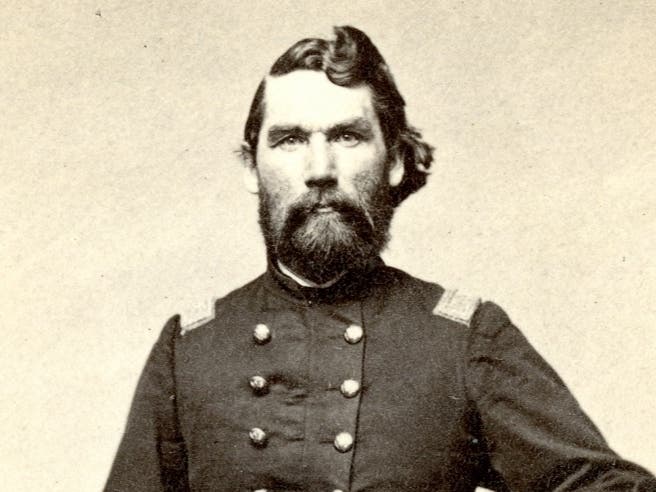
He was a seventh-generation Gould, one of the first families to settle in Stoneham. Named Jacob after his father, he went by Parker, his mother’s family name. Born in 1822, the eldest of eight, he worked, as did many, as a shoemaker, saving money for college. In 1849 he graduated from Norwich University, a military school in Vermont, tutored in mathematics, then returned to Stoneham. For a while he taught school in Stoneham and Wilmington, then began a career as a civil engineer, specializing in railroads.
A respected member of the community, J. Parker Gould became an officer in the Stoneham militia and served two terms in the state legislature. Like the Goulds who came before him, he was an active member of the Orthodox Church, as the Congregational Church was known. He may have been there in the fall of 1850 when the new pastor preached a fiery sermon against the Fugitive Slave Act, calling on parishioners to obey God’s law, rather than unjust laws made by man. He may have known the two families in Stoneham who were sheltering fugitive slaves and helping them on their journey north.
When the Civil War started in 1861 and Stoneham rushed to answer the nation’s call to arms, Captain Gould was 39 and unmarried. He was not among the first volunteers to head for Washington, sixty men of Company C, led by Captain John H. Dike. Instead, Gould recruited a second company, which included officers and seventy-seven additional men of Stoneham. It was assigned to the 13th Massachusetts Regiment. Gould’s company was called the Grey Eagles.
Find out what's happening in Stonehamfor free with the latest updates from Patch.
After weeks of drilling his recruits, Captain Gould and his Grey Eagles marched to Fort Independence on Castle Island to join the Fourth Battalion, the nucleus of the Massachusetts Thirteenth. Here on July 16 he was promoted to major, becoming battalion commander. According to Stoneham historian William B. Stevens, the other companies at first resented Gould’s appointment. Considering themselves “a crack organization,” they would have preferred a major from their own ranks.
“But as time went on,” Stevens wrote, “and the men were called into action, they learned to know his soldierly qualities and noble traits, and he soon had earned for himself the sobriquet of the ‘fighting major.’” Major Gould, it was said, “commands no man to go where he is not willing to go himself.”
Find out what's happening in Stonehamfor free with the latest updates from Patch.
For the next three years J. Parker Gould distinguished himself as a battalion and regimental commander, leading his men in fifteen battles, including Thoroughfare Gap, Second Bull Run, South Mountain, Antietam, Fredericksburg, Chancellorsville and Gettysburg—names engrained in our historical consciousness.
Early in 1864 Massachusetts Governor John Andrew recalled a tired Major Gould and asked him to recruit three new regiments, offering him command of one of them, the Massachusetts 59th. Promoted to colonel, in charge of a thousand men, Gould then returned to the battlefield, this time joining the army of General Ulysses S. Grant in the battles of the Wilderness.
Before he left, Gould had a photograph taken in his colonel’s uniform. Weariness and the desolate effects of what Gould must have experienced on the battlefield are reflected in his eyes. He has aged much beyond the three years that have elapsed.
One of the costliest campaigns of the war, the Wilderness battles left the Massachusetts 59th decimated. Gould’s regiment, wrote Stevens, “had been reduced to about 100 officers and men, all told.” Further, “[Gould’s] health had become very much impaired on account of his privations and labors.”
Now the Union Army was encamped outside Petersburg, just 19 miles from Richmond. At dawn on July 30, although he had been temporarily relieved of his command because of illness, Colonel Gould was called to lead a brigade in a third attempt to take the city. Next week, I will tell what happened.
Copyright by Ben Jacques