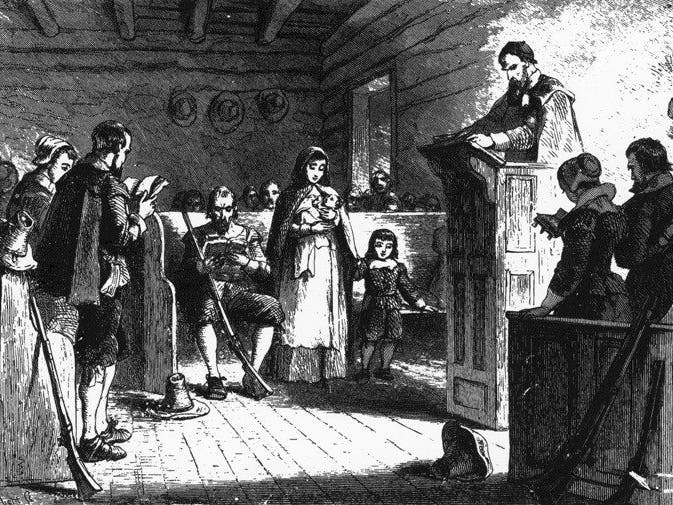
The autumn leaves would have been blazing that October Sunday in the year 1794 as the embattled minister of Stoneham rose to give his last sermon. After several town meetings, repeated acts of vandalism, and a ruling by an ecclesiastical council that he had lost his influence among the townspeople, the Rev. John Cleaveland, Jr., had resigned.
With his wife, Abigail, Rev. Cleaveland had served the town for eight years, the first minister in Stoneham after the Revolutionary War. Then, after Abigail’s death from small pox, he had married his housekeeper, a younger woman from Reading named Elisabeth Evans. Although it was never stated publically, this marriage appears to have infuriated many people in Stoneham.
Two ecclesiastical councils had met to review and advise on the dispute. They found the 42-year-old minister blameless, but acknowledged it was best for him to resign. It was the Rev. John Cleaveland, however, who would have the last word.
Find out what's happening in Stonehamfor free with the latest updates from Patch.
What a moment it must have been as Stoneham’s pastor looked out at his parishioners seated in the pews of the old Meeting House. Some had stood by him. Others had sided with his oppressors. Some he had baptized, others married, and there were families of those he had buried.
For his text Cleaveland chose Hebrews 13, verse 17: “For they watch for your souls, as they that must give account.”
Find out what's happening in Stonehamfor free with the latest updates from Patch.
In a lengthy sermon to follow, Cleaveland detailed with numerous biblical references the prescribed duty and awesome responsibility a pastor has for the souls of his flock. “How solemn will the account be which Ministers will have to give,” he said, “how they treated the character of God in their preaching!”
Had he, while ministering to the people of Stoneham, presented the character of God accurately? Or, rather, had he “described the Divine Character in such a light as is pleasing to the selfish feelings of sinners”?
Rev. Cleaveland’s theology was orthodox, and the worst thing a minister could do was to dilute and weaken the Gospel, to “strip the [scriptures] of that majesty and terror which they wear in plain scripture language . . . so that wicked men may feel more easy in their minds concerning God?”
For his watch over their souls, Rev. Cleaveland prayed he would be found faithful. He then turned to an examination of the responsibilities of the parishioners. Just as he must one day give an account, so they would be held accountable. As much is required of their minister, “Much is required of a people toward their Minister…. They must pray much for him; provide for his comfort…. Never grieve him by opposing the truths he delivers; nor by censuring him for his faithfulness, in bearing testimony against their bad conduct.”
Nor, he continued, should they “hurt his influence among his people, by prejudicing their minds against him….” If the minister has erred, he stated, he is entitled to be tried “by the rules of Christ’s house,” that is, by a council of ministers and believers—something the town had refused to do.
Then the Stoneham minister turned to those who rejected him. Those who despise “a faithful watchman will have a most dreadful account to give in the great day,” he said, “when they and their Minister must meet again at the bar of God, where nothing but truth will be admitted.”
Speaking directly to the people, Rev. Cleaveland asked them to examine their souls and their conduct—“whether any of you have had your ears open to the tattle of the vain world . . . whether you have had your minds cooled towards your Pastor from mere hear-say.”
The minister had been wounded not only by those who openly opposed him, but by those who pretended to be neutral, who avoided taking sides in a matter of such temporal and eternal importance. If you believed my ministry to be in error, he stated, you should have said so. But if you believed me to be a faithful watcher of men’s souls, you should have stood up for me.
“How can you feel easy in your minds,” Rev. Cleaveland said, “when you know you have not come forth to the help of the Lord in this place?”
For over an hour the departing minister of Stoneham opened his heart and soul before the congregation. He had expressed righteous anger and sorrow. But now it was time to close.
“I have now done with you all, perhaps, forever. Have I been faithful to you? Have you been faithful to your own souls? Will there not be a dreadful separation among us, another day?—May God enable all of us to repent of all our sins; believe in Jesus Christ, and live a holy life; then we shall have a happy meeting together in a better world!”
I can only imagine what it was like for Rev. Cleaveland as he left the Meeting House that day in October. Had Elisabeth, his young wife, sat in the pew to hear his last sermon? Did church members who had stood by him now circle around him for a final blessing, perhaps share a last meal together at the parsonage? Was everything packed up for the journey out of town?
Where would they go now? What would happen to John and Elisabeth in the years to come.
CONCLUSION
It could have ended his career. Forced in 1794 to resign as minister of Stoneham’s Congregational Church, the Rev. John Cleaveland, Jr., could have become bitter. Although the church had stood by him, most of the voting citizens of the town had wanted him gone. Had he failed, completely?
Winter was just around the bend in 1794 as the pastor and his wife left town. So must they have felt the chilling of their spirits as they departed into an uncertain future.
We know little of the next few years in the Cleavelands’ lives. One account is that they resided in Ipswich, perhaps at his father’s farm. Here Rev. Cleaveland took on the role of a visiting preacher, taking the pulpit in various churches on the North Shore. It was doubtless a time of reflection, and a time, away from the gossip of Stoneham, to enjoy the company of his new wife.
Then in the spring of 1798, Rev. Cleaveland received an invitation to full-time ministry. It came from the town of Wrentham, and in June he was installed as the pastor of North Church. He would serve there for seventeen years.
In Wrentham, the Rev. Mortimer Blake wrote, “several seasons of religious interest were enjoyed amongst his people…. They were days of brightness and prosperity.”.
Sober and thoughtful, Rev. Cleaveland was described in a sketch written for the Panoplist, a religious monthly, as “a man of clear and discriminating mind,” who acted “from principle in all his public and private conduct….” The writer continued: “He composed his sermons with care, expressed his thoughts with perspicuity, and delivered his discourses with tenderness, deliberation and solemnity, and without the least affection in language, in tone or in gesture.”
He was also noted for his punctuality. Arriving early to an appointment, Rev. Blake wrote, he would walk his horse until three minutes before the prescribed time.
Two afternoons a week he would visit families in the town, reserving other times for study and the preparation of sermons.
In Rev. Cleaveland’s first marriage there had been no children, and so it was in Wrentham, until the couple adopted two girls, Mary and Nancy. Both girls later married and started their own families.
The children must have been a comfort to Elisabeth when, on the first day of February in 1815, the Wrentham pastor died “after a wasting sickness by consumption.” He was 65.
In the funeral sermon for his good friend, the Rev. Dr. Nathaniel Emmons praised John Cleaveland for his straight-forward presentation of the Gospel. His sermons, Emmons said, were “more solid than brilliant, more sentimental than declamatory; and more adapted to assist the memory, enlighten the understanding, awaken the conscience, and penetrate the heart . . . than to gratify the vain curiosity of his hearers.”
Twenty-one years before, Rev. John Cleaveland had left Stoneham under a cloud. At his death, Emmons said, “His sun did not set in a cloud, but in its full brightness.”
Sadly, as 19th century histories are focused almost exclusively on the lives of men, little more is known about Elisabeth. After John’s death, she remarried, again to a minister, the Rev. Dr. Walter Harris of Dunbarton, N.H. She lived in New Hampshire with him until her death in 1829.
Meanwhile, back in Stoneham, the town set about looking for a new pastor. Had the townspeople learned anything from the tumult of the previous year? Were there regrets?
In November, one year after the Cleavelands departed, ministers from the area gathered with church members to install a 29-year-old preacher from Methuen named John H. Stevens. It would be a good fit for our town. Rev. Stevens would serve the people of Stoneham for the 32 years.
Note: The first part of this story, "The Preacher and the Vandals," appeared on Stoneham Patch last week. John Cleaveland story is one of many in a collection to be published this fall, titled: If the Shoe Fits: Stories of Stoneham Then and Now. Copyright by Ben Jacques.