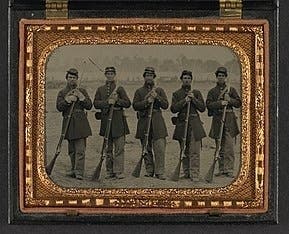
Researching the lives of those who came before us is something like working in a darkroom, developing and printing photographs—before digital photography, that is. You gather bits of images here and there, a birth, a marriage, an item in a newspaper, perhaps an obituary. If you’re lucky you find a letter, or a copy of a will.
Slowly, as in the developing tray, a picture emerges. You rinse and hang up the print to dry. Perhaps you have a story to tell. Perhaps there’s not enough.
It’s been like this as I look for stories among the early settlers of Stoneham and their descendants—men and women, children and siblings, free, indentured and enslaved.
Find out what's happening in Stonehamfor free with the latest updates from Patch.
I’m especially intrigued by how our ancestors responded during times of conflict like the Revolutionary War, the Anti-slavery movement, and the Civil War. How did the people of Stoneham respond when President Lincoln called on them to join the awful fight against a rebellious South?
Next Thursday evening, Nov 14, at the Stoneham Historical Society & Museum, I will tell the stories of seven Stoneham men, and one woman, who went to war to save the American Union and bring an end to slavery. They include a farmer, an engineer, a doctor, a preacher, a law student, and a nurse.
Find out what's happening in Stonehamfor free with the latest updates from Patch.
With Melissa Davidson Kyle, executive director of the Historical Society, we will follow the Stoneham volunteers, led by Captain John Dyke, as they headed off with the 6th Massachusetts Regiment to Washington, D. C., and the ambush awaiting them in Baltimore.
We’ll also tell the story of Stoneham’s highest-ranking officer, Colonel J. Parker Gould, and the fateful Battle of the Crater in Petersburg, Virginia. And we’ll follow two dedicated Stoneham surgeons as they fought desperately to save the lives of the wounded and ill.
The stories of how women sacrificed to support the war also need telling. They include the brave nurses, like Hannah Bray of Stoneham, Louisa May Alcott of Concord, and Clara Barton of Oxford. These women brought hygiene, relief of suffering and consolation to countless soldiers in the war. They also include the mothers, sisters, and daughters who kept the farms and factories going, who made bandages, clothes and blankets, and raised money to support the men at war.
I often wonder if a town can form a sense of character, or personality, from the aggregate lives of its people. The novelist William Faulkner said, “The past is never dead. It is not even past.”
Join us on Nov. 14 as we explore the character of Stoneham in the darkroom of Civil War history. In learning more about our past, we may learn more about who we are.