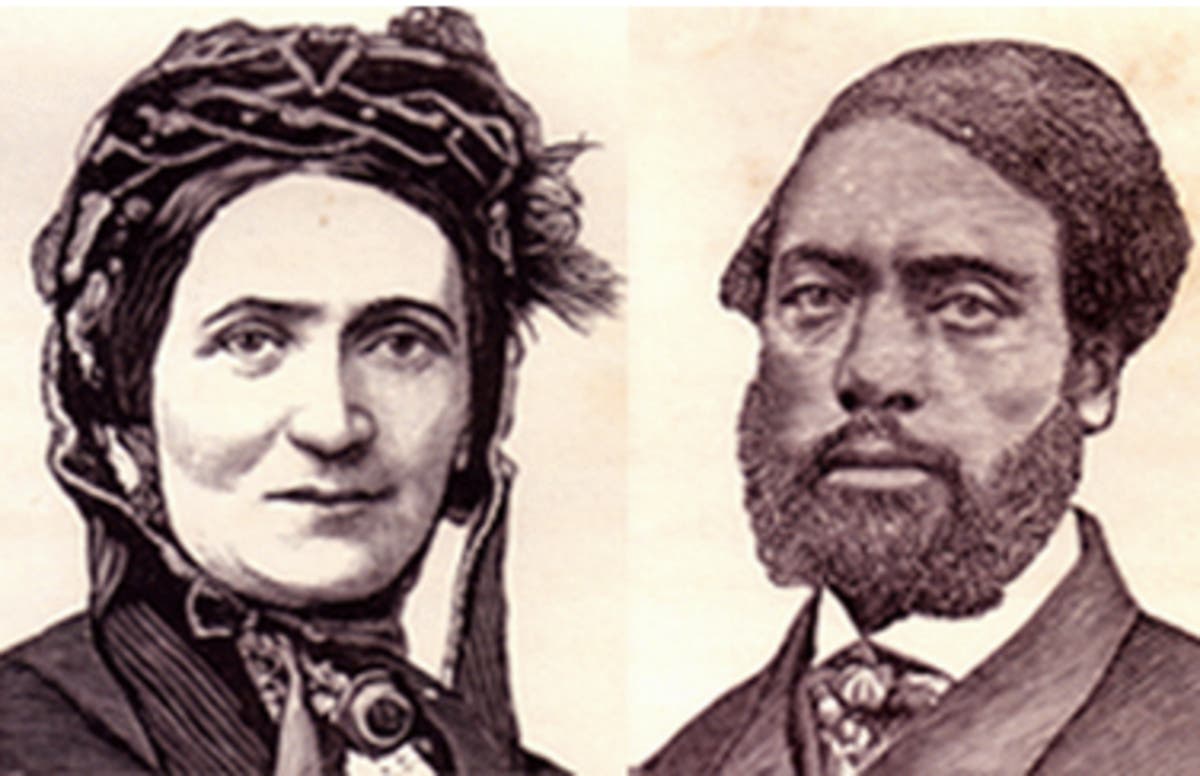
They were once slaves, but now they were free, living in Boston. He was working as a cabinet maker, she as a seamstress. Their names were William and Ellen Craft, and two years before they had escaped from Macon, Georgia. The year was 1848.
A light-skinned slave, Ellen was the daughter of her first owner and an African mother. At 11 she was taken from her mother and given as a wedding present to another family. William, a tall, dark slave, had been taught carpentry.
Allowed to marry, William and Ellen shuddered at the prospect of bearing children who might be taken away and sold. One night they plotted the only escape they thought could work, that is, to flee in plain sight, but in disguise.
Find out what's happening in Stonehamfor free with the latest updates from Patch.
Two weeks later they boarded a train for Savannah. Dressed as a young gentleman, with her arm in a sling and her head partially bandaged, Ellen had become Mr. William Johnson, traveling north to seek medical care with his attendant slave.
By train and ship, with perilous encounters at every leg of the journey, Ellen and William finally arrived in Philadelphia. Here for three weeks they found sanctuary with a Quaker family, who started teaching them to read and write. Then they continued on to Boston, where they joined a growing community of free blacks and abolitionists.
Find out what's happening in Stonehamfor free with the latest updates from Patch.
But in September 1850 the United States Congress passed the Fugitive Slave Act, part of a compromise deal intended to keep the Southern states from bolting. This law called for the return of all escaped slaves to their owners, and harsh penalties—jail and huge fines—for anyone who attempted to shelter or assist them.
Governmental and religious leaders throughout the northern states called for this law to be upheld. These leaders included the esteemed Massachusetts senator, Daniel Webster, who, despite his earlier speeches against slavery, argued for the forcible return of all fugitives to the South.
At the same time, leading clergy in Philadelphia, New York and Boston preached that it was a Christian’s duty to uphold the laws of the land, including the Fugitive Slave Act.
But not all ministers of the Gospel got onboard. The Rev. Samuel May of Boston spoke out eloquently against the inhumanity of the federal law, as did our own Stoneham minister, the Rev. William Whitcomb.
Soon after the passage of the Fugitive Slave Act, the 30-year-old Stoneham cleric stepped into the pulpit and passionately denounced the law, calling on his parishioners to, instead, obey a higher law, God’s law, that required Christians to come to the aid of the fugitive and the oppressed.
Reading Rev. Whitcomb’s sermon 168 years later, I am struck not only by the minister’s passion, but by his empathy, his love for human beings so different from him. A white man from New Hampshire, Whitcomb had the ability to feel with, to sympathize with, others across race, class, gender and culture.
Here is what the young minister had to say about William and Ellen Craft, the former slaves from Georgia, now in jeopardy just a few miles away. Learning that warrants had been issued for their arrest had filled him with a deep sadness.
“And now I very much fear that some of our brethren, almost as dear to me as any of the people of Stoneham, or the members of my own father’s family, ‘bone of our bone and flesh of our flesh,’ will be doomed to hopeless captivity.”
To Whitcomb, Ellen and William were not strangers, not undocumented aliens, not people of another country or race. They were as dear as his own family.
His powerful sermon, his passionate empathy, stand in stark contrast to the sentiments of all those who would justify exclusion and dehumanization of the most vulnerable among us, including those at our borders.
Spoken from the pulpit in an age not that different from our own, Rev. Whitcomb’s words are a source of hope and courage.
In my next column, I’ll tell you the rest of the story of William and Ellen Craft.
Note: Ben Jacques is the author of In Graves Unmarked: Slavery and Abolition in Stoneham, Massachusetts, available at the Book Oasis on 311 Main Street.