Neighbor News
The Preacher, the Doctor, and the Slave: Part One
The first smallpox inoculation began in Boston 299 years ago.
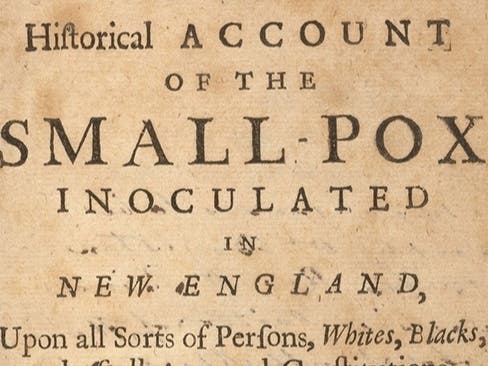
The contagion plaguing our ancestors three centuries ago wasn’t Covid-19. It was smallpox. Introduced to the Americas as early as 1507, smallpox was also a viral disease spread by contact with other humans. Already it had laid waste to native populations throughout the hemisphere.
Outbreaks of smallpox in Boston usually followed the docking of a ship from Europe. The first contagion came in 1633, then every few years until 1702. For 19 years thereafter, the city was free of the virus--as its victims had either died or developed immunity. But in 1721, despite quarantine efforts, it returned with a vengeance.
On May 26, the Rev. Cotton Mather, minister of Boston’s Second Church, entered the following in his diary: “The grievous calamity of the small pox has now entered the town.” He called for a day of prayer, “that we may prepare to meet our God.”
Find out what's happening in Stonehamfor free with the latest updates from Patch.
As the contagion spread, many residents fled the city, some carrying the virus with them. In Boston, almost 60 percent would be infected, and 844 would perish, a mortality rate of almost 15 percent. One hundred would die in Charlestown, of which Stoneham was then a part.
A major figure in the Puritan community, Mather did more than pray. He sought the help of a Boston physician, Zabdiel Boylston. Broadly educated despite his prejudices, Mather was keenly interested in science and medicine. As a corresponding fellow of the Royal Society of London, he had read reports of successful inoculation in Turkey. He had also, years before, learned of inoculation from a most unlikely source in his own household, his slave, Onesimus.
Find out what's happening in Stonehamfor free with the latest updates from Patch.
Many prominent Puritans in Massachusetts Bay owned slaves, permitted under Puritan law since 1641. While sanctioning slavery, Mather believed it was the master’s responsibility to care for his slave’s soul. As a minister, he baptized slaves, taught them to read and recite the catechism, and allowed them to form their own society.
In 1706, Mather’s congregation, in gratitude for his service, presented him with a gift--a healthy, young African man, worth, Mather noted in his diary, forty to fifty pounds. Mather named him Onesimus, after the New Testament slave who sought refuge with the Apostle Paul.
Brought into the Mather household, albeit at its most subservient level, Onesimus seems to have surprised his master with his intelligence. He learned to read and was allowed to marry. In time he was given permission to work outside the household, earning money of his own. Yet, to the frustration of his master, he never converted to Christianity.
After ten years, Mather appears to have given up on Onesimus. In 1716 he wrote out a contract granting his valued bondsman freedom, with conditions. These including paying Mather five pounds and agreeing to carry water, stack wood and shovel snow during times of need.
While in Mather’s service, however, Onesimus had shared some vital information with his master. Next week I’ll tell you how an enslaved man’s experience as a boy in Africa helped to save many lives in Boston and beyond.
© Ben Jacques