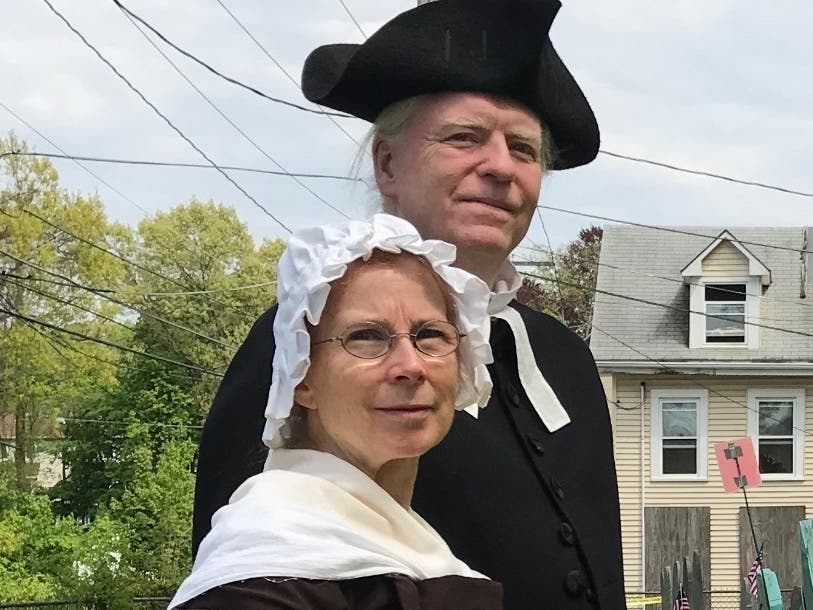
What could the Congregational minister of Stoneham have done to be driven out of town? What controversy had he started? What heresy had he preached? What social norms had he violated?
Over a span of 225 years, the question lingers? What made the villagers so mad at the Rev. John Cleaveland that they tarred his pulpit seat, cut off his horse’s tail, and nailed up the door of the church?
Stoneham’s tumultuous affair with its fourth minister began in 1785, a year after the Revolutionary War ended. Since 1776, when the previous minister was dismissed for lack of funds, the pulpit in the Congregational Church had been vacant. With the war over, the town had once again engaged a spiritual leader.
Find out what's happening in Stonehamfor free with the latest updates from Patch.
Installed at the age of 35, John Cleaveland had grown up in Ipswich, one of four sons and three daughters. His father, John Cleaveland, Sr., originally from Connecticut, attended Yale, but was expelled after two years for his separatist views. He was later awarded divinity degrees from both Yale and Dartmouth. Moving to Massachusetts, the elder Cleaveland founded a church in Chabacco (Ipswich), where he served for fifty-two years.
Like his minister father, John had also planned to attend Yale, but illness, then the outbreak of war prevented his enrollment. Instead, under his father’s tutelage, he studied languages and theology, earning the approval of ministers throughout Essex County.
Find out what's happening in Stonehamfor free with the latest updates from Patch.
In 1773 John Cleaveland, Jr., moved to Canterbury, Connecticut, his parents’ home town, and that same year married his cousin, Abigail Adams. For several years John and Abigail lived in Canterbury, where Cleaveland served as church clerk and deacon. On occasion, he was asked to preach. There is no record of children.
At the start of the American Revolution, both the father, who had served in the French and Indian Wars, and son enlisted in the Continental Army, the elder as a chaplain, the younger as a private, rising to the rank of lieutenant. Two other Cleaveland sons also enlisted. Of John junior, who served until the end of the war, an Essex County historian wrote: “As a soldier and subaltern officer, he sustained a fair and amiable character….”
After the war, Cleaveland continued to prepare for the ministry. In 1785 he accepted a call from the Congregational Church in Stoneham, and in June he and Abigail arrived in Stoneham. In the ordination service, attended by ministers from surrounding towns, John’s father preached the sermon.
Concerning their life in Stoneham, a village of about 380 souls, little has been written. According to Stoneham historian William Stevens, the reverend faithfully fulfilled his pastoral duties. He also served as librarian of the town’s first library, located at the parsonage. With no children of her own, Abigail visited families, taught their children and cared for the sick. She was noted for her compassion for the poor, who, her husband wrote, “have often largely partook of the fruits of her benevolence.”
For the next eight years there is no mention of conflict. That is, until 1793. The year before a ship from Ireland had arrived in Boston carrying passengers with small pox. Despite quarantines and a primitive inoculation program, the disease, which had periodically ravaged Massachusetts, spread to Stoneham. Especially susceptible, as she often visited the sick, Abigail was inoculated on May 21. Ten days later, however, she too succumbed to the disease. She died on June 3, at forty-two years of age.
Crushed by the death of “the wife of my youth,” Cleaveland wrote to his younger brother, Parker: “O brother, you know not how to feel for me, you may pity me in a sense, but you cannot feel with me — but I hope you will pray for me that I may be supported under this very heavy loss.”
Following a sermon preached by the minister’s father, John Cleaveland, Sr., Abigail was buried in the Old Burying Ground on Pleasant Street.
The months after Abigail’s death would have been hard for the widowed pastor. His heart must have been heavy as he worked on his sermons, preached, visited, baptized, married and conducted funerals. At some point, the Cleavelands had employed a housekeeper. This woman, whom Stevens refers to simply as “a domestic in his family,” was, we believe, Elisabeth Evans, born 1767 to Samuel and Elisabeth Evans of Reading. At the time of Abigail’s death, Elisabeth was twenty-six. Perhaps she now became a support to the middle-aged widower.
Six months later, on January 9, 1794, John Cleaveland married Elisabeth Evans. The town was furious.
Writing a century later, William Stevens described Cleaveland as “a person of great self-possession, forbearance and dignity of character.” But after he wed his housekeeper, “he was treated by the town like a thief and a pick-pocket.”
A few days after the wedding, the attacks began. “On the Lords day, the 12th of January last,” Cleaveland wrote in the church book, “the door of the ministerial pew in the meeting house, which I have occupied for my family since my ordination here, was found nailed up when I went to meeting in the morning.”
Then, “in the month of February last, the seat in the pulpit, and the seat and chairs in the ministerial pew were so defiled with tar as to render them wholly unfit for use till cleansed — the door of the pew was also taken away.”
On a Monday evening, March 24, citizens at a town meeting in Stoneham “voted that the town of Stoneham desire the Rev. Mr. John Cleaveland of Stoneham to relinquish his ministry in Stoneham, and to leave said town of Stoneham as soon as he can conveniently.” No reason was given.
Two centuries and a quarter later, we look back and wonder, what was the basis for the town’s ill treatment of its pastor? Was it simply that Cleaveland did not observe the traditional waiting time before re-marrying? Was it the difference in their ages, he forty-two, she twenty-six? Was it because Elisabeth Evans was Welsh? Was it a matter of social class, a clergyman marrying a housemaid? Was it because she didn’t fit the mold of a preacher’s wife?
Church records show that Reverend Cleaveland baptized several members of an Evans family in Stoneham, perhaps related to the Reading family. But no record has been found of Elizabeth’s baptism in either town. Perhaps she did not attend church regularly, or make the confession of faith required for full communion. The Rev. Mortimer Blake, who in the 1850s penned a profile of Cleaveland, said little of Elisabeth Evans, except to note: “She was not pious….”
It is also possible that among townspeople there was a growing dissatisfaction with the Puritan orthodoxy preached by Cleaveland, religious thought and practice that had shaped colonial life in Massachusetts for a century and a half? There may also have been unresolved conflicts over church affairs. Had certain members been slighted, or called out for their behavior? Had there been arguments over salary? We should remember that until 1826, when the link between town and church was formally dissolved, religious and civil affairs were intertwined. Since the first minister arrived in 1729, the town had overseen the hiring, provided housing, firewood, and paid his salary.
On this last matter, however, Stoneham’s history was hardly exemplary. Reverend Cleaveland’s predecessors had struggled to obtain support. At a 1750 town meeting, the Rev. John Carnes had complained in a letter: “Time has been when I have had no corn nor meal in my House & when I have wanted many other necessaries…. You have never made good your contract with your minister, and was it not for some of his good Friends in this Town and other Places, he must have suffered.”
For Rev. Cleaveland, the dispute doesn’t appear to be about finances, although the town did stop payment of his salary after calling for him to resign.
At a Sunday service in May, held at the parsonage, Reverend Cleaveland read a letter from the town, signed by four selectmen, Jonathan Green, Peter Hay, David Geary, Jr., and James Hill, Jr. It read (original spelling): “This Certifies that the Select men of Stoneham agreeable to the unanemus Vote of the town of Stoneham have Locked and fastned up the meeting house in Stoneham.”
The only hint of the town’s rationale is found in the resolution authorizing the closing of the church. It stated that “the said Cleaveland’s doctrine and conduct of late has been and is very dissatisfactory to the inhabitants of the Town so that a considerable number of the inhabitants of Stoneham cannot conscientiously attend his public ministry, but go to other towns (or stay at home)….”
Reverend Cleaveland, however, was not ready to go. As no specific reason was given for the town’s demand, he called for an ecclesiastical council, such as had officiated at his installation nine years before. To this council he invited five ministers from area towns to review the “unhappy situation” and give their advice. To help with the expenses of the council, the Stoneham church voted to pawn its two silver communion cups. For ten dollars, ownership of the cups was transferred to Deacon Edward Burnham and Brother Abraham Gould.
Church records show that Cleaveland twice invited town representatives to join the council, which they declined, and urged them to state their complaints in writing, which they refused to do. In another action, compounding the insult, the selectmen refused to authorize the prosecution of those who had committed vandalism.
The battle between church and town must have wrenched the hearts of well-meaning citizens. Many of those siding against Cleaveland would also have been members of the church, including Captain Peter Hay, the town moderator. Church records show that he had requested church permission to “seek his [religious] edification in some other place.”
On the other hand, church members who stood by their pastor would have found their relationships strained to the breaking point with those who wanted him gone.
Throughout the summer, no resolution was found. In July, the church again called on town leaders to participate in a mutual council. This time they could appoint half of the delegates. Again, the town refused. Instead, it appointed a committee of seven to enforce the minister’s removal.
With each new town action, Rev. Cleaveland and the church he had loved began to accept the inevitable. In September, after another meeting, the ecclesiastical council concluded that although it had found the Stoneham pastor blameless of wrongdoing, “Mr. Cleaveland’s influence among this people is irrecoverably lost and that his ministerial connection with them be dissolved.”
The Council, while validating the minister’s “moral, Christian and ministerial character,” recognized that the hostility of many in the town had made it impossible for him to continue as their pastor. Now, it was time for him to withdraw, and to this effect the Council called on the town to compensate him for his injury, and to deal fairly and honorably with him.
In a formal letter to the town, read at the October 23 town meeting, Cleaveland wrote: “I do, therefore, now, Gentlemen, ask You to dismiss me from my ministerial connection with the town of Stoneham — wishing the peace and happiness of this people, and the salvation of all their souls. I subscribe, your Friend and minister, John Cleaveland.”
These, however, would not be his last words. In the old Meeting House, built sixty-five years earlier when the town incorporated, the reverend would give his final sermon in Stoneham.
Next week I'll tell you about that sermon, and what happened to Rev. Cleaveland and his new wife after they left town.
© Ben Jacques