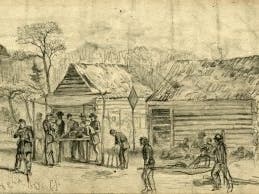
The last I read of William H. Heath, he was riding in a carriage with Col. Lyman Dyke on the way to Salem. Born in New Hampshire, William Heath had graduated from Harvard College in 1853, where he studied medicine, and the following year, at age 25, had started a practice in Stoneham. Seven years later, he married Delia Maria Belknap of Medford.
From all accounts the young doctor found Stoneham a good place to live and work. He was elected to the school committee and was treasurer of the Stoneham Five Cents Savings Bank. This particular day, he and Colonel Dyke were talking about starting a free library. The fruits of their labors led to the beautiful facility we have today at 431 Main Street.
William B. Stevens in his 1891 History of Stoneham recalled Dr. Heath’s “kindly smile and genial courtesy,” and praised him as “a very useful and public-minded citizen.”
Find out what's happening in Stonehamfor free with the latest updates from Patch.
As a surgeon in a growing industrial town of 3,200 residents, Dr. Heath would have had a busy practice. He would have made numerous house calls, delivered babies, lanced boils, treated injuries incurred on farms and factories, and illnesses ranging from consumption to smallpox.
Stoneham needed his skills, so when the Civil War started, he at first remained to care for those at home. They included soldiers returning from the war, men healing from wounds and diseases.
Find out what's happening in Stonehamfor free with the latest updates from Patch.
In May of 1863, however, Dr. Heath got an urgent telegram from Massachusetts Surgeon General William J. Dale. He had just learned that both the surgeon and assistant surgeon of the Massachusetts 2nd Infantry had been taken prisoner in the Shenandoah Valley campaign. They desperately needed replacements. Would William Heath come to Boston?
In Boston the Stoneham physician was asked if he would accept a temporary assignment to the regiment. “Yes,” Dr. Heath replied. “When?” “This afternoon,” the surgeon general replied.
According to one account, Dr. William H. Heath left for Virginia that very afternoon, without seeing his wife, to whom he sent a goodbye letter.
On June 3 Dr. Heath joined the 2nd Massachusetts Volunteer Infantry at Bartonsville, Virginia. A month later he accepted a permanent commission as second-assistant surgeon.
As a regimental surgeon, Dr. Heath would have practiced under the harshest of circumstances. Army doctors were often blamed for the high mortality rates of their patients. Surgeons, critics said, were too quick to amputate limbs, often without anesthesia.
It’s true that Civil War medicine, conducted before an acceptance of germ theory, was not hygienic, which contributed to high mortality rates. Also, doctors were slow to find effective treatments for the diseases that ravished armies on both sides, accounting for twice as many deaths as in battle. But the Civil War was also the incubator of significant innovations in American medicine. These included the use of quinine to prevent malaria, the isolation of soldiers to stem infectious diseases, and the development of safe anesthesia.
According to a study by Robert F. Reilly, M. D., “Medical and surgical care during the American Civil War, 1861–1865,” anesthesia was used in over 80,000 surgeries in the Civil War. Chloroform was preferred because it worked quickly, could be used in small dosages and was nonflammable.
Other advances came in the evacuation and transport of the wounded, techniques for repairing arteries, and rudimentary neurosurgery. As the war progressed, large, well-planned general hospitals were built, to which patients from field hospitals were sent by train or boat.
Regardless of medical improvements developed during the Civil War, a field surgeon’s job must have been horrendous. Three out of four surgeries were amputations.
“Each amputation took about two to ten minutes to complete,” writes Dr. Reilly. “There were 175,000 extremity wounds to Union soldiers, and about 30,000 of these underwent amputation with 26.3 percent mortality. The further from the torso the amputation was carried out, the greater the survival. As the war went on, it was noticed that if amputation was done within 24 hours, mortality was lower than if performed after more than 48 hours. Only about 1 in 15 Union physicians was allowed to amputate. Only the most senior and experienced surgeons performed amputations.”
Less than a year after his first commission, William Henry Heath of Stoneham was promoted to full surgeon at the rank of major. As such, he would have conducted numerous amputations, working around the clock in poor conditions. The worst days were those immediately following battle, when the wounded filled the surgical wards while others lay on stretchers outside.
When Dr. Heath wasn’t performing surgery, he would be making rounds. One Union surgeon wrote to his wife that he had worked from daylight until dark dressing “the wounds of 64 different men, some having two or three each.” He was “completely exhausted,” he continued, “but shall soon be able to go at it again.”
In The Record of the Second Massachusetts Infantry, 1861-65, the chaplain wrote: “Dr. Heath “served with great faithfulness and zeal, being distinguished as a very careful and skillful operator.... He was to be recognized as one of the best surgeons and truest men in the corps.”
Late in 1863, the 2nd Massachusetts marched west to join with the Army of the Cumberland. There they fought in the battles of Wauhatchie, Lookout Mountain, and Chattanooga. Under General William Tecumseh Sherman, they fought at Kennesaw Mountain and Peachtree Creek, before starting the siege of Atlanta. Exhausted and ill, Dr. Heath could go no further.
John Hartwell, in an online article, “Surgeons who Gave their Lives in Service to the Suffering,” picks up the story. “It was here that Surgeon William Henry Heath’s health failed him. ‘In consequence of his untiring attention to duty,’ he had contracted ‘typho-malarial fever,’ and was sent for treatment, to the Officers’ Hospital at Lookout Mountain, Tenn.”
Not long after, on August 28, at age 35, the good doctor died. In the official report Heath was described as “a faithful, conscientious, efficient officer, of superior qualifications.”
Captain Charles F. Morse wrote of Dr. Heath: “He was one of the best men I ever knew, — a pleasant, genial, kind-hearted companion, and as good a surgeon as I have ever seen in the army; his loss has been felt throughout the whole division. He fairly wore himself out in the service; this whole summer he has been surgeon of our division hospital and principal operator, in which position he worked himself to death.”
Today, in Lindenwood Cemetery, you can find the gravestones of William Henry Heath and his wife, Delia Maria Belknap, widowed at age 28. From their short time together in Stoneham, there were no children. As far as I could tell, she never remarried, but lived until 1913, when she died at age 76.
The Heath gravestones, recently refurbished to a shining white, are on a grassy knoll facing west. Visiting them one afternoon, I felt as if Dr. Heath and his wife had only yesterday been with us.
© Ben Jacques