Community Corner
History: Manufacturer, Innkeeper and Entrepreneur Burrage Yale
The man who gave his name to Yale Avenue was a larger than life character who drew strong feelings from his fellow citizens.
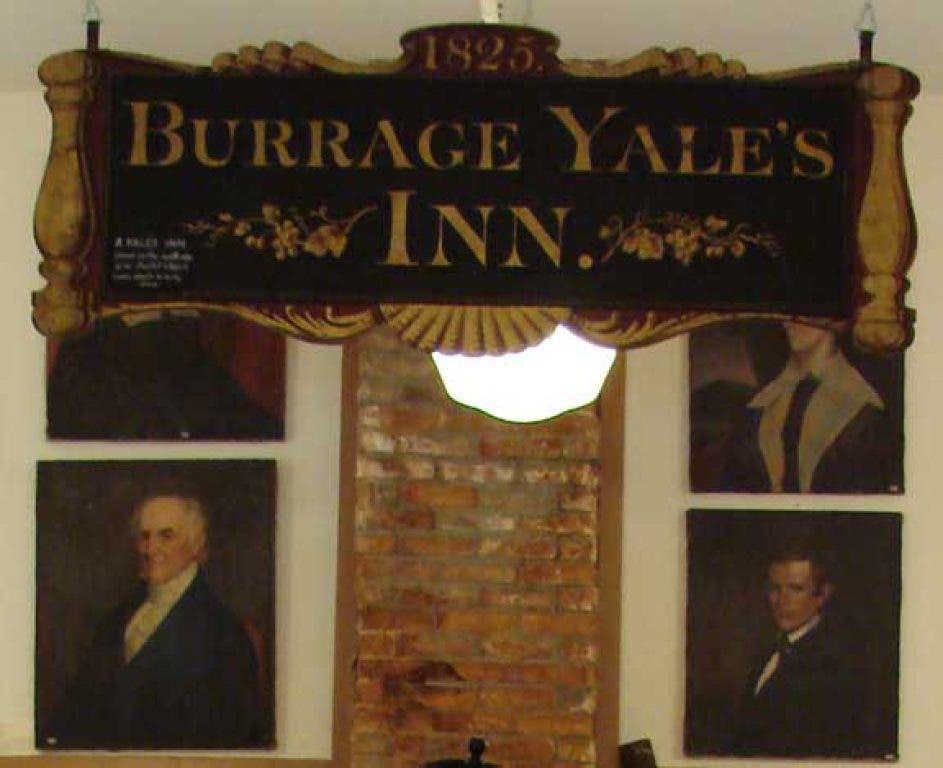
In the year 1800, a 19-year old itinerate tin peddler from Meriden, Connecticut passed through the old town of South Reading. Burrage Yale, the energetic and ambitious young salesman, must have taken a liking to the town. Within two years, he returned to make the town his home, and established a tin manufacturing business that made his fortune. It would become the town’s most important single business for several decades.
His first small tin shop stood on the corner of Main and Lafayette Streets. As the business prospered, he purchased a large old home on Main Street at about the present site of the Post Office. Yale moved into the house with his young wife, Sarah Boardman, the daughter of Col. Amos Boardman who kept an inn at 18 Elm Street. Yale had stayed at Boardman’s inn during one of his earliest stays in the town of South Reading, and must have taken a shine to the innkeeper’s daughter. The new Mrs. Yale had been a school-teacher, and taught in the Centre Schoolhouse located on the present Upper Common. She was a sweet-tempered and generous woman much beloved by her pupils, many of whom would later work for her husband, whose temperament was quite different from that of his wife.
A shrewd man of business, Burrage Yale went from owning one tin cart to owning a thriving factory across the street from his house, at the later location of the Wakefield YMCA (the present location of Artichoke’s Restaurant). In addition, he owned one hundred tin carts and employed the same number of tin peddlers to travel across New England selling his wares in towns and villages throughout the area. Ever alert to potential profits, Mr. Yale also opened the Old Tavern House, where he operated a tavern and also rented rooms as an inn. By 1813, he added a country store located on the corner of Main and Lafayette streets to his holdings.
Find out what's happening in Wakefieldfor free with the latest updates from Patch.
The Yale tin factory had the reputation of being the best place in the country in which to learn the art of tin plate making. Boys from 16 to 21 years of age were provided with housing, food, clothing, schooling and “attention to morals,” while these young men worked scheduled hours and promised, while being educated at the factory, never to commit a crime or to marry.
With his business interests established and earning healthy profits, the ambitious Mr. Yale became interested in having a political career, but sadly, some of the characteristics that made him successful as a businessman (strict punctuality, attention to detail and a penny pinching attitude) also made him completely unattractive to voters. In fact, he was widely viewed as a tyrant in the workplace and an unmerciful creditor. On one memorable evening, he was hung in effigy upon one of the ancient oaks across the street from his factory. The effigy figure was then ripped from the tree to roars of approval from the crowd, while it passed from hand to hand to be tossed into a bonfire. The next day, the old oak tree was hung with the sign, “This great and mighty lord, he is no more!” (Since Yale’s home was located just across the street, one can only imagine his feelings upon hearing the crowd cheer.)
Find out what's happening in Wakefieldfor free with the latest updates from Patch.
Yale ran for state legislature several times but was always soundly defeated by the voters, who had no doubt had encountered his severe exactness about little trivial matters and his domineering spirit. Nonetheless, he was sometimes successful in purely local elections for offices requiring his exacting talents, at one time serving as both Town Moderator and Town Treasurer. Perhaps his most important public office was that of Postmaster of South Reading, which he held for three years, probably using as his office a room in his home, on the present location of the Post Office.
Upon the death of his first wife, the sweet Sarah Boardman Yale, he remarried the Widow Wyman Richardson of Woburn. The new Mrs. Yale was considered an accomplished and estimable lady, but no one was very surprised that the union did not work out. In a very short time, the couple separated, and the second Mrs. Yale put distance between herself and her bridegroom -- she left the state entirely and went to live with her relatives in Connecticut.
A public spirited but somewhat parsimonious man, Burrage Yale would often lend his moral support to worthy causes, but seldom offered his financial support. Nevertheless, he made a large donation to the purchase of a new fire engine, named “The Yale” in his honor. The Yale Engine and the Yale Engine House (located on the present Lower Common), were important to the Town for many years.
Burrage Yale made significant contributions to the foundation and growth of the town of South Reading, employing over 100 people in the factory, in addition to the peddlers who hawked his wares across the area. In the year 1860, he paid a tax of $886.02, more than Cyrus Wakefield ($377.82) and Lucius Beebe ($353.38) combined. At his death on September 5, 1860 at the age of 79, the firefighters of the Yale Engine Company marched in the funeral procession in full uniform.
Three years later, the shoemaking firm of Thomas Emerson’s Sons bought the old tin factory and established their shoemaking factory there. Later that same year, a new road was laid out between Main Street and Railroad Street (the present North Avenue.) The name of the new road was Yale Avenue in memory of the man who had his home on one side of that road, and his factory on the other.