Health & Fitness
GREENHOUSES on the TURNPIKE
Greenhouses were first introduced to Mass. in the 1830s. Initially built as estate conservatories for the wealthy or amateur horticulturists to provide blooms for their enjoyment and decoration.


GREENHOUSES on the TURNPIKE...Part 1
Florists, greenhouse agriculture and nurseries also played a significant roll in Westborough farming scenario on the Worcester Turnpike. Greenhouses or hothouses were first introduced to Massachusetts in the 1830s. They were initially built as estate conservatories for the wealthy or amateur horticulturists to provide seasonal blooms for their enjoyment and decoration. The houses were very ornamental with decorative wrought iron, curved glass, mechanical vent systems and heaters. The first known greenhouses built in Westborough were at the Gilmore and Davis farms on the Turnpike in the 1880s. However, greenhouses soon became used on a much larger scale by commercial growers and for retail sales purposes. From 1930 to 1970 Westborough was recognized as a significant producer of carnations in Massachusetts.
However, the late 1960s, early 70s were years when there was a significant decline in the greenhouse growers industry. The cost of fossil fuels used to heat the glasshouses in the winter, maintenance and repair of the glass and cypress bars and employee costs significantly diminished the profit margins. By the early 1970s the larger greenhouse ranges were disappearing (throughout) Massachusetts. The greenhouses were torn down and the land was sold off to developers. The carnation-growing business migrated to the sunshine states where the overhead was minimal and labor was abundant.
Find out what's happening in Westboroughfor free with the latest updates from Patch.
The first commercial greenhouse was built at the N. Porter Brown property on Lyman Street near the corner of the Turnpike in 1897. Mr. Brown and his son Albert erected a 110 x 21-foot greenhouse for the purpose of cultivating pink carnations for the Boston market. Brown also advertised as a grower of California violets in the New England Florists Magazine.
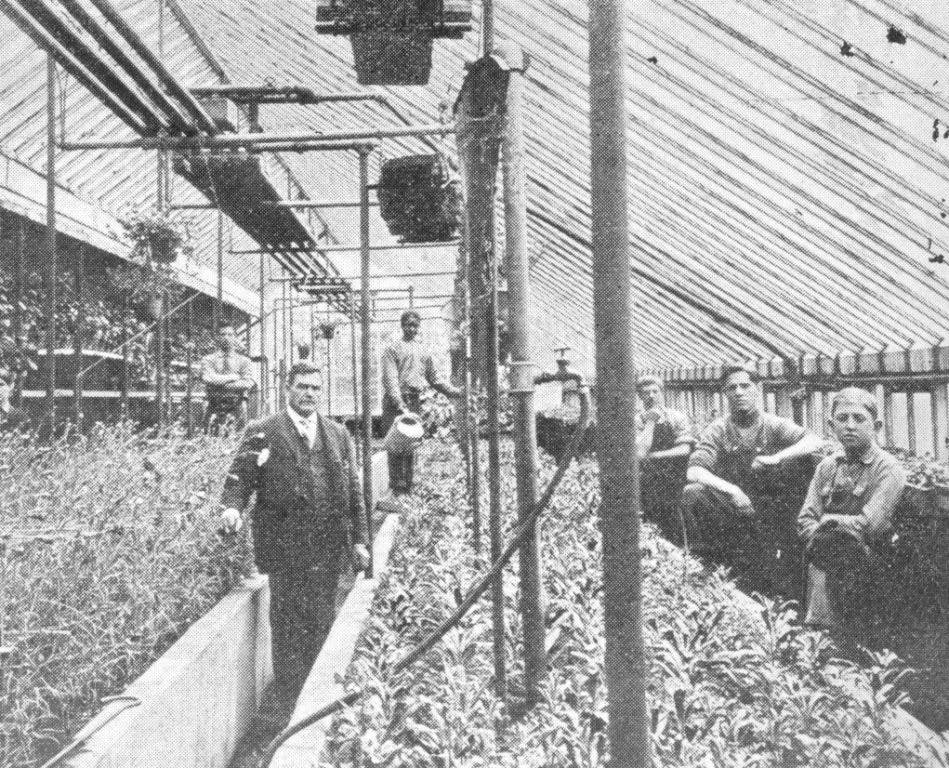
Lyman School Greenhouse built 1901
Find out what's happening in Westboroughfor free with the latest updates from Patch.
The Lyman School boys built a 100 x 28-foot greenhouse in 1901 located directly behind the administration building. It was particularly useful not only as a means to propagate seedlings of vegetables, fruits and flowers for the school farm, but also as a learning experience for the boys.
Westborough Conservatory ~ Leonard Midgley
Leonard Clegg Midgley was born in England and came to America in 1869. He married Clara E Holden of Worcester in 1885. He was self taught in horticulture and spent two years at the Worcester Conservatory. While at the Conservatory he was recognized by the Worcester County Horticultural Society for carnation display in 1904. That same year he began leasing property in Westborough, built two large greenhouses and entered the wholesale florists business as the Westborough Conservatory. In 1907 he purchased a 50-acre site today Westborough Shopping Plaza and 14 additional acres for $4,000.
In 1912, Midgley was awarded the Blake Medals for creation of Eureka Scarlet carnation. He was an officer of the Worcester County Horticultural Society until 1910, Worcester Chamber of Commerce, Worcester Grange and Royal Arcanum. He founded the Midgley quartet. Whose Who in New England 1915
Paul Brigham
In 1912 the Midgleys sold the Conservatory to Paul Brigham. Under Brigham the Westboro Conservatory became a thriving wholesale flower business primarily growing carnations for shipment to the Boston market and the east coast. The Boston & Worcester Street Railway built a freight house at Lyman Street to accommodate the growers.
Then in 1923 Brigham took a partner, Archibald MacGuffog of Nahant, an experienced grower from Glasgow, Scotland. In 1928 business was so good that the partners bought 10 acres of land bordering the Turnpike that was part of the La Paradis Farm Inn owned by Elmer Bliss of East Main Street and built two Lord & Burnham greenhouses, 50 x 500 feet, close to the Turnpike.
Even though business continued to flourish, there was a split in the partnership and by 1933 the partnership had terminated, and MacGuffog took over the houses on the Turnpike. The following spring he opened a retail store. Both locations continued to prosper. Brigham primarily catered to the wholesale market while MacGuffog, with the help of his daughter Sylvia, expanded their retail business, primarily, offering cut flowers and arrangements, bouquets, catering special events and holiday plants. In 1936 Brigham and MacGuffog separately won blue ribbons at a New York City flower show for their prize carnations. In 1937 Brigham added an additional greenhouse 40x150 to his range making 40,000 feet under glass. The range consisted of five greenhouses on 5½ acres of land. Resource: masslandrecords, 2582-106
At a New York City flower show in 1939 Brigham’s carnation design and creation again brought him national attention when he won two first place awards for his Salmon Pink “Eleanor” and “ Matchless White” carnations and a second for a dark red named “Woburn”.
Archibald MacGuffog ~ Sylvia MacGuffog Valencia
Archibald MacGuffog added an additional four premium Lord & Burnham greenhouses to the Turnpike range. These houses covered an area of 1¼ acres under glass. From 1933 an estimated one million carnations per year where grown here. Sylvia MacGuffog married Estaban Valencia in 1937 and began traveling throughout the country attending horticultural shows and seminars.
Sylvia took over MacGuffog Inc. in 1954 when her father died. She became the third generation florists of the MacGuffog family. Sylvia became nationally known and toured the country lecturing on flower design and management. She became the first woman officer and member of the board of directors in the Floral Telegram Delivery Association FTD.
An A-frame-style glass front showroom and retail store (were) built as part of a large greenhouse for customer access to view and purchase cut flowers, bouquets and arrangements. A fire of undetermined origin destroyed the showroom in 1966.
In 1961 Sylvia was chosen to supervise the floral decorations for President Kennedy‘s Inaugural at the White House and at four inaugural balls using over 78,000 red/white and blue carnations from locally-grown florists. Sylvia MacGuffog died of a heart condition Nov 16, 1965 she was 52 years old.
The American Floral Industry honored Sylvia MacGuffog Valencia in 1967 with the establishment of the Sylvia Award, a silver cup presented yearly in tribute to her distinctive flower design and outstanding business-woman leadership. Reference: Society of American Florists, Westborough Chronotype
In 1983 MacGuffog’s Greenhouses and home were leveled and the site was developed as the Westboro Executive Park, three, three-story non-descript brick office buildings. In 1967 Brigham’s was sold to Bob Bergevin, who continued the wholesale carnation business until 1970. See Part 2
Glenn R. Parker