Neighbor News
Priced Out: Massachusetts and Winchester Attempt to Tackle Housing Crisis
Winchester can improve affordability by expanding housing options and altering zoning near transit and town centers.


Note: Although property taxes were identified by 61.9% of respondents as a contributing factor, this paper does not focus on property tax reduction because of the potential impact on essential public services and community infrastructure if current balanced numbers are adjusted. Our research focused primarily on housing supply and zoning policies.
Winchester’s Housing Crisis Is Pricing Families Out
By: Sonia Rife (Grade 8)
Find out what's happening in Winchesterfor free with the latest updates from Patch.
To afford housing in Massachusetts today, families may need an income well over six figures. For countless people, this reality seems virtually impossible.
Housing affordability in Massachusetts has become an increasingly urgent issue as the costs of both renting and purchasing homes are rising well beyond average wages. The median home cost in the Greater Boston area has risen to $900,000, while incomes have not increased at the same rate. According to Mass.gov, from 2000 to 2024, home prices have increased by 73%, while in the same time span, the median household income has only increased by 4%. Over a short timespan, the overpowering rate at which home prices are increasing will leave the majority of low-to-middle-income citizens in a chaotic state.
Find out what's happening in Winchesterfor free with the latest updates from Patch.
To better understand the way residents perceive the issue, I conducted a community survey among residents connected to Winchester and nearby Metro North suburbs. Nearly all respondents described housing as unaffordable. Focusing on people in this specific Massachusetts suburb, Winchester, where our group intends to concentrate, 97.5% of respondents of all ages and occupations find Winchester’s housing moderately expensive to exceedingly unaffordable.
I questioned what the respondents would support for taking action to address this affordable housing issue. 67.4% of respondents said to build more affordable housing. 75% of those who responded want to build more housing near public transportation/Massachusetts Bay Transportation Authority (MBTA) train stations. 97% of respondents support converting areas with unused buildings into housing units.
The housing affordability crisis in Massachusetts is primarily driven by restrictive zoning and insufficient housing supply, which prevent housing production from meeting demand near major job centers.
The survey responses connect to research on the primary causes of the housing affordability crisis.
- Zoning Restrictions
Local zoning laws are legislation that determines what type of housing may be built and where. Most Massachusetts communities mainly zone land for single-family houses. There are strict rules regarding lot size, building height, density, and parking minimums. These make it difficult to build new housing developments while Massachusetts is lacking in housing supply. Single-family zoning limits the construction of apartments and multi-family housing; multi-family housing is only allowed on a small percentage of land in MA. Established by Section 3A of the Massachusetts Zoning Act, while single-family homes are permitted on 96% of the state, two, three, and four-or-more-family units are only authorized in 38%, 7%, and 3.5%-4% of the state, respectively. The vast majority of the state is off-limits to multi-family construction without a special permit or variance. Nevertheless, this is actively changing due to the MBTA Communities Law.
Parking minimum requirements increase development costs. Large parking requirements take up expensive land that could otherwise be used for building, making denser housing near public transit harder to build.
- Underbuilding/Housing Supply
Massachusetts has not built enough housing to keep pace with demand. Experts estimated that Massachusetts needs approximately 220,000 additional housing units by 2035 to address the shortage. Limited housing supply directly affects rising home prices and rent costs. Demand for housing remains high due to strong job opportunities, universities, hospitals, and access to Greater Boston.
The Metropolitan Area Planning Council (MAPC) observed 409,000 single-family home sales in Massachusetts from 2010 to 2019 and estimated that only 24% of sales were affordable to moderate to low-income families (70% statewide AMI, or median income). Between 2007 and 2011, Massachusetts lost 11,500 affordable housing rental units for low-income families, further shrinking an already limited affordable housing supply. To afford a house in Massachusetts, you need a yearly income of approximately $162,000, as the median single-family home price in the Greater Boston area is $950,000.
- Transportation and Transit Connections
The MBTA Communities Act requires communities near transit stations to allow multi-family zoning districts. Building housing near commuter rail and public transportation can increase supply while reducing dependence on cars.
- Investor Activity
Investor purchases also contribute to competition in the housing market. Around 1 in 5 homes in Greater Boston were purchased by investors.
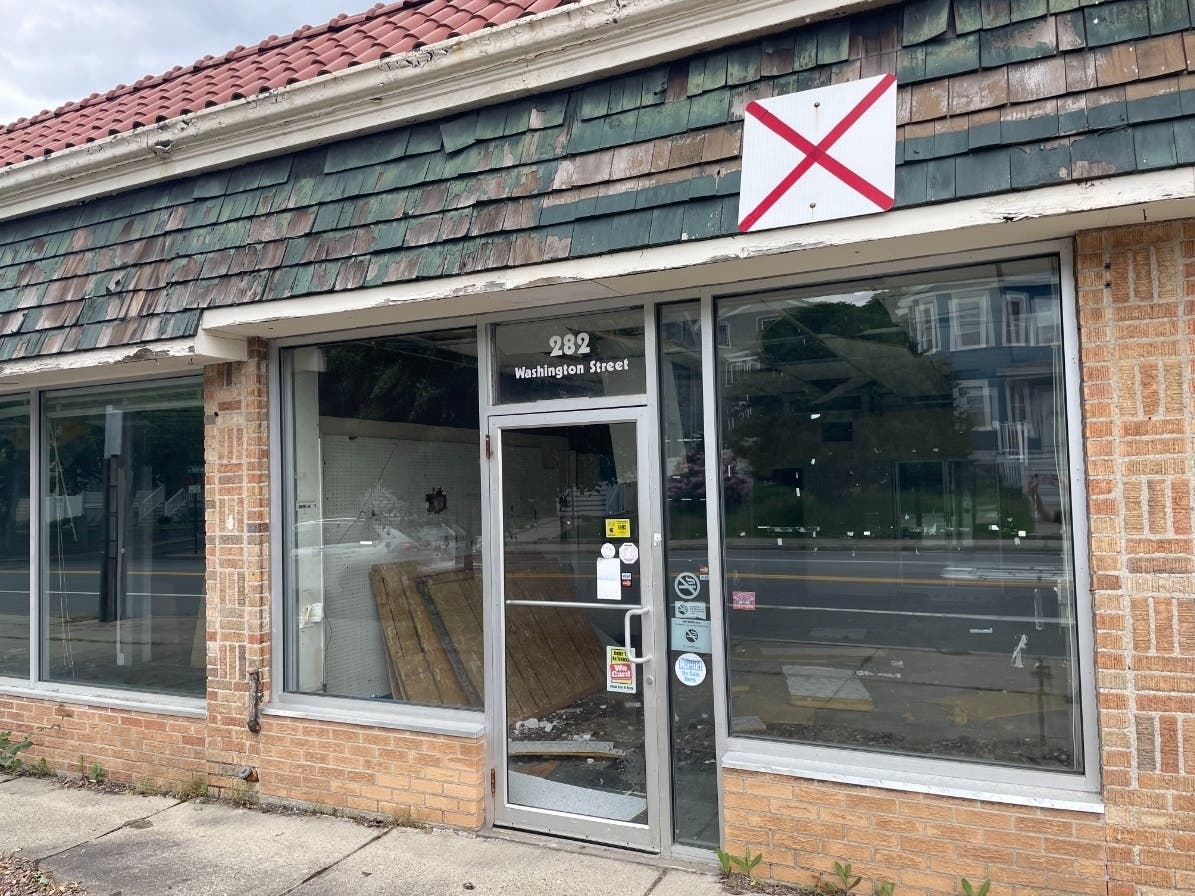
Winchester’s housing debate reflects broader statewide efforts to address affordability through local action. Winchester is a town with access to public transportation, including Winchester’s two commuter rail stations, connecting it to the MBTA Communities Act discussed above. In Winchester, a recently discussed topic regards how unused commercial properties and abandoned development sites along Washington Street represent potential opportunities for transit-oriented housing. Supporters argued that converting these spaces into multi-family developments would help increase housing supply. Through various proposals from different development companies and numerous town meetings, the abandoned slots have been bought by Winchester and are going to be used to build affordable units.
Winchester town officials began publicly discussing the purchase of underutilized commercial properties near Washington Street for affordable housing development in 2020. Some of these commercial properties have been vacant since 2013, and there was initially a plan to develop a CVS site that was ultimately rejected because of strong public opposition. In 2020, town meeting members proposed allocating $3.15 million for several plots. Ultimately, the town acquired the plots for approximately $5.3 million using eminent domain. Eminent domain allows the government to take private property for public use, provided the owner receives compensation, but the process is often controversial since it can force property owners to sell land against their intentions. However, town planners stated that simply owning the land would not help Winchester achieve “safe harbor” affordable housing status. Town meeting members also proposed amendments requiring that any housing units built on the site be rental-only developments and that future property sales or eminent domain actions receive additional town approval and legal review. In 2022, the town issued a request for proposals (RFP) for the plots and ultimately selected the Melanson Development Group to develop the land within the guidelines the town set forth regarding housing development. Currently, the zoning board has approved a permit for a 64-unit, three-story mixed-income development at the location. Next steps will be to sell the land to the Melanson Development Group and then begin construction.
Even though the affordability crisis seems to be worsening, state and local governments have begun implementing numerous solutions. Developers have begun building houses to rent, not to sell. Build-to-rent housing increases supply and provides more affordable options than buying due to the decrease in competition and value. Additionally, the Massachusetts state government created plans and legislation to change zoning laws and create more apartments and multifamily homes. One major example is the MBTA Communities Act, which requires towns with MBTA access, such as Winchester, to allow multifamily housing near transit stations in order to increase housing supply. Cities may also gain grants and tax breaks for building more housing. Boston has already approved more than 60 development projects, adding around 3,733 housing units. Boston is also converting empty office buildings into apartments and using public land to build housing, parks, and libraries. Furthermore, an Anti-Displacement Plan was created to help protect residents from increasing housing prices and displacement from their communities. Affordable housing is currently being funded through federal and state governments, tax credits, and local funding, while housing vouchers help cover rent gaps for low-income families. For example, Chapter 40B allows developers to bypass some zoning restrictions if affordable housing is included in the project. The Affordable Homes Act (AHA) invests more than $5 billion into affordable housing, public housing repairs, first-time homebuyer programs, sustainable housing, and ADUs (Accessory Dwelling Units, informally known as Granny Flats). Momentum Fund provides additional funding to speed up housing projects. Proposed policy changes focus on increasing housing supply and improving affordability. These include reducing parking minimums near transit, increasing zoning flexibility, allowing more multifamily housing by right, and strengthening anti-displacement protections to help lower-income residents remain in their communities.
The goal is not to eliminate local planning or overwhelm communities, but rather to create carefully managed housing flexibility that allows teachers, young families, seniors, and workers to continue living in the communities they support.
Addressing housing affordability will require balanced changes that increase housing supply while preserving the stability of existing communities.
Get Involved
- Petition: https://www.ipetitions.com/petition/make-winchester-a-affordable-town
- Community Survey: https://docs.google.com/forms/d/e/1FAIpQLSf-Cy9S2YwTiP09plp5C6m86KQsAWE1vemkXR3ZwPHCLg4tdQ/viewform?usp=header
“Accessory Dwelling Units.” Mass.gov, 2024, www.mass.gov/info-details/accessory-dwelling-units?_gl=1. Accessed 25 May 2026.
“Affordable Rental Housing.” Mass.gov, 2025, www.mass.gov/info-details/affordable-rental-housing.
“Chapter 40B Planning and Information.” Mass.gov, 2026, www.mass.gov/chapter-40b-planning-and-information?_gl=1. Accessed 25 May 2026.
“Consumer Prices Are Even Higher as Businesses Try to Keep up with People Eager to Buy.” NPR, 12 Jan. 2022, www.npr.org/2022/01/12/1072548425/consumer-prices-are-even-higher-as-bus....
“Executive Office of Housing and Livable Communities.” Mass.gov, 2023, www.mass.gov/orgs/executive-office-of-housing-and-livable-communities?_g.... Accessed 25 May 2026.
“Healey-Driscoll Administration and MassHousing Announce First-In-The-Nation Momentum Fund Commitment to Build More Reasonably Priced Housing.” Mass.gov, 2025, www.mass.gov/news/healey-driscoll-administration-and-masshousing-announc.... Accessed 25 May 2026.
Hernandez, Joe. “Trump Calls Affordability Crisis a “Hoax.” the Data Tells a Different Story.” NPR, 11 Dec. 2025, www.npr.org/2025/12/11/nx-s1-5639957/trump-affordability-hoax-economy-mi....
“MBTA Communities Compliance Model & Components.” Mass.gov, 2026, www.mass.gov/info-details/mbta-communities-compliance-model-components?u.... Accessed 25 May 2026.
“Multi-Family Zoning Requirement for MBTA Communities | Mass.gov.” Www.mass.gov, www.mass.gov/info-details/multi-family-zoning-requirement-for-mbta-commu....
“Planning Department Advances Zoning Reforms in Support of New Housing, Small Businesses.” Boston.gov, 31 Dec. 2025, www.boston.gov/news/planning-department-advances-zoning-reforms-support-....
Rife, Sonia. “Affordability & Cost of Living | Community Survey.” Google Docs, 2026, docs.google.com/forms/d/17rT6TqJ7Gl_U6Q0lb63HgrLZbu-UtotLYOXEqVMeVAo/edit#responses. Accessed 25 May 2026.
Ruiz-Goiriena, Romina. “Biden’s Infrastructure Plan Calls for Cities to Limit Single-Family Zoning and Instead Build Affordable Housing.” Www.usatoday.com, 14 Apr. 2021, www.usatoday.com/in-depth/news/nation/2021/04/14/zoning-biden-infrastruc....
Solis, Steph. “Massachusetts Housing Market’s Spring Thaw Begins.” Axios, Axios Boston, 13 Apr. 2026, www.axios.com/local/boston/2026/04/13/massachusetts-march-real-estate-sales. Accessed 25 May 2026.
“The Affordable Homes Act: Smart Housing, Livable Communities | Mass.gov.” Www.mass.gov, www.mass.gov/info-details/the-affordable-homes-act-smart-housing-livable....
“The Zoning Framework in Massachusetts.” Mass.gov, 2021, www.mass.gov/info-details/the-zoning-framework-in-massachusetts?utm_sour.... Accessed 25 May 2026.
Abnewswire.com, 2026, www.abnewswire.com/pressreleases/2026-massachusetts-housing-trends-show-.... Accessed 25 May 2026.
Atlas, Zoning. “National Zoning Atlas.” National Zoning Atlas, 2026, https://www.zoningatlas.org/zoning-report-massachusetts-2026. Accessed 25 May 2026.