Schools
Bloomfield Hills High School Plan Going To Voters in May
School board approves ballot proposal and will put $20 million down while asking for $58 million bond request.




Eager for closure on a divisive community issue and to speed construction of a single, unified high school, the Bloomfield Hills Schools Board of Education on Thursday approved a $78.7 million millage proposal for the May 8 ballot.
The board also approved $20 million of existing funds toward the project, making the bond request closer to $58 million to be paid over 26 years.
Find out what's happening in Bloomfield-Bloomfield Hillsfor free with the latest updates from Patch.
The vote was unanimous, and was greeted by cheers from several supporters and district employees still at the Doyle Center shortly before 10 p.m. Several residents opposed to the measure left before the final vote.
"I just don't know how to bring you more value, I just don't," said Superintendent Rob Glass, who said he spent 14 months working on a proposal that wouldn't meet the same fate as failed consolidation plans of the past. Those included two bond requests for $121 million and $73 million that lost convincingly at the polls in 2007 and 2010, respectively.
Find out what's happening in Bloomfield-Bloomfield Hillsfor free with the latest updates from Patch.
The current plan is a combination of new construction and renovation to parts of the existing Andover High School campus. If the bond passes, the hybrid building could house 1,650 students at a new Bloomfield Hills High School by the Fall of 2015. Students would leave the Andover site for two years and be split, with ninth-graders going to Hickory Grove and grades 10-12 moving into Lahser High School. Model High School would move to Pine Lake during the transition and would be on the new high school campus if it is built.
If the bond fails, Andover and Lahser will still merge into Bloomfield Hills High School as planned in the fall of 2013. But they will remain on separate campuses.
The district will still save money in operations in that scenario, but not nearly as much as the $2.4 million expected annually if the bond passes, Glass said. Those savings are critical to help the district maintain academic programs given declining enrollment and economic forecasts.
Glass provided the board with three options that included designs for enhanced athletic facilities and collaborative learning spaces that each added about $8 million to the base cost for the hybrid plan. He recommended both in an ‘all-in’ scenario, and board members deliberately chose to combine all the options into a single proposal to limit confusion at the ballot box.
"I'm completely at peace with this decision," said Trustee Mark Bank, who has two children that will be affected by the transition. "We're preserving academics and our comprehensive curriculum . . . and there's great definition to the plan. There is no blank check."
The Cost
District figures show that the owner of a home with a taxable value of $250,000 would pay $290 annually if the millage passes.
That price includes the $20 million contribution from the district, which will come from a combination of existing capital improvement funds ($11 million) and a portion of the district’s co-curricular endowment fund, which currently consists of $12 million in contributions and $1.6 million in interest.
Glass recommended keeping roughly $5 million of that money in reserve for emergencies or other facility need that may arise.
Currently, the district levies roughly 2.5 mills. The Sinking Fund, a voter-approved millage for facility upkeep, is scheduled to decrease from 1.5 mills to just under 1 mill in 2014, and will be phased out in 2018 unless renewed.
While the May millage request is a new tax, Glass said that the overall tax rate will decrease long term, even if it passed.
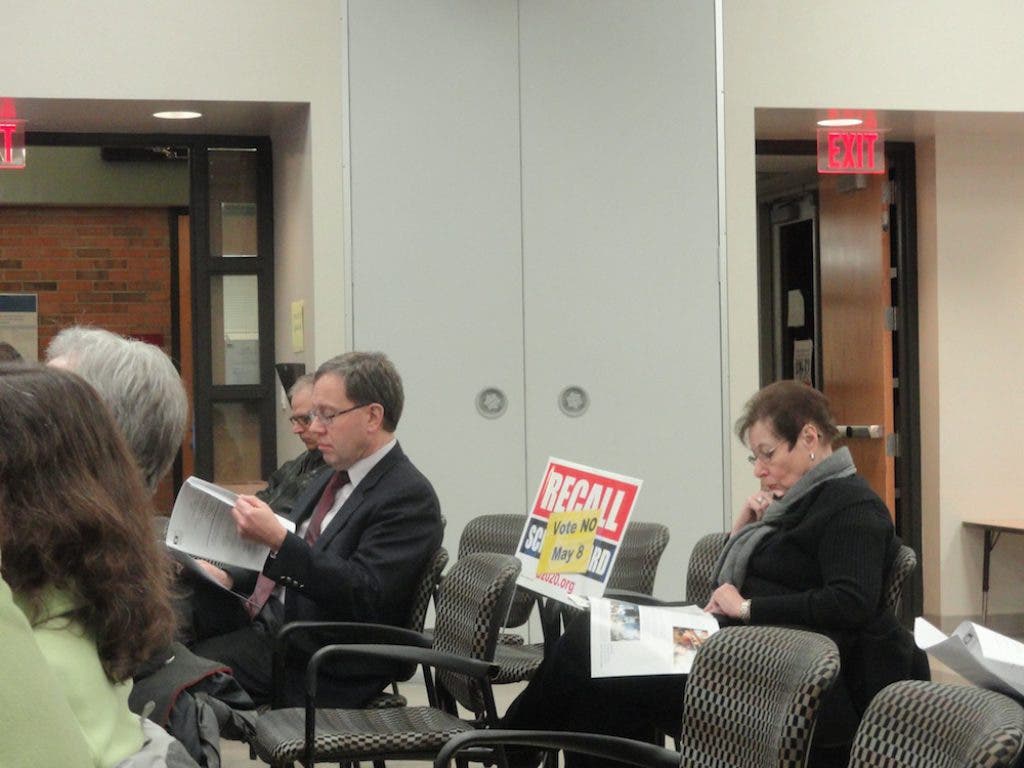
Isabella Tucci said that's not a convincing argument and that immediate tax increases could deter potential home buyers from choosing the district. She brought a yard sign from the failed effort to recall the entire board with a yellow sticker on it urging a "no" vote May 8.
She added that trust issues over past missteps by the district still exist, and won't be helped by having a May vote, when turnout is expected to be lighter than the November presidential vote.
Those issues don't exist for Charles Gaba, a Lahser alumnus that moved back into the district for the school system just before the 2010 ballot question and voted 'no.'
"There was a transparency issue, and it seemed like a bad plan," he said. "I'm 100 percent behind this plan, and I think the current board and Superintendent Glass have done a fantastic job communicating everything. I want a May election."
The Timing
The board agreed that a May vote was necessary to prevent a third year of construction/student transition, and to give families some sense of the future before the end of this school year.
Board critic Chris Fellin argued that a May vote would circumvent the public's ability to decide the issue. He estimated that roughly 80 percent of district voters do not have children currently in the district, and will have a hard time getting informed in time.
"A November election is the right time," Fellin said. "Twenty percent are parents and other 80 percent will absolutely be there in November. They won’t be sufficiently notified."
He also raised questions about traffic and expressed some concerns about emphasizing bricks mortar over academics.
Glass promised the vote will be sufficiently publicized and that it will be top-of-mind for engaged voters.
"If there's someone who thinks this is a stealth election, or that they don’t know this is happening, then I don’t know what they’re paying attention to," he said.
Get more local news delivered straight to your inbox. Sign up for free Patch newsletters and alerts.