Crime & Safety
UPDATED: Alleged Uber Shooter's $10M Lawsuit a Fake, Sheriff's Office Says
Kalamazoo County officials say "lawsuit" was postmarked in Philadelphia and that accused Uber killer Jason Dalton "did not send it."


Updated at 12:29 p.m.
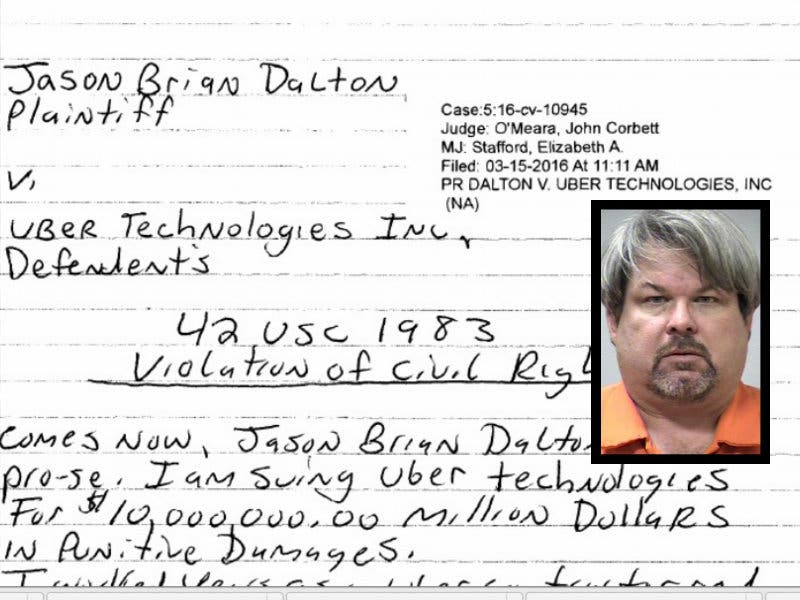
KALAMAZOO, MI – Though widely reported around the world, a $10 million federal lawsuit reportedly filed by accused Kalamazoo shooter Jason Dalton against the ride-hailing company Uber appears to be a hoax.
The hand-scrawled, disjointed complaint, which was widely circulated, was postmarked in Philadelphia and wasn't authorized by Dalton, Kalamazoo County Undersheriff Paul Matyas told WOOD-TV.
Find out what's happening in Bloomfield-Bloomfield Hillsfor free with the latest updates from Patch.
“To let you know, the Dalton lawsuit was a hoax,” Matyas said in a statement to the television station. “I was suspicious last night when I saw the envelope the lawsuit came in was postmarked Philadelphia. We investigated and Dalton did not send it, did not authorize it and does not know who sent it. Further it was not his handwriting and it is not a jail envelope.”
A host of news organizations around the world, including Patch, reported the lawsuit as legitimate.
Find out what's happening in Bloomfield-Bloomfield Hillsfor free with the latest updates from Patch.
In a statement Thursday, U.S. District Court spokesman Rod Hansen said all lawsuit filings are entered electronically into the system upon receipt.
"The procedure is to receive it, put it into the system, get a magistrate judge, district court judge, and docket the case,” he said. “At some point in the future the subpoenas would be delivered. At this point in the process we would be able to determine if it was fake.”
Earlier on Patch
Dalton, 45, of Kalamazoo, a former insurance adjuster with a clean criminal record, reportedly picked up fares between the shootings that rocked the security of the western Michigan town on Feb. 20. He has been charged with six counts of open murder and two counts of felony firearm.
He described “an artificial presence” that “feels like it is coming from the phone itself.”
A “devil figure ... would give you an assignment and it would literally take over your whole body," according to the police report.
He also said Uber drivers don’t have to “drive at all” and that “the car just goes.”
The Phony Lawsuit
Get more local news delivered straight to your inbox. Sign up for free Patch newsletters and alerts.