Politics & Government
Flint Airport Stabbing And U.S.-Canada Border Security: 6 Essential Facts
U.S.-Canada border crossings get a closer look after the FBI said it regards the stabbing of a Flint airport police officer as terrorism.

DETROIT, MI — Authorities say a Canadian man from Tunisia crossed legally into the U.S. days before stabbing a police officer in the neck at a Michigan airport. The attack raises questions about security along the northern border, including what the process is for travelers and how many people are detained or denied entry.
(For more local news, click here to sign up for real-time news alerts and newsletters from Detroit Patch, click here to find your local Michigan Patch. Also, like us on Facebook, and if you have an iPhone, click here to get the free Patch iPhone app.)
A look at some common questions and answers:
Find out what's happening in Detroitfor free with the latest updates from Patch.
Q: How many people cross from Canada into the U.S. each day?
A: U.S. Customs and Border Protection says about 216,000 people come into the U.S. from Canada on a typical day. That's out of an average of 1.2 million people processed daily at all points of entry into the U.S. According to the Bureau of Transportation Statistics, the busiest port in terms of non-commercial traffic is Buffalo-Niagara Falls, New York. Detroit came in second, and Champlain-Rouses Point, New York, was fifth. Federal authorities say the suspect, Amor Ftouhi, entered at Champlain.
Find out what's happening in Detroitfor free with the latest updates from Patch.
Q: How many different places are there to cross?
A: Border officials say there are 328 ports of entry, including land crossings and international airports, across the U.S. Of those, about 100 are along the Canada border.
Q: What's the process for getting across the border?
A: Travelers need a valid passport, enhanced driver's licenses offered in some U.S. states and Canadian provinces, or another official expedited entry card, such as Nexus. Such documentation became required in 2009 for U.S. and Canadian citizens who enter the U.S. at land and sea ports of entry from within the Western Hemisphere. The change was among many implemented after the 2001 terrorist attacks. Before that, a verbal claim of citizenship and identity were typically sufficient.
Q: How many people are detained at US. borders or refused entry?
A: Customs and Border Protection officials say they deny entry to about 750 individuals a day nationwide. That could be due to invalid travel documents, an expired visa or a criminal record in another country. About 1,140 people who are not lawfully in the U.S are apprehended daily. For fiscal year 2016, the agency reported nearly 416,000 apprehensions of what it describes as "illegal aliens," about 2,300 of whom were detained on the U.S.-Canada border.
Q. Are there examples of authorities stopping potential attacks at the Canadian border?
A. Border officials say agents at all ports of entry identify nearly 900 individuals on a daily basis who raise national security concerns. Spokesman David Long said the "primary mission" of his agency is preventing entry of attackers or weapons in to the country.
The 1999 arrest of Ahmed Ressam as he arrived at Port Angeles, Washington, by ferry from Canada with explosives in his rental car raised concerns about attackers living and operating north of the border due to lax immigration and refugee laws. Ressam was convicted in 2001 of planning to bomb Los Angeles International Airport during millennium celebrations. The Algerian who had trained at Osama bin Laden's camps in Afghanistan was sentenced to 37 years in prison.
Q: What are the staffing levels of U.S. border patrol agents?
A: The number of U.S. border agents has increased nearly fivefold since the early 1990s, from about 4,000 in fiscal year 1992 to 19,828 in fiscal year 2016. It reached a high of roughly 21,500 in 2011, the first of three years in which the level remained above 21,000. The overwhelming majority of those agents work along the Mexican border.
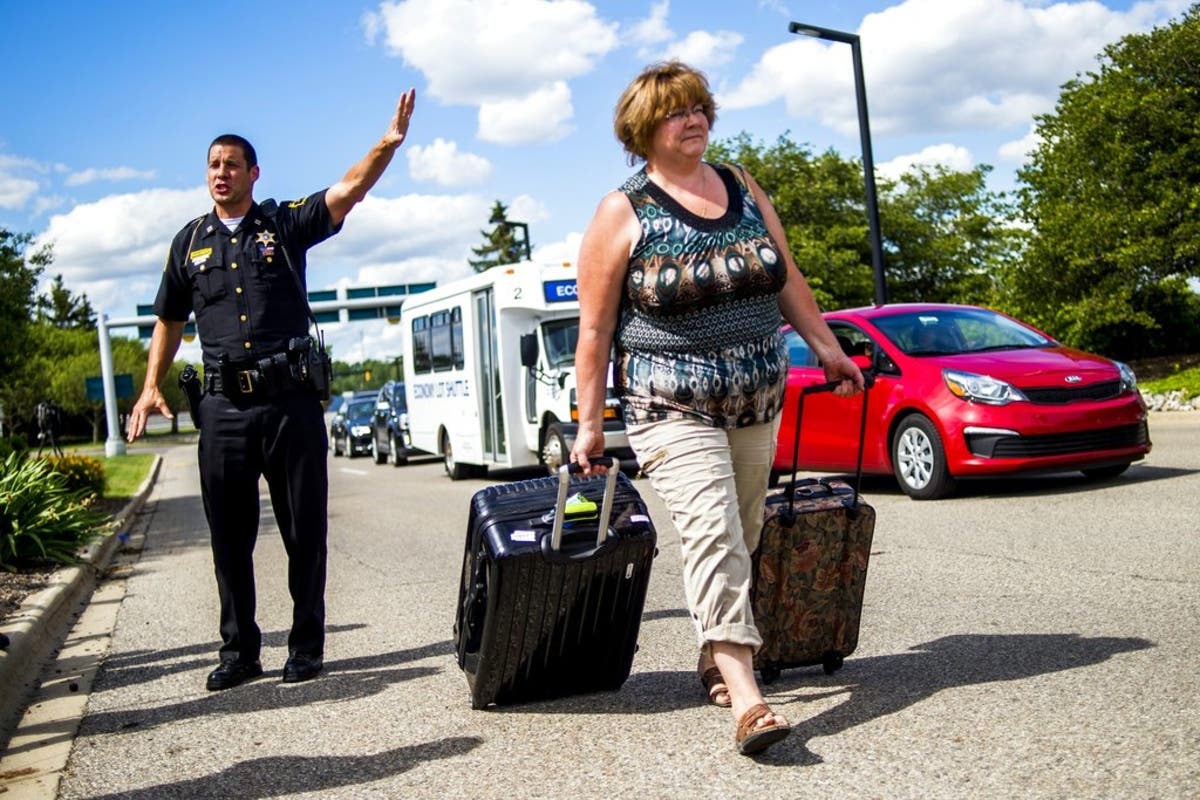
A traveler walks her bags up the roadway as a police officer guides traffic flow after Bishop International Airport reopens in Flint, Michigan, Wednesday, June 21, 2017, after a police officer was stabbed at the airport. A Canadian man shouted in Arabic before stabbing a police officer in the neck at the airport on Wednesday, and referenced people being killed overseas during the attack that's now being investigated as an act of terrorism, federal officials said. (Jake May/The Flint Journal-MLive.com via AP)