Community Corner
13 Mile Road in the Rare Old Days
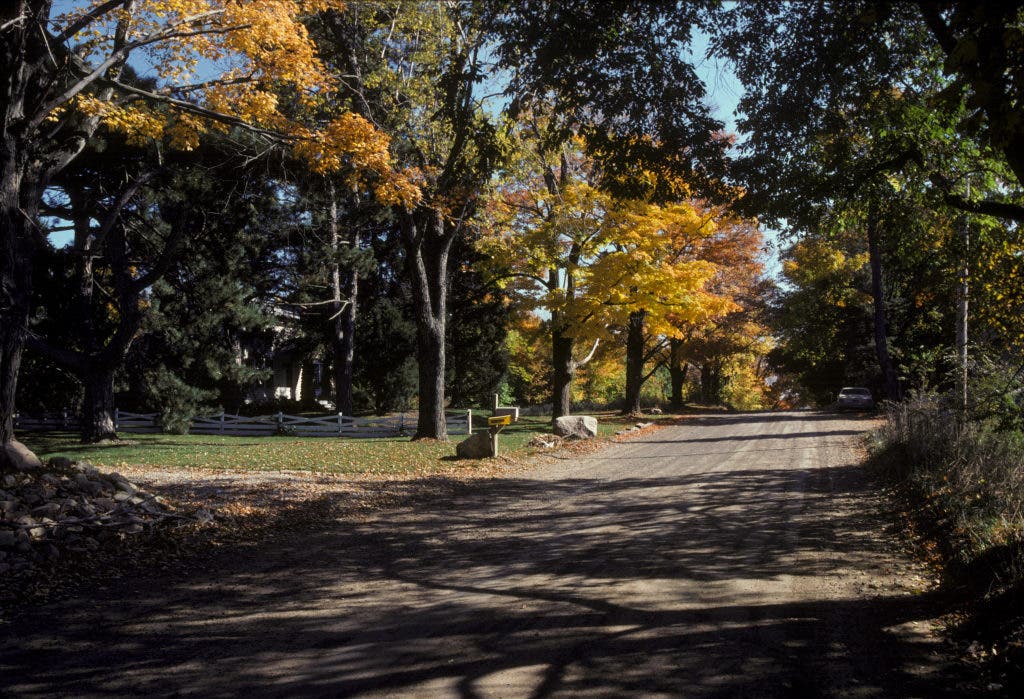
Long stretches of gravel road and undeveloped land kept the Farmington Hills neighborhood quiet.


After a life of non-stop small suburban home dwelling, I decided to take a new direction in 1980. I wanted to move to an older farmhouse on acreage in a rural setting. It needed to be reasonably close to possible work locations and have ready access to major highways.
All of these needs were met on 13 Mile Road in Farmington Hills.
Life there was indescribably idyllic throughout the '80s, and I would like to share some remembrances of those rare old times to try to give you an image of what living there then was like.
Find out what's happening in Farmington-Farmington Hillsfor free with the latest updates from Patch.
The area had a great percentage of unpaved roads, no sidewalks, no strip malls, and only a few traffic lights. The small businesses that did exist, primarily along Orchard Lake Road, were usually run by the owners who took a great deal of interest in knowing their customers personally.
One such place was “Irish Pizza” on the south side of 13 Mile Road, just west of Orchard Lake Road. My wife and I frequently dined on their products and they knew who we were when we gave them our phone number upon ordering.
Find out what's happening in Farmington-Farmington Hillsfor free with the latest updates from Patch.
Huge old trees closely lined the major roads, spaced 30 or 40 feet apart, and their upper limbs arched over the road forming a living tunnel of shade in the summertime. The gravel roads often developed pot-holes, and you had to drive slowly on the roads, there was no option. The road-side vegetation grew right up to the edge of the car tracks and you could almost smell what it was like to have been a pioneer settler in the 1830s.
The roads followed the rise and fall of nature’s topography and your “lawn” was at the same elevation as the road. There was the occasional bad car accident where someone would get driving too fast, lose control and slam into one of the trees. Those of us who lived in the area often walked down the street as our path and would stop and talk there, uninterrupted, for extended times. Our neighbor’s dog had a favorite pot-hole that he liked to sleep in.
When I moved in, I only had two neighbors, one next door, and one across the street, both far away by standards in Dearborn, my hometown. My property was surrounded by natural woods complete with hiking trails that were a delight to our kids. In the winter, we had our own sledding hill right behind us. At drive-time rush hour, you could stand in the middle of 13 Mile at the top of our hill and look eastward towards Drake Road and watch an endless string of car headlights approach. Almost without exception, when these westbound cars came past the “Pavement Ends” sign, to the stop sign at Drake Road, they turned left or right and left us undisturbed.
I remember the first time I decided to go exploring and took 13 Mile westward. It seemed like quite a trek just to get to the stop sign at Halsted. Continuing on, there were large open areas of farm land on either side of the road, and 13 Mile became a narrow 2-track road that had the occasional muddy patch with a temporary drive-around path so you could avoid getting stuck. The road virtually disappeared at the top of the very steep hill just east of Haggerty, and it was not readily apparent that there was an official road to travel on.
I stopped and got out of the car. All was silent. Then I heard the distinctive sound of a single car pounding its way through the pot holes on Haggerty. It took a while to spot the movement of the car since the road was not really visible through the bushes and trees. An old farmhouse stood directly at the bottom of the hill in the path of 13 Mile. You had to make a left turn and travel a short while before coming to 13 Mile again.
The west side of Haggerty Road in this area was composed of a few large farms with huge barns, which had classic oil paintings reproduced on their sides. Going only a few miles in any direction was quite an adventure, which would reveal old farms, horse-riding locations and a few old stores and gas stations. There was also the occasional lumber yard, and I got to know all of them quite well. I knew who to talk to, and where I could find that special piece of wood I needed for my current project.
Life on 13 Mile was quiet and slow, and it was a rare event when a car would come by. Usually, those who did come by would be lost, and they would stop for driving directions. If someone had car trouble late at night, you could expect they would pound on your door and ask to use your phone to call for help. Others that drove the area late at night were playing “Santa Claus”, and would leave nice presents along the side of the road for us to discover the next day. These presents consisted of old appliances, unwanted dead trees, lawn clippings, and dreadful old furniture. Since the law eliminating lead in paint was recently passed, we got the occasional gaggle of half used gallon cans of paint.
All of my neighbors lived along 13 Mile, and they all seemed to specialize in something. My next door neighbor would look after the mental health of the area, while collecting every loose rock in sight, Roy across the street would sell you a restaurant or a bar. Another specialized in trees, while another grew apples to sell. Some kept horses and constantly rode them up and down the neighboring streets.
There is so much more I could tell, but my space is limited. Perhaps you can see why we loved our area so much, and why we would always say “On 13 Mile, where the pavement ends, life begins”.