Politics & Government
Do You Know Where You Live?
Where are the township boundaries? Why are there two zip and area codes? What should you put on your return address label? We have the answers here.
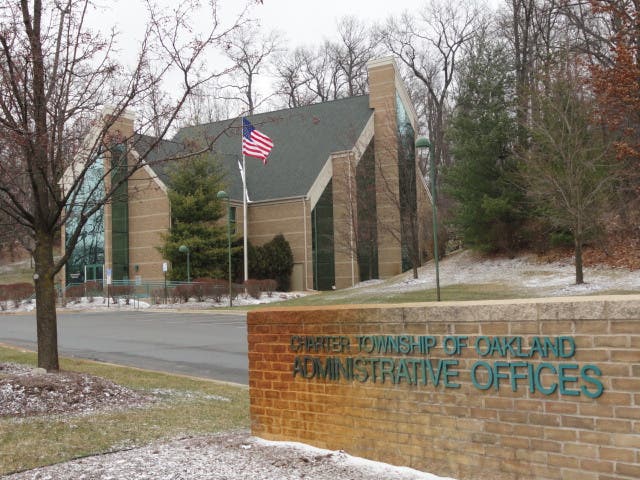
Recently, the young daughter of an Oakland Township Patch reader was asked to recite her address in class. When the little girl replied “Oakland Township,” her teacher told her she was wrong because the school, using the girl's ZIP code, lists Rochester as her address.
This prompted the girl’s mother to ask, where do we live?
For residents of Oakland Township, that’s not an easy question to answer, but there are some historical accounts as well as current policies that can help shed some light on the issue – and perhaps make it a little less confusing.
Find out what's happening in Oakland Township-Lake Orionfor free with the latest updates from Patch.
From the beginning
Oakland Township is one of the state’s oldest townships. Its first parcels of land were purchased by William Russell and Benjamin Woodward in 1819. Settlers began moving into the area and building log cabins by 1826 and, when the Michigan Territory was organized in 1827, Oakland Township was among its original 25 townships.
Find out what's happening in Oakland Township-Lake Orionfor free with the latest updates from Patch.
According to “Heritage in Oakland County,” a booklet written by historians Delta Kelly and Barbara Kandarian in 1976, Oakland Township originally comprised the upper three-fifths of Oakland County, while “the lower two-fifths was designated Bloomfield Township.”
“By an 1827 act of the Michigan Territorial Legislature,” Kelly and Kandarian pointed out, “Oakland Township lost ten townships but still contained what are today Addison, Oxford, Orion, Oakland and Avon.”
As the area grew with more settlers, the boundaries changed – many times. The township has been at its present size since Michigan officially became a state on Jan. 26, 1837.
So now that we know the history of the township's formation, let’s answer some other pertinent questions about where township residents live.
Where are the boundaries of Oakland Township?
The township covers approximately 36 square miles in land.
While not entirely drivable, the township boundaries do roughly follow five major roads: Romeo Road to the north, Mead and Dutton roads to the south, Kern Road to the west and Dequindre Road to the east.
The township is bordered by four surrounding communities: Addison Township to the north, Rochester Hills (formerly Avon Township) to the south, Orion Township to the west and Washington Township in Macomb County to the east.
So, if you live within these boundaries, you live in the Charter Township of Oakland. Period.
What is a charter township?
According to the township’s web site, there are two types of townships – general law and charter – and they differ from other forms of government. As stated, Oakland Township is a charter township.
On its web site, the township’s governmental office notes that “Charter township status is a special township classification created by the Michigan legislature in 1947 to provide additional powers and stream-line administration for governing a growing community. A primary motivation for townships to adopt the charter form is to provide greater protection against annexation by a city.”
The web site further states that “townships serve other governmental units by providing tax collection services. To avoid imposing an unnecessary burden on citizens to pay separate property taxes to the township, schools, special assessment districts and the county, Michigan townships provide uniform assessment of property values and collect all property taxes on behalf of the other units of government.”
Why do I have to pay fees to use some facilities in Rochester?
If you live within the boundaries of Oakland Township, you only pay Oakland Township taxes, not taxes levied by Rochester or Rochester Hills.
Some facilities, such as the Older Persons Commission (OPC) and the Rochester Hills Public Library, which reside in neighboring communities, may be used by Oakland Township residents for free because the communities have agreed to share those facilities and fund them through local millages.
There are also shared resources that are not funded by a millage, but rather by user fees. These resources include community recreational facilities such as parks and programs such as RARA.
Since RARA (Rochester Area Recreational Authority) is within the City of Rochester and used most often by residents of Rochester and Rochester Hills, it charges Oakland Township residents a higher non-resident fee.
On its web site, RARA shows the increase in use by township residents and states, “The cities of Rochester Hills and Rochester cannot continue to subsidize recreation for so many non-residents. Representative of these two cities serving on the RARA Board of Directors are working to encourage communities that readily participate in RARA activities to participate more in the funding.”
As for voting, township residents vote in township elections and not those in surrounding communities.
“When township residents pay their taxes, they go to the township hall,” said Janine Saputo of the township’s Planning Commission. “When they vote, they go to the township precincts and vote for local government. When they visit their local government they go to the township hall in Goodison.”
Sometimes this is the only reminder that one lives in Oakland Township,” she remarked.
It’s worth noting that over the years, township residents have come to rely heavily on the resources offered by larger and more commercialized communities to the south, namely Rochester and Rochester Hills. Thus a pattern of use develops, which continues to this day. Why build a library in Oakland Township, for example, when there is a large one nearby in Rochester?
Why does such a clearly-defined area have so many addresses?
Township residents use one of two ZIP codes – 48306 or 48363. All mail from Oakland Township (or Oakland as the township prefers) is processed through the United States Post Office located in Rochester. ZIP code boundaries are defined by the U.S. Post Office.
The Zoning Improvement Plan, or ZIP, was officially established by the U.S. Post Office in 1963. According to the “The United States Postal Service: An American History 1776-2006,” a tremendous increase in the volume of mail in the early 1960s led to the creation of a system that could make sorting and delivering mail easier and more efficient.
According to ZIP code maps from the State of Michigan, the lower portion of the township, as well as the northern section of Rochester Hills, a bit of northern Rochester and a tiny part of Orion Township and the City of Auburn Hills to the east, are covered by the 48306 ZIP code.
Residents living north of Gunn or Buell roads up to the township’s northern boundary use the 48363 ZIP code.
Since the township doesn’t have a post office, township residents use the address of the nearest post office in Rochester. Why? The answer may very well be because it’s always been that way, since the development of Rochester superseded that of more northern communities.
“The post office will accept a variety of names with the same ZIP,” said Oakland Township Manager James Creech. “For example, the post office will accept for 48306 Goodison, Rochester, Rochester Hills, Oakland, Oakland Township and Rochester Hills.”
“If you mail something to Oakland, MI 48306 or to Oakland, MI 48363,” said Saputo, “it arrives fine.”
Sometimes including the name of one municipality over another in a mailing address is a matter of preference. People and businesses often use the nearest municipality with the most name recognition.
Saputo said she notices township businesses prefer to use Rochester and even Rochester Hills in their advertising. This was the case in 1959, when Oakland University (which is located in two municipalities – Rochester Hills and Auburn Hills) used Rochester instead of Avon Township (now Rochester Hills) as their mailing address.
Why doesn't Oakland Township have a post office?
Again, this is a matter decided by the U.S. Post Office and is most likely determined by population size. There once was a post office in Goodison, which is an uncharted village or hamlet within the boundaries of Oakland Township. It was named for the Goodison family who purchased the Hemingway mill and established a nearby post office in 1874.
Because the mill, post office and a few other merchants were so close together, Goodison became a flag station for the Detroit and Bay City Railroad and the hub for local commerce.
As the need for a railroad declined and populations in surrounding communities grew, there was no longer a need for a post office in Goodison.
Why is Goodison unincorporated?
Population, most likely.
“Goodison did not move forward to incorporate as a government separate from the township,” said Saputo. “It remains a hamlet and is the name of a place.”
She’s not sure why, but believes it has to do with the lack of population growth.
The township’s Planning Commission, however, is considering creating a Goodison Sub Area Plan as part of the township’s overall Master Plan. It will help to plan the hamlet’s future and may, said Saputo, “raise the township’s profile a bit.”
What’s with the school boundaries?
Public school boundaries are determined by the governing school district which, in turn, designs boundaries based on population. They don’t necessarily follow municipal boundaries. In other words, where you go to school doesn’t always reflect where you live.
Baldwin Elementary, Delta Kelly Elementary, Hugger Elementary and Musson Elementary are all within the Rochester school district. Oakview Middle School, however, is in the Lake Orion school district, probably because it’s located in the northern most area of the township and away from the other schools, which are all south of Buell Road.
Why does Oakland Township have two different area codes?
Oakland Township possesses two area codes – 248 and 586 – the latter of which is consistent with phone numbers in nearby Macomb County.
“As residents are now moving to cell phones and canceling landlines,” said Oakland Township Clerk Judy Workings, “the 586 prefix is no longer much of a concern.”
The creation of area codes has to do with the number of devices in an area requiring a phone number. With all of the cell phones, fax machines, modems and more, the phone companies need to create new numbers.
According to ATT&T’s web site, “the telecommunications industry is running out of phone numbers in existing area codes . . . In some areas, the need for new numbers is so great that state regulatory commissions and the telecommunications industry have determined that the best solution is to add new area codes.”