Community Corner
Restored Lacy-Landon Farmhouse Keeps 160 Years of Memories Alive
It took 23 months to relocate and completely renovate the historic Oakland Township home.
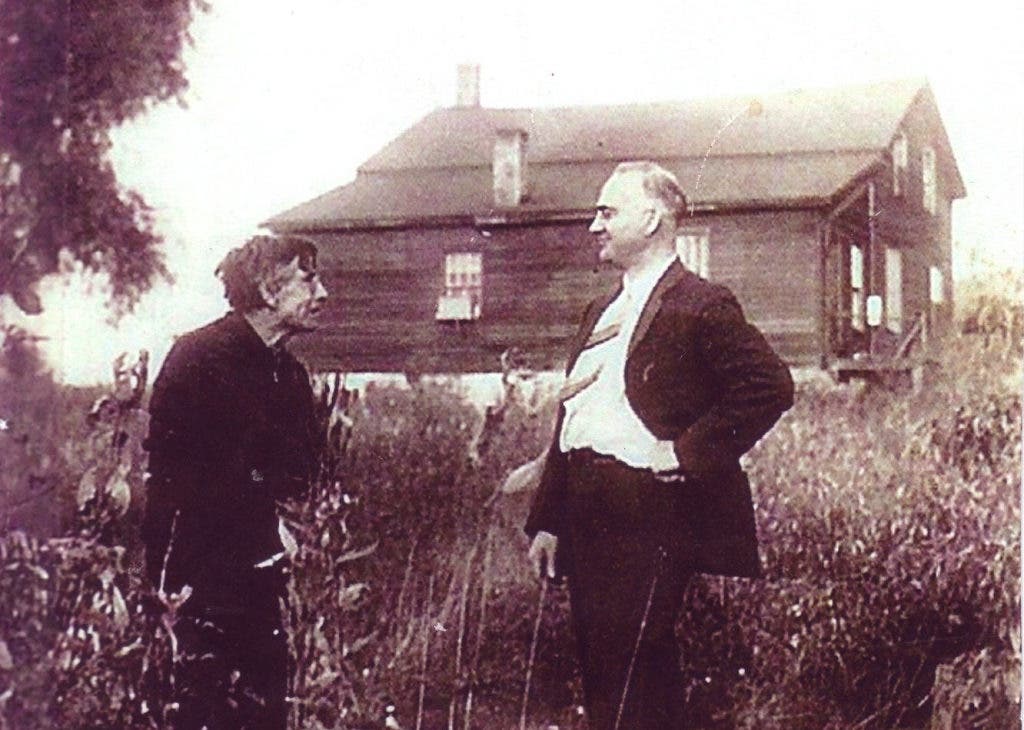


The Lacy-Landon farmhouse in Oakland Township may well be one of the happiest homes in the township.
In researching and reviewing letters and documents about the home, it’s clear that two of the families who lived in the house the longest since it was built in 1852 – the Lacys and the Landons – held fond memories of their time on the farm.
The home is now privately owned by the family of the late Jerry York, who was once the chief financial officer of IBM and Chrysler, a financial aid to billionaire Kirk Kerkorian and a board member at both General Motors and Apple, Inc.. The home underwent an intense historic rehabilitation between 2007 and 2008.
Find out what's happening in Oakland Township-Lake Orionfor free with the latest updates from Patch.
The home was relocated to another area on the property, stripped to its original timber frame and reconstructed over the course of 23 months.
On May 23, the Oakland Township Historical Society and the Oakland Township Historic District Commission jointly sponsored the presentation about the home’s rehabilitation. The program was held, in part, to recognize May as National Preservation Month, an annual event sponsored by the National Trust for Historic Preservation.
Find out what's happening in Oakland Township-Lake Orionfor free with the latest updates from Patch.
This year’s theme, “Celebrating America’s Treasures,” as well as the aim of the National Trust, is to educate the public about how historic preservation not only enriches our cultural and physical landscape, but also our economy, right down to Main Street. It’s also about the history in our own backyard – the local places and people who contributed to the American story.
Eli Lacy buys land of an “inferior quality”
According to Heritage of Oakland Township, written by Delta Kelly and Barbara Kandarian, the Lacy-Landon farmhouse was built in 1852 alongside Lake George Road on a 40-acre parcel purchased from the federal government by Powell Carpenter in 1836.
Eli Lacy, who was born in New York in 1795, bought the property in 1840 after he and his wife, Mary, ventured westward from New York to Oakland Township with eight children in tow.
In a letter from Eli’s grandson, Arthur Lacy, written on June 29, 1960 to Mr. and Mrs. Lyle Spezia, who owned the home from 1950 to 1996, Lacy provided a brief history of his family’s life on the farm in Oakland Township.
The Lacys “bought on land contract from Powell Carpenter for $300, 120 acres of unimproved land in Oakland Township,” Arthur Lacy wrote, “where they first built their log home, and later in 1852, built the home in which you now live.”
In Portrait and Biographical Album of Osceola County written by the Chapman brothers in 1884, the land was said to have been “marsh and lake, about one third of which was upland of inferior quality, and the remainder entirely worthless.”
The Lacys raised ten children – six sons and four daughters – in the home, each of whom attended Eaton school, a one-room schoolhouse on the corner of Predmore and Lake George roads.
In his letter, Arthur Lacy noted that the Lacy family was considered well-read and “studious.”
While none of the children attended college, they each received an education “especially in English,” Arthur Lacy wrote, “and some were brilliant writers of both prose and poetry.”
He went on to state that the Lacy home was “virtually a literary academy” that included the Bible, works by Shakespeare, Michigan statutes and “standard works on logic, philosophy and mathematics.”
Despite the intelligence and focus on education, however, the Lacys were said to be in tremendous debt and nearly impoverished.
The Chapman brothers described Lacy as “a man of respectability and fair intelligence” whose “financial abilities were lacking."
Arthur Lacy wrote that Eli didn’t have money when he married and was “caught up in the money panic of 1837 which paralyzed the country and when even the rich could not pay their debts because of the scarcity of money."
“Thousands have passed through a more degraded poverty,” the Chapman brothers wrote, “but the cases where a family of such a high order of intelligence has been forced to so low a condition of destitution are certainly uncommon.”
The children reportedly wore unlined clothing and attended school in bare feet during the winter.
Francis Lacy, the youngest son and Arthur Lacy’s father, was considered to be “mentally bright and physically active,” noted the Chapman brothers. Francis grew to be “quite the scholar and at age 16 engaged as a teacher.”
Eventually, Francis became a writer and editor, publishing his poetry in a pamphlet titled “Leisure Hours” in 1860 and in another titled “A Ray of Light” in 1863. Later, he owned and operated a shingles mill in Nirvana, MI.
In April 1858, the Lacys, now debt-free, sold the farmhouse and purchased four acres of land in Goodison, an unchartered hamlet in the township. There they built a new house where they lived until their deaths in the mid-1870s. Both Eli and Mary are buried in Paint Creek Cemetery.
In his letter, Arthur Lacy recounted some family anecdotes, including how the children learned to swim in a nearby lake and used a natural spring on the property for drinking water, and how Mary Lacy was a talented weaver whose remaining bedspreads and clothing were considered “precious heirlooms.”
The Landons move in
The Landon family bought the farm house in 1881. So loved was the little house that it remained in the family for nearly 75 years.
The history of the Landon family's time spent living in the house unfolded in a letter written by Eva Mae Landon to Jerry York on Oct. 25, 2007.
Her great aunts Eva and Mae owned the home from 1937 to 1950 (though Eva reportedly first owned the home on her own from 1921 to 1937). Both women were teachers. Eva, however, was the first teacher at Eaton school. Eva Mae Landon’s grandfather, Clarence, worked the farm.
By 1937, the house was in terrible shape.
In Arthur Lacy’s letter to the Spezias, he remarked on how the family had made the property so beautiful with landscaping. He was surprised, he noted, because “when I last saw this home in the fall of 1937, it was in very dilapidated and unkempt condition, weatherbeaten, brown and dingy, and showed every year of its old age.”
The Landons, however, remodeled the farmhouse in the late 1930s. Rooms were changed around, walls were removed and additions were made. They sold the farmhouse to the Spezia family in 1950.
“It was wonderful growing up on the farm in the country,” Eva Mae Landon wrote in her letter to York. “Attending a one-room schoolhouse, fishing in the creek, ice skating and sledding all winter.”
She also noted that it was “a happy house and I am sure it will continue to be.”
New owners help keep happy memories alive
Lyle Spezia and his wife also remodeled the farmhouse and added lush landscaping to the property.
“It was a great happiness to me to see your home which my grandfather, Eli Lacy, built,” wrote Arthur Lacy to the Spezias in another letter dated Nov. 22, 1960, “so completely restored, beautified and modernized, surrounded by your spacious lawns and the lovely artificial lake and bird refuge in the rear.”
The Spezia's sold the property to Jerome Dooling in 1996. The Yorks purchased it from Dooling in 2004.
Not only was York a well-known businessman and financial adviser, but he was also a staunch supporter of local history and preservation. In 2008, he hired a local contractor to help rehabilitate the Lacy-Landon farmhouse and convert it into a guest residence on the property.
Farmhouse in rehab
Since the farmhouse is in a certified historic district, the township’s Historic Districts Commission oversaw the renovations, which had to conform to the Secretary of Interior’s Standards for the Treatment of Historic Properties as determined by the National Park Service.
As noted on the web site for the National Park Service, rehabilitation is defined “as the act or process of making possible a compatible use for a property through repair, alterations, and additions while preserving those portions or features which convey its historical, cultural, or architectural values.”
Through its interpretation of the Secretary of Interior’s Standard, the Historic Districts Commission approved all work including the relocation of the farmhouse to an area approximately 500 feet behind the original site facing Lake George Road.
One reason for the relocation was to protect the house from further damage as water had been running under the house for decades.
The house was to be restored to its 1910 appearance. As a result, additions such as a garage, kitchen, modern chimney and porches were removed.
In the presentation on May 23, Greg Matzelle, the contractor hired to oversee the demanding work, explained the painstaking process of stripping the house of all its exterior siding, removing interior fabrics and placing them into cold storage, finding wood from nearby barns to replace damaged and rotting timber beams and dismantling the home piece-by-piece.
Estimating that nearly 30 percent of the structure's original timbers were damaged beyond repair, Matzelle and his team salvaged as much of the original materials and frame as possible.
Features, finishes and style of construction that made the home distinctive or characteristic of its era were to be retained. This was done by using timbers of the same age from other structures to replace damaged ones and removing wood from one area of the house to use in another. For example, attic planking was removed, refinished and used as the flooring on the first floor.
The original cut stone foundation was reproduced by using stone from the original foundation and surrounding area as a veneer over masonry block.
By March 2008, the house was nearly finished. Dry wall mixed with plaster was used on the interior walls, exposed beams were now a striking architectural detail and authentic appliances were either used or mimicked.
The kitchen contains an original 1930s stove retrofitted to operate with gas, a refrigerator was masked with cabinetry to resemble an old ice box and a wood burning stove was installed.
Next, York asked for a barn to be constructed near the house for use as as a garage.
The Landons had built a barn when they owned the property, but it sat across the street.
A new barn would have to be constructed of similar wood from the same era as the house. Since no local barns were slated for demolition – actually a good thing – the search was on to find a suitable barn elsewhere.
In an interesting example of how the old mixes with the new, Matzelle found an ad on eBay from someone selling a barn of similar size, shape and age in Athens, OH.
The Historic Districts Commission deemed the barn “appropriate.” So, on to Ohio they went to retrieve the barn and relocate it to Oakland Township. Siding from a barn in Lake Orion was used to replace damaged siding on the Ohio barn – it was necessary to obtain wood with an authentic and aged patina.
A local blacksmith shop made all of the farmhouse’s interior door hinges, handles and other metal accessories. The original stairs were removed, refinished and reinstalled. They’re still worn by decades of use and include a comfortable foot pattern leading up and down the stairs.
“There’s a lot of unspoken history in those stairs,” Matzelle told the audience during the presentation on May 23.
In 23 months, a damaged and deteriorating farmhouse was rehabilitated and updated to not only save the historic structure from demolition, but to adapt and reuse it as a guest house.
Then, just two years later in March 2010, York died suddenly.
In November 2010, he was nominated for a Paint Creek Center for the Arts Award for "Recognition of History."
In a letter of support addressed to township trustees, the Oakland Township Historical Society stated that York “helped to create awareness and supported Oakland Township heritage preservation through his personal project to totally restore the Lacy Landon Historic District. ... In the few years Jerry York was a township resident, ... he made a major impact on the preservation of Oakland Township history.”
Today, the Lacy-Landon farmhouse stands as a testament to the hard work and dedication of township residents who have lived in the house or on the property for the past 160 years. It truly is the little house that could; it is happy once again and awaiting another century worth of memories.