Neighbor News
City of Plymouth's Flawed Railroad Quiet Zone Process
City of Plymouth Railroad Quiet Zone Rejection Rebuttal
For the past two years, the City of Plymouth has been studying whether or not railroad quiet zones could be effectively implemented at the City’s seven crossings in a cost effective manner. I do not live near a crossing but do hear the train horns at night when my windows are open...and have had overnight guests who complained about the noise. After attending a packed house information session back in December, 2013 regarding the possibility of quiet zones, I offered my assistance to the citizen’s committee that hoped to help the City with the feasibility study. It was during the course of this committee’s work that I am able to offer the following review of the now rejected quiet zones.
Timeline:
12/2/13: Standing room only information meeting of concerned citizens at City Hall requesting quiet zones.
Find out what's happening in Plymouth-Cantonfor free with the latest updates from Patch.
2/14: Citizen’s committee begins meeting monthly.
3/14: City Goal Champions agree to meet monthly with the citizen’s committee but the City stops these monthly meetings after 5/14.
Find out what's happening in Plymouth-Cantonfor free with the latest updates from Patch.
5/14: Meeting with One City Goal Champion and City contracted engineer.
9/14: One City Goal Champion resigns and is never replaced.
11/14: Remaining City Goal Champion and City engineer meet with citizen’s committee to review suggested crossing safety improvements for submittal (submittal to CSX is never shared with committee).
6/17/15: City presentation by admitted opponent of implementing quiet zones in Plymouth.
Facts about the process:
The citizen’s committee offered extensive assistance to the City in researching quiet zones implemented in over 600 other cities in the U.S.; the majority of this assistance can still be found at:
https://sites.google.com/site/plymouthquietzone/
The City’s Goal Champions would not accept the majority of the input from the citizen’s committee because “[sic]... we do not want the study to be biased by a group that is pro quiet zones.” Yet without input from the citizen’s committee, the City appointed a councelman who publicly was opposed to quiet zones to author the final feasibility study, someone with no experience in quiet zones who never once met with the citizen’s committee.
At a cost of $18k, the City hired the City’s engineering consulting firm, Wade-Trim, to do an initial feasibility study; this firm also did not have any experience with quiet zones. Much of what the feasibility study needed was already in the aforementioned citizen’s committee documents or could have been provided through the citizen’s committee.
The City promised to keep the citizen’s committee informed about all of it’s activities but it repeatedly did not do so. Some examples: The Goal Champions stopped meeting on a regular basis with the committee; the City issued requests for proposals to insurance companies without input from the committee, the City did not provide the document submitted to CSX and the City did not provide CSX’s report for review.
The Biased Final Report and Presentation:
The City presented their findings during a special meeting on June 17th, 2015; their handout link is shown below. There are too many factual errors and misleading representations in this report to detail...if I’d like you to continue reading the rest of this article. So I will focus on the main point of contention of the author: that insurance for quiet zones is not available to cover up to the $200M in liability that the City would become exposed to. Specific facts related to this assertion:
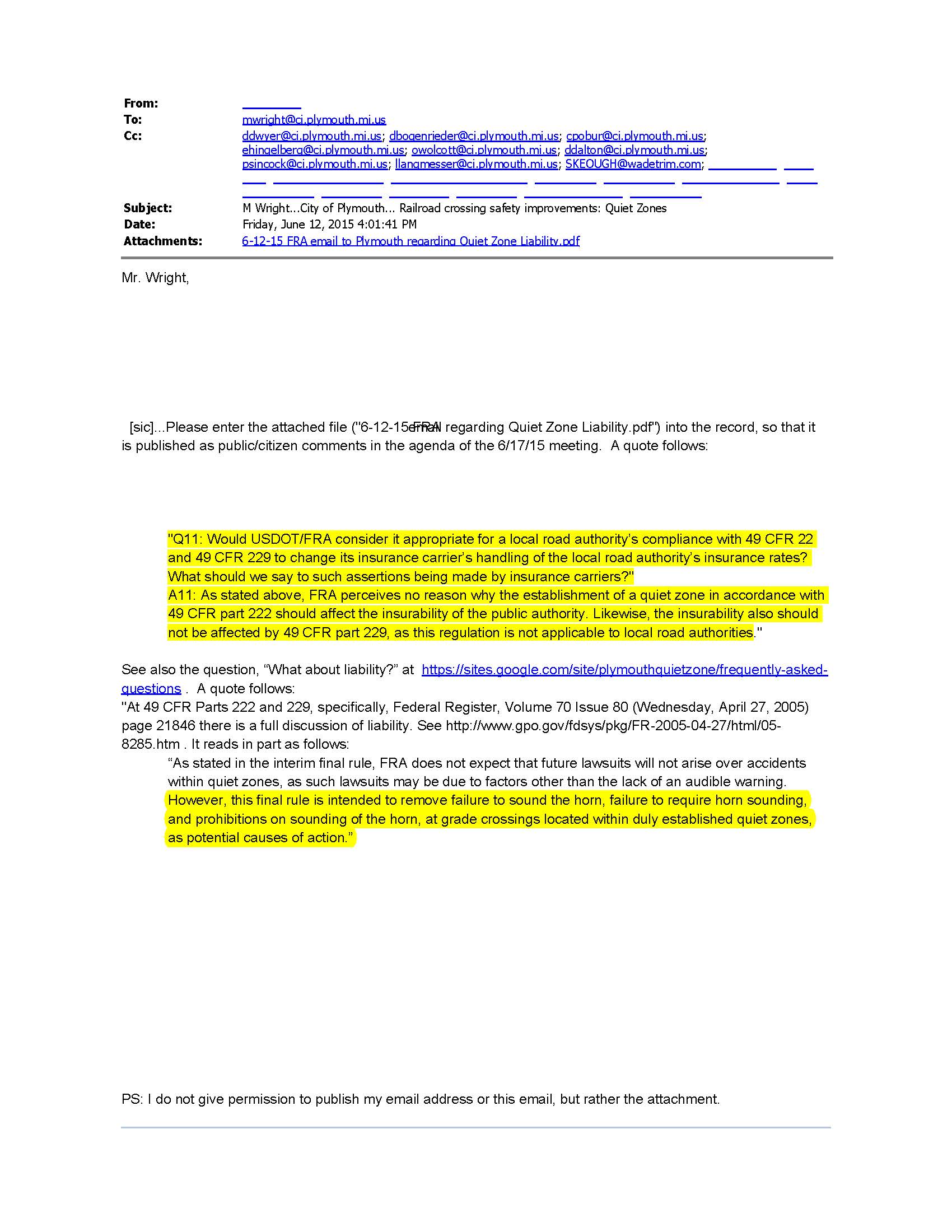
United States Department of Transportation Federal Railroad Administration (FRA) Opinion on Liability: After repeatedly hearing the City’s unfounded concerns regarding liability (remember, over 600 Quiet Zones already exist in the US), the citizen’s committee contacted the FRA for clarification of this issue. After persistent and repeated requests to the FRA by the citizen’s committee, the FRA’s opinion on liability was finally received and forwarded to the entire City Commission on 6/12/15, a summary of which is shown in the attachment. The FRA specifically says that it does not expect insurability to change in a quiet zone and that removal of the requirement to sound a horn at a crossing can not be a legal cause of action (against the City in this case). The City did not include this in it’s record as requested and no reference to the FRA’s opinion was included in the presentation or report.
Executive Summary 2nd Bullet Point Factual Error: “With respect to quiet zones, the federal rules remove liability from the railroad when quiet zones are implemented”. Factually incorrect, see above. Note that we all know that in today’s society, anyone can sue anyone...but the likelihood of a successful lawsuit in a quiet zone, which by definition must be safer than a regular crossing, is extremely remote.
Insurance Not Available: On page 8, the report states “My research has confirmed there is no commercially available liability coverage for municipalities seeking to employ quiet zones”. Yet on page 9, the report states that the Michigan Municipal League does not exclude coverage for quiet zones. The report also states that another carrier, Travelers, would insure quiet zones for an additional $20 to $40k per year (Note that Traveler’s overall insurance policy may be less costly than the City’s current carrier, but this information is not included in the report). Both insurer’s would require the City to use their insurance for all other requirements the City had vs. issuing a rider just for quiet zones. Note that this point was brought up on several occasions to the City Commission; in fact, the citizen’s committee asked that the request for proposal for the coverage be reviewed by the citizen’s committee to make sure the City requested an overall quote that included Quiet Zones, but the City declined.
$200M Liability Reference, CSX Report & $4M Cost Estimate: Related to insurance, the report repeatedly cites a $200M cap on accident liability at a railroad crossing, but no reference is provided. Over 20% of the content of the City’s report deals with accidents at railroad crossings, but does not document any accidents in Quiet Zones. This alone is a testament to the quality of this study and report (such fear mongering caused one resident at the 6/17 meeting to ask the City to close all the roads in the City since there are far more accidents on roads than at railroad crossings). The report and presentation also cite CSX cost estimates of $4M, but the CSX report is not included nor is it on the City’s website. Based on the reported $4M cost to implement quiet zones, it is assumed that the City recommended four quadrant gates at each crossing. This level of implementation is the most costly and is overkill and unnecessary in most cases. Wixom, for example, is planning on implementing a CSX crossing Quiet Zone by adding a “centerline barrier” at a cost of $25k. This is the same type of “channelization” device the Citizen’s committee recommended for several of the crossings in Plymouth. See below link for information on the Wixom crossing.
Summary:
I think it should be clear to the reader that the City has not been transparent with the citizen’s committee or the citizens of Plymouth in regards to this feasibility study. If you aren’t yet convinced this was a biased and inaccurate report, imagine yourself in a court of law:
You are a vocal majority of the citizens asking for a quiet zone. Your opponent has the opposite viewpoint, has no expertise inzquiet zones, is ”employed” by the judge and has publicly stated he is against quiet Zones. The judge then asks your opponent to do a study of quiet zones without your input, review or recourse. Your opponent’s report is presented just as you would expect: it recommends against quiet zones. The jury in this case is the City Commission who ”hired” the opposing counsel in the first place. And the jury never has any dissenting votes.
If you believe the above process and decisions were fairly conducted, I recommend that you vote for all three incumbents in the upcoming election in order to keep the status quo.
If you agree that the above process is severely flawed, I, Jack Wilson, would appreciate your vote in the upcoming elections. Even if not me, I believe the City of Plymouth would be better served with any of the other non-incumbents.
http://mi-plymouth.civicplus.com/AgendaCenter/ViewFile/Agenda/06172015-496 (City 6/17/15 Handout)
http://www.spinalcolumnonline.com/news/2014-09-03/News/Wixom_Soon_to_Bec... (Wixom Quiet Zone )