Community Corner
As Venus and Jupiter Hug in the Sky, Moon Will Join Party for Cosmic Triangle
If you're an early morning riser – and even if you're not – set the alarm to see one of skywatchers' "11 must-see events for 2014."


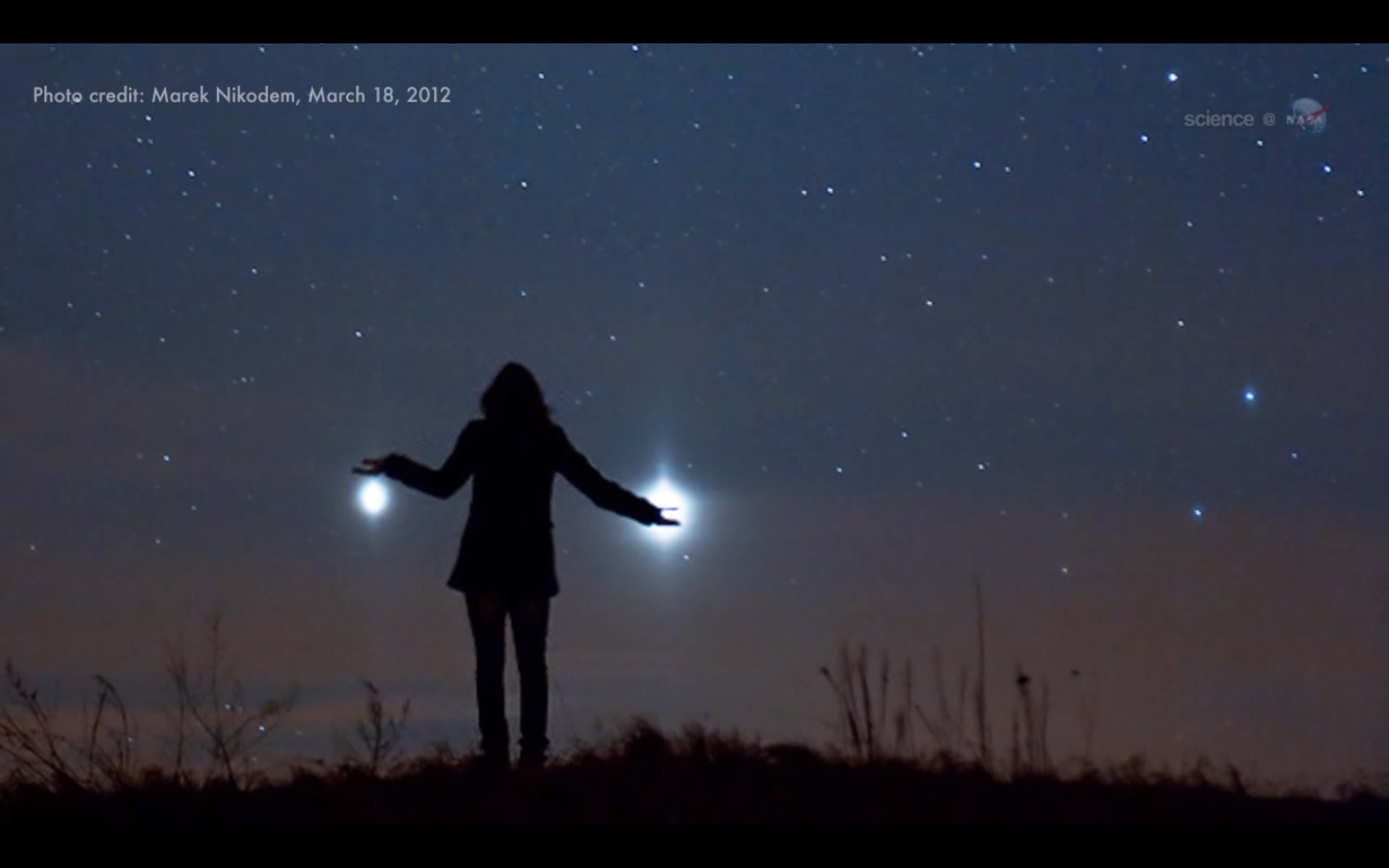
Early morning risers still have a few chances to see an extremely close alignment of Venus and Jupiter. A sliver of a moon joins the party Saturday. (Screenshot: NASA video)
_________________________
A small sliver of a crescent Moon will appear in the early morning sky Saturday, joining Venus and Jupiter to form a cosmic triangle in what is already one of the must-see sky events of 2014.
Find out what's happening in Plymouth-Cantonfor free with the latest updates from Patch.
Since about mid-month, the two largest planets, Venus and Jupiter, appear to have been hugging one another in the low east-northeast pre-dawn sky, space.com reports. At the peak of the event, the two planets were separated by less than two-thirds of the apparent width f the moon.
The specular conjunction has been visible about an hour before sunrise since mid-August and is waning, NASA says. But before early morning risers’ reward completely slips away, the moon will join the party.
Find out what's happening in Plymouth-Cantonfor free with the latest updates from Patch.
The planets and the moon will be exceptionally bright and close to one another. Binoculars aren’t necessary for viewing, NASA says, but they will make the event more spectacular.
The best time to view is about a half hour before sunrise, preferably in an open area without a lot of light pollution or tree or skyline obstacle.
Space.com calls the appearance of a double planet one of 11 must-see skywatching events of 2014. Still ahead on the celestial calendar are:
- Oct. 8, total lunar eclipse: In the United States, the best viewing conditions will be in the western half of North America and the Hawaiian Islands. The eclipse is expected to be relatively bright, possibly featuring coppery red hue across the lower part of the moon, and a brighter upper rim. With the right equipment, a tip of rarely seen Uranus may be visible.
- Oct. 19, near collision of a comet with Mars: Comet C/2013 A1(Siding Spring), discovered by Robert H. McNaught at Australia’s Siding Spring Observatory, will pass extremely close to Mars. The encounter may be close enough to create a “stupendous shower of meteors as seen from the Martian surface,” space.com says.
- Oct. 23, partial eclipse of the sun: Much of North America will experience the partial eclipse, though its intensity will vary by geographic location. In the Pacific Northwest and Northern Plains, more than 60 percent of the sun’s diameter will be eclipse. Closer to the East Coast, the moon will only begin its encroachment as the sun sets.
- Dec. 13, the Geminid meteor shower: Often regarded as the best of the annual meteor showers, the Geminids get cheated by the calendar this year. They’ll peak during the last-quarter moon, which space.com says “will pretty much squelch all but the brightest meteors.”
Get more local news delivered straight to your inbox. Sign up for free Patch newsletters and alerts.