What do Slime Time, Glow Show, Kitchen Chemistry and the Dry Ice Capades have in common?
They’re a few of the learning sessions in the Crazy Chemworks camp for ages 6-12 conducted this week at the Utica Community Schools Velocity Jr. program.
The Chemworks student-scientists experienced how to change liquid to solid and back again, handle laboratory tools, build and break molecules, measure pH levels, experiment with chemical changes and even concocted their own slime for the “slime Olympics.”
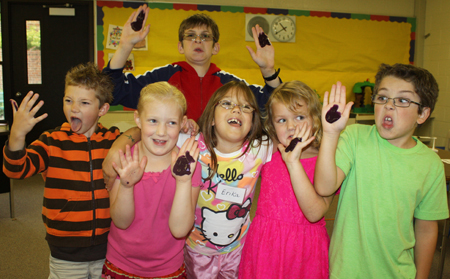
Led by teacher Jessica Fellows of the Mad Science Group, Inc. the children produced the latter by combining a polymer (polyvinyl alcohol), a cross-linker (sodium borate) and a bit of paint to produce a chemical reaction and presto… purple slime!
You might think the gooey substance would lead a dull existence, but no, with the children’s help, it competes in “Olympic” events such as the stretch-a-thon, high jump (bouncing over objects) and a bubble blowing contest.
The overall goal of the camp each day “is to have the children experience basic science and chemistry concepts through fun, hands-on activities,” said Fellows.
Learning results from games and teamwork, problem-solving and observation. Household items are used so students can continue experimenting at home.
By week’s end, they will have used several pieces of real lab equipment including a petri dish, beaker, graduated cylinder, Erlenmeyer flask, pipet and black light.
Fifth grader Ian Payne, who attends Oakbrook Elementary School, especially enjoyed using the black light to check for counterfeit currency and decipher messages written in invisible ink. Ian also observed that, “Black light emits UV rays, just like the sun.”
Another Oakbrook student, second grader Elizabeth Meier, best liked mixing baking soda with vinegar inside a balloon to produce a chemical reaction to inflate it. As Elizabeth described the experiment, her eyes grew nearly as big as the balloon.
Each day includes time for lab work, discussion, reflection and journaling. Students make predictions, test and record their results and come to sometimes surprising conclusions.
For example, in the Super Sticky Stuff session, students were asked to predict which is the stickiest from among molasses, corn syrup or lemon water, after moisture has evaporated from each. (Hint: it’s neither molasses nor corn syrup).
In Kitchen Chemistry, the students tested sugar cubes, croutons, canned beans and applesauce to determine whether they contain starch (carbohydrate) or protein. This led to a discussion about our bodies’ need for both nutrients. Upon observing the applesauce react negatively to a few drops of the chemical Biuret reagent, Flickinger Elementary School third grader Erika Holmberg declared, “There’s no protein in applesauce!”
The chemistry camp is offered at the district’s Velocity Jr. center at the former Rose Kidd Elementary School. Velocity Jr. is a science, technology, engineering and mathematics (STEM) education partnership between Utica Community Schools, the City of Sterling Heights and Macomb Community College.