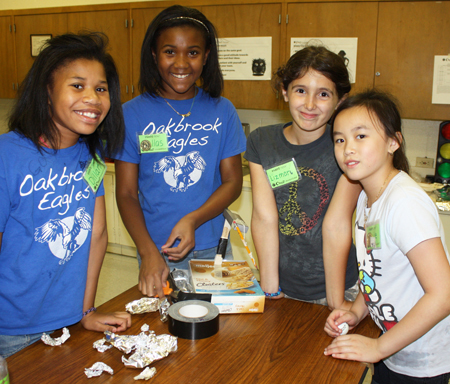
Dozens of young scientists undertook a weeklong ‘expedition’ to explore the Earth from all angles – high in the sky, beneath the oceans, over land and deep underground during the Geo-Quest camp at Utica Community Schools’ Velocity Jr. Center.
Activities each day of Geo-Quest centered on four STEM-based (science, technology, engineering, mathematics) learning modules: Ecoverse, Cache Dash, Launchitude and Amazing Atlas Games.
Geo-Quest is part of Camp Invention, a nationally acclaimed STEM program that immerses children in imaginative, hands-on activities to supplement and reinforce school-year learning.
The intrepid first through sixth graders stretched their curiosity and creativity as to why and how things work the way they do (or don’t) while discovering a deeper understanding of the natural world. They were presented with thought-provoking problems to solve and tasks to complete on their own or working in teams.
Here’s a snapshot of day four on their journey:
In Ecoverse, the students delved into the underground realm of molten rock. After learning a bit about what volcanologists do and the instruments they use, the students built their own seismometers to simulate measuring the ground motion of seismic waves generated by earthquakes or volcanic eruptions.
They also constructed popsicle-stick rafts equipped with bits of pumice (rock that floats!). The rafts, along with a wading pool, plastic cones filled with a vinegar and baking soda mixture were used to simulate volcanic eruptions and the impact of swift-moving lava in displacing large volumes of water and whatever else in its path.
In related activities, the Cache Dash module had the students explore sandstorms, hurricanes and tsunamis and then design solutions for how children around the world could stay safe in the midst of natural disasters.
During the Launchitude module that same day, the students filed mock patents and marketed ‘Duck Chucking’ devices they built earlier in the week. (Readers of UCS Web posts may recall an earlier feature describing the Great Duck Chuck Challenge, when the Geo-Quest campers used recycled materials and “lots and lots” of duct tape to send toy ducks flying the farthest).
In day four of the Amazing Atlas Games, the students learned that everything floats more easily in very salty water. Inspired by examples of how ocean animals and plants remove salt from their bodies, the children designed fantasy animals to bring life to the Dead Sea.
Geo-Quest's enthusiastic ‘head counselor’ Marjorie Stevens (UCS math consultant) said, “As an elementary teacher, I’m proud to be involved with Camp Invention. It gets children excited about science and learning. The more positive experiences our students have while learning increases their desire to continue learning during the school year.”
Several engineers and other professionals from the Ford Motor Company volunteered to mentor students at the camp. Ford Motor Company also provided camp scholarships for several of the children. The UCS teachers participating were Allison Bigelow and Dawn Breininger.
Friday, the last day of camp, proved to be the ultimate summer science fair with the Inventors’ Showcase – a chance for the young explorers to demonstrate their creations and all they learned for their parents and other family members.
By the way, did you know that ash from erupting volcanoes can travel around the world? In fact, the 1991 eruption of Mount Pinatubo in the Philippines sent ash so high into the atmosphere that it traveled around the globe in less than two weeks. Of course, our Geo-Quest campers could have told you that!