Neighbor News
Aisling Gheal: A Visionary Collaborative - Part 3
EMSO and the Center for Irish Music present Aisling Gheal - a concert celebrating the traditional and classic music of Ireland

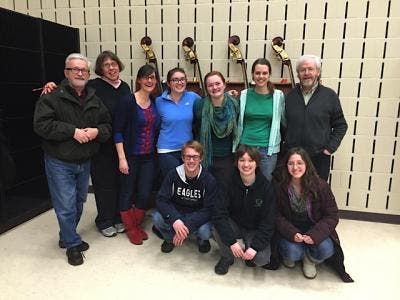
by Siobhán Dugan
Word from the Benches
So how has it been going as these performers have been getting together to play and learn? Some EMSO musicians, Elizabeth notes, will get more or less out of the ‘Origins’ series depending on the curiosity and engagement they bring to it.
Find out what's happening in Woodburyfor free with the latest updates from Patch.
Delightful flute player Megan Gangl has that spirit of adventure that thrives on stretching her musical horizons. Like many EMSO members, she has a lifelong commitment to music even though her career is in another field. She has been playing since her school days; in a band, then in a quintet for a couple decades and then in EMSO as a way of pursuing a new musical adventure. That spirit leads her to particularly enjoy the ‘Origins’ series, including the Aisling Gheal concert.
“This is my favorite concert of the whole season, every time,” Megan shared, “because I feel I learn a lot about another culture and their music and the complexity of that music. Seeing the blending of folk music traditions and classical music tradition, seeing how composers pull from both traditions, I feel invigorated because we’re learning from each other.” While the musical reach when working with, say, Bulgarian musicians (with 5/8, 8/8, 9/8, 11/8 metrical patterns changing from measure to measure) is wider than with Irish music, there are still significant differences in approach for the classically trained.
Find out what's happening in Woodburyfor free with the latest updates from Patch.
“Even in articulation,” Megan recalled laughingly, “Norah would say ‘Well, you can slur there. Or not.’ And we were taken aback by it! Of course, amongst the flutists we started conferring: Are you going to slur? Am I going to slur? Cause here we were trying to do it the same way again.” It certainly created a little comic angst among the classically trained players as they are trained to follow the rules and play what is written. “Sometimes we get so stuck on what is on the page, it’s hard to think about the overall sound,” Megan reflected, “I think folk traditions are focused on the other end of it, how does it sound as a whole, what feeling are they creating.”
For EMSO French horn player John Sassaman, the difference in musical hardware caught his interest. Before the advent of modern silver concert, the tapered wooden flute with its distinct warm tone and voice that varies in timbre over its range would have been found in orchestras anywhere, but while common in Irish tradition still today, they are a bit of a curiosity for classical musicians.
From the Irish traditional side, Norah likes what she’s hearing in rehearsals: “EMSO is an excellent orchestra and they are doing a great job of keeping the accompaniment light, and the rhythm driving.” From an educator’s perspective, she is thrilled with this experience for the Young Adult Ensemble members. “CIM students in this ensemble are learning so much about themselves as musicians - how to play their instruments better, how to bring the music out of a tune, and how to practice efficiently. They are going through a very rigorous process of learning a high volume of music for one single performance. They are learning how to work hard, how to focus, how to play together, to arrange and work in a collaborative context, how to write bio’s and show up at rehearsals (in strange places) on time!”
As well, Norah notices how an event can bring focus to a young player’s practicing. “The fact that it is a performance seems to work well for American students” in that regard, she notes, “I prefer that pressure for them to the pressure of a competition, particularly for young adults. A performance is something that can be shared, and maybe even repeated!” And of course, broadening audiences by sharing them is a natural move for two such community based groups as EMSO and CIM.
CIM student, mandolin and fiddle player Connor Padden, strongly echoed this view. After some time in Suzuki and Old-Time style fiddle, Connor felt himself gravitating to the music he heard his paternal relatives playing at home, and sought out CIM for lessons. An avocational musician, Connor plans to keep playing Irish music into his adult life; he is headed to Montana next fall to pursue a degree in Engineering and has already begun organizing an Irish seisiún there. At CIM, Connor had joined the Advanced Youth Ensemble, but did not see himself competing in a Fleadh (Irish traditional musical competition), which had become a focus of that group; it just not his thing. “I get the point of it. But I just like playing. Playing and performing for the fun of it, and having people enjoy it.” So getting together with the newly formed Young Adult Ensemble to practice for the Aisling Gheal performance suited him down to the ground, and he found a kind of fellow-feeling in the obvious joy the classical musicians have for their music.
For harper and singer Hannah Flowers, the collaboration has been really exciting. Hannah, who plans a career in music, began her musical education in classical music at very young age. Traditional music came along a decade or so later in high school, and she currently plays both classical and traditional in different settings. “It has been really interesting to see these two radically different traditions collide,” she says, “My classical musician friends really don’t understand traditional and I think this is a really good opening to show them what this whole Irish music thing is all about!” To Hannah, playing traditional music with a full orchestra both enhances and detracts from the music in different ways. For example, the musicians will be performing the beautiful lullaby “Dún do shúil” (Close Your Eyes). In its original form, it is a tender song with sparse guitar accompaniment. In the current arrangement a sweeping orchestra backing has been added, which adds beautiful layers of harmony and depth. At the same time, this locks the melody into a fixed rhythm instead of an open and free flowing phrasing and might also diminish the sense of intimacy of the original.
From her classical background, Hannah can understand what a stretch traditional music might be for the EMSO musicians: “Classical musicians have a difficult time playing fast and they don’t quite understand the whole learning-by-ear thing,” she says, “But it’s been great to see the orchestra willing and eager to learn in new and different ways. The orchestra members are stepping out of their comfort zone, and so are we traditional musicians. I don’t know if any of us will ever have this kind of opportunity again. This is really going to be a fantastic concert that shouldn’t be missed!”
Irish musician and composer Dáithí Sproule, a 2009 Bush Artist Fellow, has lived in Minnesota for over 30 years. He appreciates the intersections that made the concert possible, enjoying the developments that pull together threads of his career from far disparate times and places. The journey of the tune ‘The Roseville’ embodies this. Dáithí wrote it many years ago in the home of dear friends David Aronow and Laurie Pouchak in Roseville, Minnesota, during a difficult period of his life. “I made the tune up on the guitar, mostly flat-picking single notes. I got a kick out of it because it is in a peculiar time, with six beats, and wherever it came from in my head, it was kind of jolly, whereas most of the things I compose are on the sad side (Irish blues!).”
Altan liked the tune, so it became part of their repertory and was recorded on the CD ‘Local Ground’. “Then it made another jump in status when it was picked to be one of the tunes to be arranged for orchestra by Fiachra Trench. The first time I heard it, it had become so big it reminded me of the 1812 overture or something …and I was really glad that this little tune which was in honour of these very special friends was out in the world in this way. For it now to be part of a Center for Irish Music project — and of course I am devoted to the Center and its people —and for our students to be playing in it is a wonderful thing for me.
Dáithí continued, “We have vibrant musical communities in Minnesota, with active and committed learners, great audiences, and a cadre of hardworking volunteers. It’s wonderful to see all these elements coming together to share music across boundaries. I was at one of the rehearsals recently and the students are doing a great job. I am looking forward to taking some pride and credit in their performance with the orchestra, even though I deserve none, since it is all their own great talent and hard work, and Norah Rendell’s coaching of the group! But then that’s the beauty of being a teacher!”
Vision for the Future
EMSO will most certainly go on to collaborate with others on more genre-bending musical journeys. What about CIM? “The students in the ensemble have been working for years to develop the technical skill and aesthetic understanding of traditional Irish music. They represent the success of our mission – passing the music down to the next generation,” says Norah. So does the future hold more such collaborations? It might. In spite of the level of work involved in creating them, Norah finds great value in them for some of the most advanced students: “I would love to find more opportunities like this for young adult musicians at the CIM who are growing wings and taking off as musicians in their own right.”
____________________________________________________________________________________________________
Please join East Metro Symphony Orchestra and the Center for Irish Music for
Aisling Gheal (Bright Vision)
Sunday, March 8, 2015 at 3pm
East Ridge High School, 4200 Pioneer Drive, Woodbury, MN 55129
$10 adults - $6 seniors – 18 and under free
Visit www.emsorch.org or www.centerforirishmusic.org for more information