Neighbor News
Siblings Enrolled at Connections Academy Will Demo State Fair's Winning Rube Goldberg Machine at School's STEM Day
Math and science teachers bring school's K-12 online students together for fun day of interactive STEM activities and special demo.
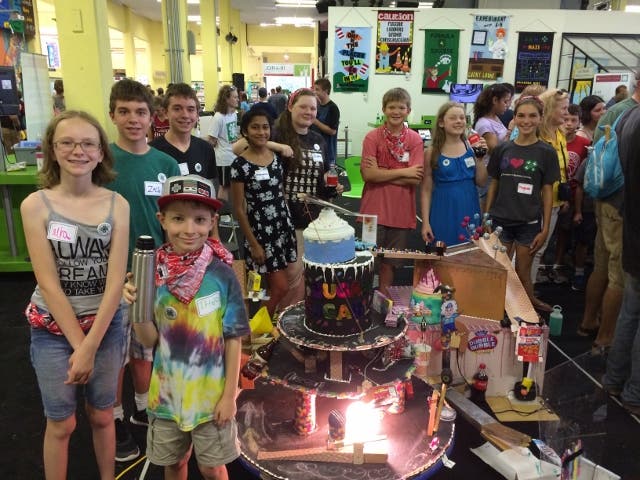
Summer is over, school is back in session, and the 2015 Minnesota State Fair is a distant memory. But for the youth who make up the Washington County 4-H Rube Goldberg Machine team, these events will not soon be forgotten.
While memories of summer typically evoke images of sleeping-in and lazy days for students, for this team of nine students, ranging in age from 4th grade to 11th grade, summer vacation was all about power tools, gears, levers, physics—and toothpaste.
The team put in approximately 630 man-hours to build, from scratch, a 50-cubic-foot machine that used solar energy, electrical energy, kinetic energy, and potential energy to run its many built-in simple machines. Not only did the Washington County 4-H team participate in the 2015 State Fair Rube Goldberg Machine Competition, they took first place. The machine begins with one step, which triggers another, which triggers another, and so-on, until, after 20 complex steps, the machine does what it was ultimately designed to do—squeeze toothpaste onto a toothbrush.
Find out what's happening in Woodburyfor free with the latest updates from Patch.
Seem pointless? Welcome to the strange and wonderful world of Rube Goldberg Machines. A Rube Goldberg Machine (RGM) is defined as, “a contraption, invention, device or apparatus that is deliberately over-engineered to perform a simple task in a complicated fashion, usually including a chain reaction”. The expression is named after American cartoonist and inventor Rube Goldberg (1883–1970).
The team chose to build their machine with a “Sugar, Candy, Cake” theme, which included large candy boxes, Life Savers, gum drops, pixie sticks, a “cake”, and a ramp. The group liked the theme’s irony since they ultimately were creating a machine promoting dental hygiene. The team even chose to challenge themselves further by including extra steps that worked against gravity.
Find out what's happening in Woodburyfor free with the latest updates from Patch.
“I was amazed by the quality of engineering that this team applied to their machine,” said coach Kristin Weeldreyer of Woodbury. “The Rube Goldberg Challenge is not only a fun and exiting STEM activity, but also an excellent opportunity for students to tangibly-visualize the importance of knowing how to use and integrate skills such as creative problem solving, advanced structural and tactical planning, time management, physics, visual design, and teamwork.” Weeldreyer’s children are on the team and attend MTS Minnesota Connections Academy, a K-12 online public school that students across the state attend from home. They will demo the machine at their school in November.
As Weeldryer notes, the process of building such a machine yields many lessons for those involved. From teamwork to physics, building an RGM is a great way for kids to integrate their science, technology, engineering, and math skills—all while having lots of fun. That is why, for the second year, the University of Minnesota has offered this opportunity to youth in 4-H to build an RGM and bring it to the Fair to compete with other RGM’s from around the state. All teams’ machines are built to accomplish the same simple task which changes every year. This year the task was to place, “any amount of toothpaste onto the bristles of a toothbrush”. Other tasks for RGM competitions at the collegiate-level have included zipping a zipper, pouring a glass of water, and starting a coffee pot, to name a few.
For the Washington County 4-H team, those man-hours paid-off. The judges, each of whom had an engineering background, had many encouraging comments for the team such as:
“This was an excellent machine! I was impressed with how the team was able to demonstrate how they applied math skills to increase the precision of their structural engineering. There was shared involvement by all team members.”
“The team demonstrated great working knowledge of energy and simple machines. They obviously learned lots of STEM skills and applied them to the building of their machine. Genius!”
“The team members are all very smart! They had great knowledge of kinetic and potential energy—and other physics terms. Every one of these kids could be a physics major!”
After so many summer hours of working on their machine, one would expect the group to breathe a sigh of relief that it is done. Not these kids. They are already discussing ideas for the machine they will build next year!